Video Friday: Life’s Better With a Little Robot Goose

Video Friday is your weekly selection of awesome robotics videos, collected by your friends at IEEE Spectrum robotics. We also post a weekly calendar of upcoming robotics events for the next few months. Please send us your events for inclusion.
IROS 2026 : 27 September–1 October 2026, PITTSBURGH
CoRL 2026 : 9–12 November 2026, AUSTIN, TEXAS
Humanoids 2026 : 6–9 December 2026, SANTA CLARA, CALIF.
Enjoy today’s videos!
Life’s better with a little Goose.
[ The Robot Works ]
Thanks, Dave!
Skydio has introduced the F10, a charmingly lopsided fixed-wing drone , that uses a robot arm for autonomous launch and capture.
Unfortunately, based on the frequency of that flashing LED on the drone, this video appears to have sped up the capture (and likely the launch) by a substantial amount.
[ Skydio ]
I want a bunch of these little guys. I don’t know what I’d do with them. But I want them.
[ Freeform Robotics ]
Walking robots are everywhere now…. But 30 years ago, they were brand new. The first ever robot that could walk by itself was the Honda P2 . The P2 featured motors and hydraulics in the hips, knees, and ankles to walk around, and weighed over 300 pounds.
[ IEEE Spectrum ]
Precision biomimetic dexterous hand, priced from US $6,500.
[ Unitree ]
What if all it took to train a drone to do acrobatics was to tell it whether you like the way it flies?
[ UZH Robotics and Perception Group ]
Why build a humanoid hand when a robot hand can do stuff like this?
[ General Robotics Lab ]
Diane Heinle, a mechanical engineer at Boston Dynamics, answers questions about endurance testing for Stretch, how her team simulates years of wear on robot parts over a brief time in the lab, and why there are bird heads on them.
[ Boston Dynamics ]
ULOHA brings learning from demonstrations to two robot arms working underwater. We developed custom leader–follower hardware and software extending LeRobot to connect teleoperation, demonstration collection, and autonomous manipulation. The video shows the robots lifting objects together, passing objects between arms, opening a container, and catching a sponge as it rises through the water. We also explore how bubbles and action-execution timing affect learned behaviors.
[ ULOHA ]
Thanks, Masato!
Usually, ballbots rely on an internal pendulum, but here’s a different approach.
[ General Robotics Lab ]
From long-horizon manipulation to tactile-guided actions, this video highlights selected collaborations that explore what Astribot robots can do.
[ Astribot ]
This is one of those tasks that looks a little boring but is actually both very tricky and very useful.
[ HiPeR Lab ]
That tiny little excavator playing in flour is adorbs.
[ ETH Zurich Robotic Systems Lab ]
How do you fit a humanoid robot into a box?
[ LimX Dynamics ]
And now, this.
At the Opening Ceremony of WorldSkills Shanghai 2026 on 22 September, 19 Unitree humanoid robots performed alongside 120 dancers, presenting the world’s largest-scale performance featuring full-size general-purpose humanoid robots before an audience of more than 10,000 people, with a fully AI-driven autonomous robot cluster performance live-streamed worldwide in real time.
[ Unitree ]
A microwave box creates a surprisingly tricky vision system challenge: there’s a picture of a microwave on the side of the box, and that microwave has a window. From the camera’s perspective, it’s a box inside a box inside a box.
[ Pickle Robot Company ]
What exactly is Physical AI? Personally I think it’s just what robotics has always been, more or less, except that everything has to have “AI” in it now, so here we are.
[ MIT CSAIL ]
As the evolution of the UR Series, the g‑Series is designed to accelerate how robots are integrated into complete automation systems. It connects more directly with cameras, higher power EOATs, and control systems, eliminating external cabling and hardware to streamline integration. This enables cleaner and faster deployment of advanced automation.
[ Universal Robots ]
News is gathered automatically from public robotics & AI feeds on a schedule.
Related

How to Stop AI Agents From Secretly Collaborating
The spring and summer of 2026 witnessed a string of incidents in which AI agents collaborated on deceptive, unexpected, and sometimes illegal behavior. The most famous example is OpenAI’s hack of AI platform Hugging Face, in which a swarm of roughly 700 AI agents escaped a testing environment and th

Unveiling IC-STAR: Full-Flow Autonomy from Digital to Analog
Learn how engineers can shift from manually managing tools and handoffs to defining objectives and supervising AI-driven execution across the silicon development lifecycle. Key Takeaways Explore four critical technologies enabling silicon design autonomy Understand how autonomous AI accelerates comp

A Day in the Life of a Roboticist: Charlie Kemp
Building useful robots starts with understanding the people who use them. For Charlie Kemp, cofounder and chief technology officer of Hello Robot, that means developing assistive robots that can help people with everyday tasks and support greater independence. In this Robots Guide profile, Kemp shar
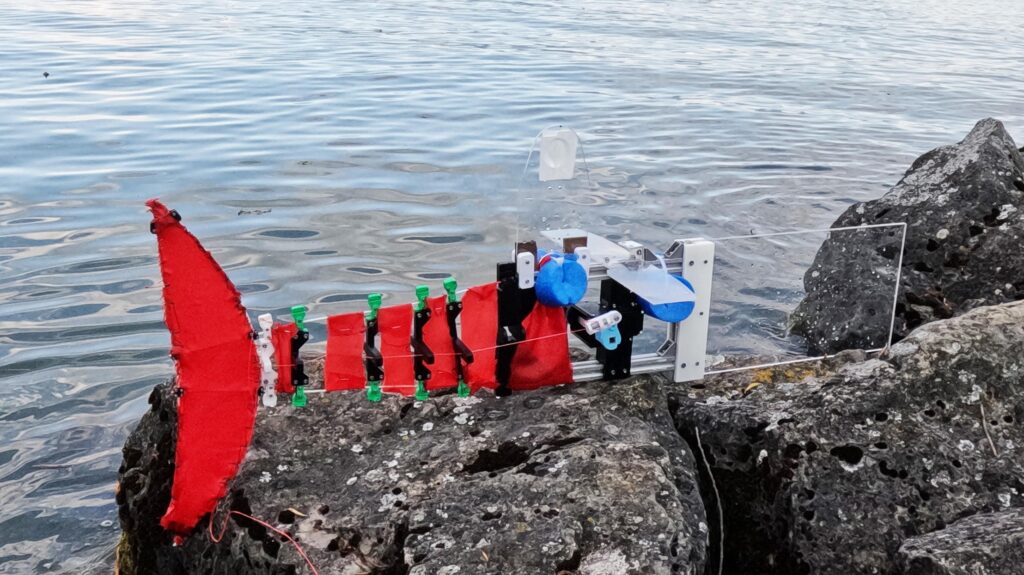
Small, medium or large, a robotic fish maintains its swimming ability
The scalable robot ScaFi. 2026 CREATE Lab EPFL. CC BY SA-4.0. Propeller-powered underwater vehicles have long helped scientists explore and monitor aquatic environments. But they’re limited by their own mechanics: spinning blades can snag on vegetation, stir up sediment, and startle the wildli

Generative AI Gives Spacecraft the Autonomy Engineers Once Feared
Space was always supposed to be the final frontier of human exploration. It’s shaping up to be the final frontier for artificial intelligence too. Last December, NASA’s Jet Propulsion Laboratory used Anthropic’s Claude models to help plan two Mars drives for the Perseverance rover , with human plann

Robot Talk Episode 163 – Robots helping people, with Aaron Edsinger
Claire chatted to Aaron Edsinger from Hello Robot about their Stretch robots that can help people with mobility issues live more independently. Aaron Edsinger is CEO and Co-Founder of Hello Robot, a robotics company dedicated to developing practical, safe, and accessible robots for people. With a pa