AGIBOT introduces Worken to measure robot productivity at AGIBOT Innovation Day 2026
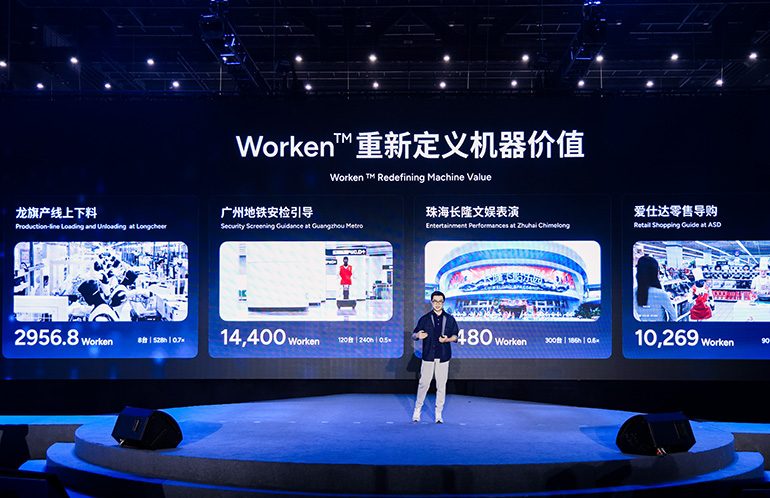
Peng Zhihui, president, CTO, and director of AGIBOT, introduces Worken at AGIBOT Innovation Day 2026. Source: AGIBOT
AGIBOT today introduced Worken, a proposed framework for measuring the productivity of robots in real-world environments, at AGIBOT Innovation Day 2026 in Shanghai. Combining the words “Work” and “Token,” the concept seeks to shift attention beyond the number of robots manufactured or deployed toward how much useful work they can perform autonomously and consistently.
The company also unveiled AHA3, its integrated “three intelligences in one” hardware platform, and highlighted advances in its AGILE motion intelligence framework, including a new self-evolving agent capability. AGIBOT debuted GO-3 Preview, its next-generation embodied AI foundation model, showcased its WITA-Omni 1.0 omni-modal interaction model, and launched the G2 Max industrial robot and Link-U OS 1.0.
The event also featured actual applications across manufacturing and commercial services, demonstrating AGIBOT’s focus on translating robotics innovation into productive work. The company said they reflect its deployment-first focus, with practical innovation spanning robot hardware, locomotion, task and interaction intelligence, operations, and an ecosystem intended to support real-world deployment at scale.
Founded in 2023 as Zhiyuan Xinchuang Technology Co., AGIBOT is focused on embodied AI. The Shanghai-based company ‘s portfolio spans humanoid robots, quadrupeds , dexterous systems, and commercial cleaning systems. Last month, AGIBOT said its 20,000th robot had rolled off the production line, and IDC reported that the company led global humanoid robot shipments in the first half of 2026.
Submit your innovation now!
Worken is a proposed measure of robot productivity
As robots move from large-scale production into increasingly diverse applications, AGIBOT said there is another dimension of progress: the productive work robots can deliver once deployed. In addition to manufacturing scale, technological capabilities, and deployment milestones, the company said sustained autonomous operation and measurable task output are increasingly important indicators of robotic value.
“Over the past few years, the robotics industry has made remarkable progress in hardware, AI models, and large-scale manufacturing,” stated Peng Zhihui, co-founder, president, and chief technology officer of AGIBOT. “But as robots begin working in factories, warehouses, and service environments, we need to answer a more practical question: How much productive work are they actually delivering?”
“Worken is our attempt to develop a new way of answering that question,” he added. “We want to move beyond measuring how many robots are built or delivered and begin measuring how effectively they can perform useful work, autonomously and consistently, in the real world.”
Even deployments involving similar numbers of robots can deliver different levels of productivity, depending on how independently the machines operate, how frequently human intervention is required and how much acceptable work they complete.
AGIBOT described Worken as “effective intelligent work hours,” bringing three factors into a proposed measurement framework:
Worken = Number of Active Robots × Autonomous Working Hours × Output Efficiency Ratio
The first factor counts robots actively performing tasks in real-world environments, rather than units simply manufactured or held in inventory. The second measures time spent working autonomously, rather than total powered-on time.
The third factor assesses productive output against a reference benchmark for a defined task, such as the amount of acceptable work completed by a human worker under established operating standards.
The Worken framework combines the number of active robots, autonomous working hours, and an output efficiency ratio to measure robot productivity in real-world deployments. Source: AGIBOT
By connecting deployment scale, autonomy, and task output in Worken, AGIBOT said it wants to provide a more comprehensive way to describe robotic productivity across applications such as industrial handling, logistics, inspection, and commercial services.
“The concept also opens up a broader discussion about the economics of robotics,” said the company. “While hardware depreciates over time, improvements in software and AI models may enable the same machine to perform more useful work during its operating life. Measuring that output alongside total lifecycle costs could help businesses evaluate the longer-term value of robotic deployments.”
AGIBOT said Worken is an evolving framework that will be further refined through deployments and operational data. By developing task-specific benchmarks and accumulating practical experience across different applications, the company said it hopes that Worken can serve as a widely applicable reference for measuring the productive value of physical AI.
The event also featured the release of the “2026 Embodied Intelligence Industry Innovation Report,” which discussed the industry’s progress toward real-world deployment. Jointly compiled by China Economic Information Service and the Shanghai Industrial Innovation Center of the China Academy of Information and Communications Technology ( CAICT ), the report included Worken and AGIBOT’s deployment examples as part of its industry analysis.
AGIBOT unveils AHA3 platform and new physical AI models
The AGIBOT Humanoid Architecture, or AHA3, which unifies “three intelligences in one” — locomotion, interaction, and manipulation Intelligence — in an embodied AI system. The company said it designed the third-generation hardware architecture to improve efficiency.
Built on advances in motor- drive technology, integrated computing , and high-speed connectivity including Wi-Fi 6 and 5G, the AHA3 is designed to reduce integration complexity, improve system responsiveness, and support more capable robots in industrial applications.
To…
Les actualités sont collectées automatiquement depuis des flux publics robotique & IA.
Articles liés

汤道生预告混元Hy4,首次加入视觉理解,Flash版本也将推出
智东西 作者 | 江宇 编辑 | 李水青 智东西10月29日报道,今日,在2026腾讯全球数字生态大会上, 腾讯集团高级执行副总裁、云与智慧产业事业群CEO汤道生发表主旨演讲 ,围绕AI Agent在企业的规模化落地、腾讯云AI产品与基础设施升级,以及全球化战略等话题,分享了腾讯AI Agent及基础设施建设的最新进展。 汤道生宣布,腾讯混元大模型Hy4正式版即将发布。 相比今年8月28日发布并开源的Hy4 Preview,新版本实现全面提升,尤其强化了长程任务和真实生产力任务的处理能力,显著提升思维链效率,并 首次加入视觉理解能力 。腾讯还将于近期推出 Hy4 Flash ,在继承Hy4视觉

1799元,小米前高管王腾创业做AI戒指,现场感谢雷军栽培
智东西 作者 | 云鹏 编辑 | 李水青 智东西10月29日北京现场报道,刚刚,由 前小米中国区市场部总经理王腾 带队创立的科技品牌ISHO今日宜休举办了首场发布会,作为公司创始人兼CEO的王腾登台发布了 ISHO Ring智能戒指、ISHO iFlow智能温控系统 两款AI睡眠科技生态产品。 ISHO Ring做工比较精致,戒指小巧,主要负责 睡眠健康监测, 芯片和传感器配置都较为“豪华”,设计据称是“珠宝级”。 ISHO iFlow包括 主机和床 两部分,负责进行睡眠干预, 调节睡眠时用户的体温, 床内部有水循环系统。 值得一提的是,在介绍床的部分,王腾直接躺了上去分享其使用体验。 硬件是
27岁清华教授创业押注RSI,首款模型开源!3个月融了近4亿
智东西 作者 | 孙小雯 编辑 | 程茜 智东西10月29日消息,昨晚,北京大模型创企超衍智能 发布并开源首款大模型Apex-35B-V1.0 。该模型构建过程中,AI自主参与了数据构造、实验设计、代码执行、训练结果分析和训练优化等环节。 Apex-35B-V1.0总参数量 为350亿 ,每个Token激活约 30亿参数 ,支持 26.2万Token上下文 窗口。其以 Qwen3.6-35B-A3B 为基础,经中训练和后训练进一步优化,支持编程、Agent、问答和深度搜索等常规任务,以及AI研究、计算科学、机器人仿真等任务。 ▲Apex-35B-V1.0官方技术介绍(图源:超衍智能) 根据超衍
卖8500元一副的XR眼镜,凭什么?
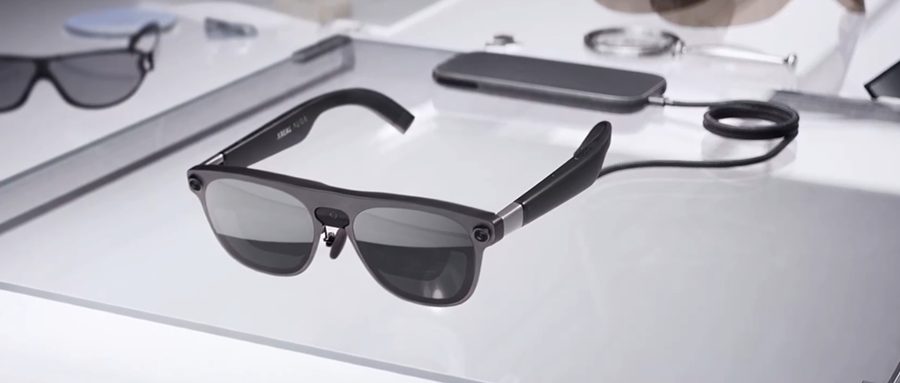
智东西 作者 | 云鹏 编辑|李水青 智东西10月29日消息,今天凌晨1点,专注消费级AR眼镜与空间计算领域的XREAL,在谷歌Android开发者峰会上,正式发布了全球首款搭载Android XR的分体式空间计算XR眼镜——XREAL AURA。 智东西在2025年XREAL总部的一次沟通会上就已得知这款产品正在研发中,如今其终于正式开售,XREAL也第一次完整展示了其在空间计算系统上的产品设计、配件和基于Android XR的应用生态。 大家比较关心的价格方面,XREAL AURA起售价为1279美元(约合人民币8520元),发售期限时优惠价为1099美元(约合人民币7320元),目前首批

大众把三年在中国攒的家底,打包成了一颗「星」
头图来源:极客公园 10 月 28 日,合肥,大众汽车集团(中国)办了自己的第一次技术日。 这场发布会的主角叫「VEGA」,名字取自织女星,是大众在中国本土自研的一体化技术矩阵。它把整车平台、电子电气架构和高级驾驶辅助系统三大核心技术打包成了一套体系。 按大众的说法,它由此成为中国市场唯一一家拥有本土开发自研技术矩阵的外资车企。 大众汽车集团(中国)董事长兼 CEO 贝瑞德在台上说,短短三年,大众在中国打造出了一套一体化的技术矩阵,在国际汽车制造商之中,能做到这一点的应该屈指可数。 这句话的背后,是大众这几年在面对激烈的「中式竞争」后,第一次重新找到了方向的自信。 「在中国造」到「在中国研」

30秒录音,0.13秒转完!英伟达开源340亿参数语音模型
智东西 编译 | 黄菲 编辑 | 江宇 智东西10月29日消息,今日,英伟达发布并开源语音模型Nemotron 3.5 Transcribe,该模型整合了语音转写、多人发言识别等能力,在英文语音识别的9个公开测试集上,其平均词错误率(WER)为4.71%,优于阿里巴巴的Qwen3-ASR-1.7B(4.94%)。该模型支持40种语言,最长可处理1小时录音,用户无需微调便可通过自然语言指令调整转写风格。 ▲英伟达发布开源语音模型Nemotron 3.5 Transcribe,来源:NVIDIA 从模型参数来看,Nemotron 3.5 Transcribe的总参数量约为340亿,每次推理时激活的