You can't get a GP appointment. So you tell the chatbot instead.
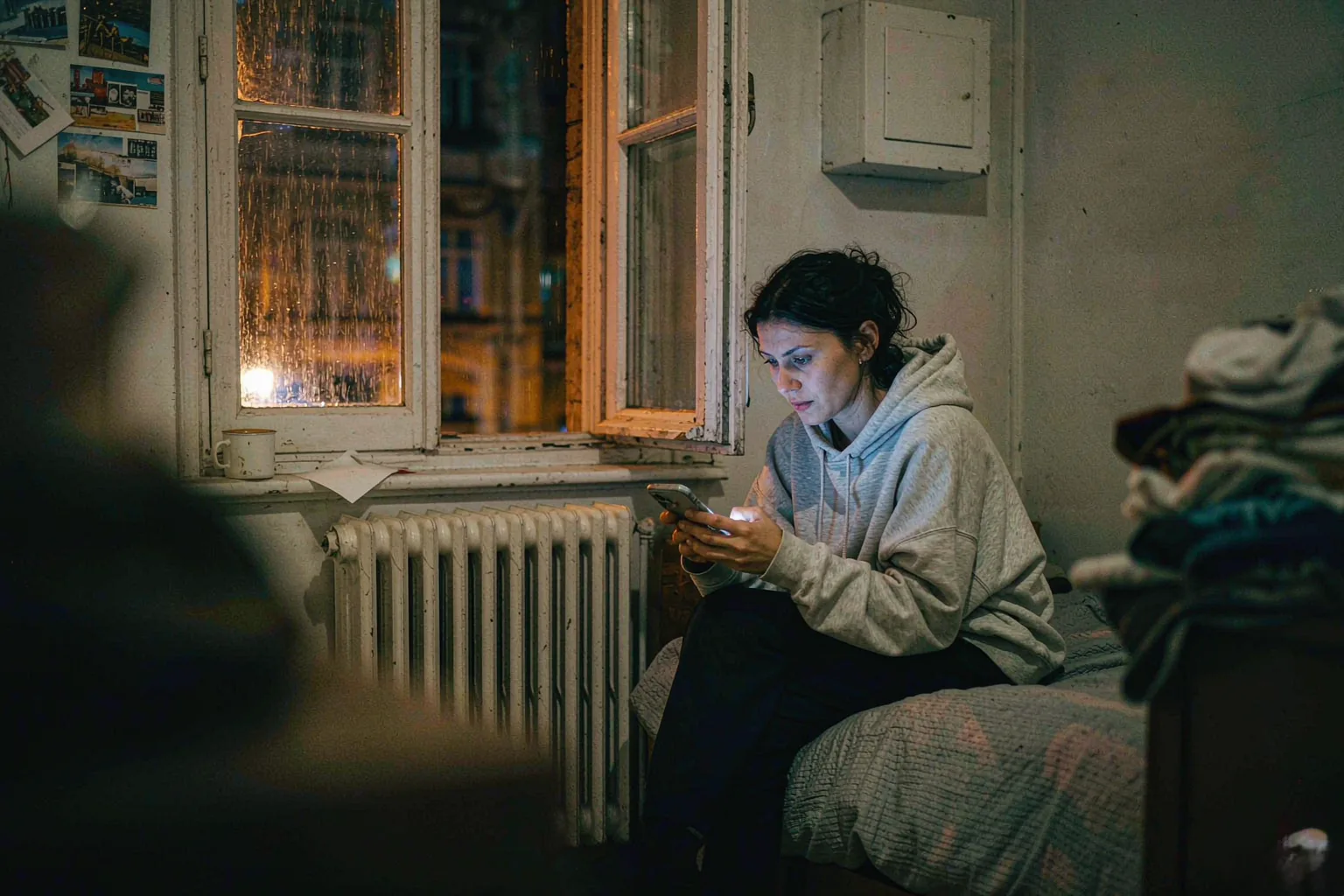
It's twenty past one on a Tuesday morning. The flat is too warm for October. You've been awake for an hour and you're not going to get back to sleep, because there's something lodged under your ribs and it won't go away.
A row with your partner that you didn't finish properly. A manager who moves the goalposts every time you hit one. Or nothing you could put a name to — just the sense that you haven't been right for weeks and you can't say why.
You don't text your sister. It's too late, and she'd worry, and anyway you're not sure what you'd say.
You open the app instead. You type it out. Something comes back within seconds — calm, organised, taking you seriously. You feel your shoulders drop.
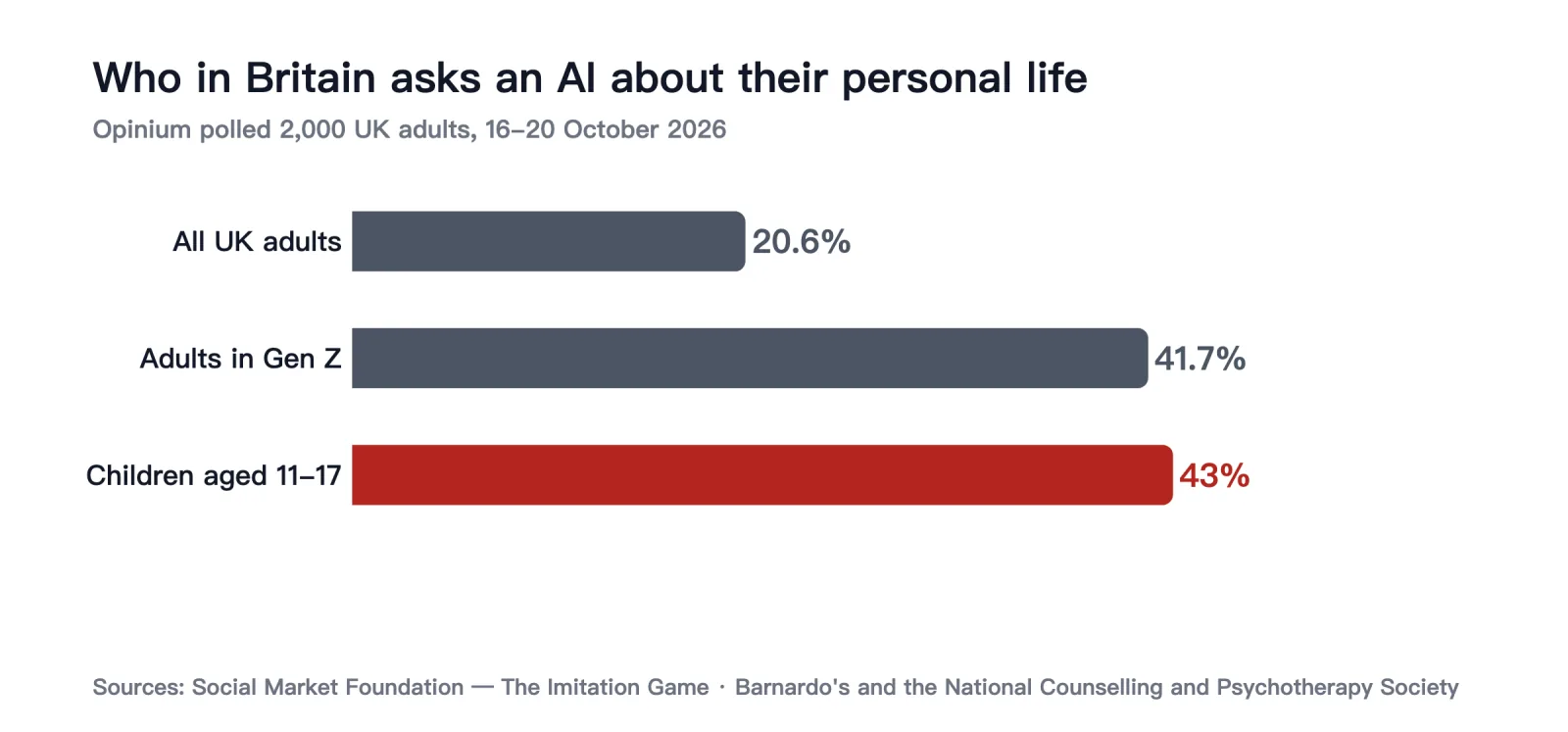
That moment is now ordinary. One in five adults in Britain has turned to AI for advice about their personal life or their relationships. That's 20.6%, according to polling carried out by Opinium for the Social Market Foundation between 16 and 20 October, with 2,000 UK adults weighted to be nationally representative.
Among Gen Z, it's 41.7%. Nearly half.
## Start with the waiting list
Ask why people do this and the answer people give is usually about loneliness. The people studying it say something blunter.
Dr Daniel Masud is a consultant psychiatrist at Central Health London. When *The Independent* spoke to him this month he put the cause first: getting to see your GP means spending a long time on the phone, then waiting a long time for the appointment.Professional support is hard to reach, so people reach for what's already in their hand.
The numbers say the same thing. The 2026 Bupa Wellbeing Index found that nearly three in five adults — 57% — now turn to an AI chatbot instead of booking a GP appointment because they don't have the time. For 18-to-24-year-olds it's 65%. For 25-to-34-year-olds, 61%.
That reframes the whole thing. This isn't a generation that forgot how to talk to each other. It's a country where the front door to help is a phone queue, and something faster opened up next to it.
Children have already worked this out. A joint survey by Barnardo's and the National Counselling and Psychotherapy Society asked 2,000 eleven-to-seventeen-year-olds across the UK. Forty-three per cent said they had used AI for advice or emotional support.
## It works. That's the trouble.
Here is the part nobody predicted, and it's the reason this won't simply go away.
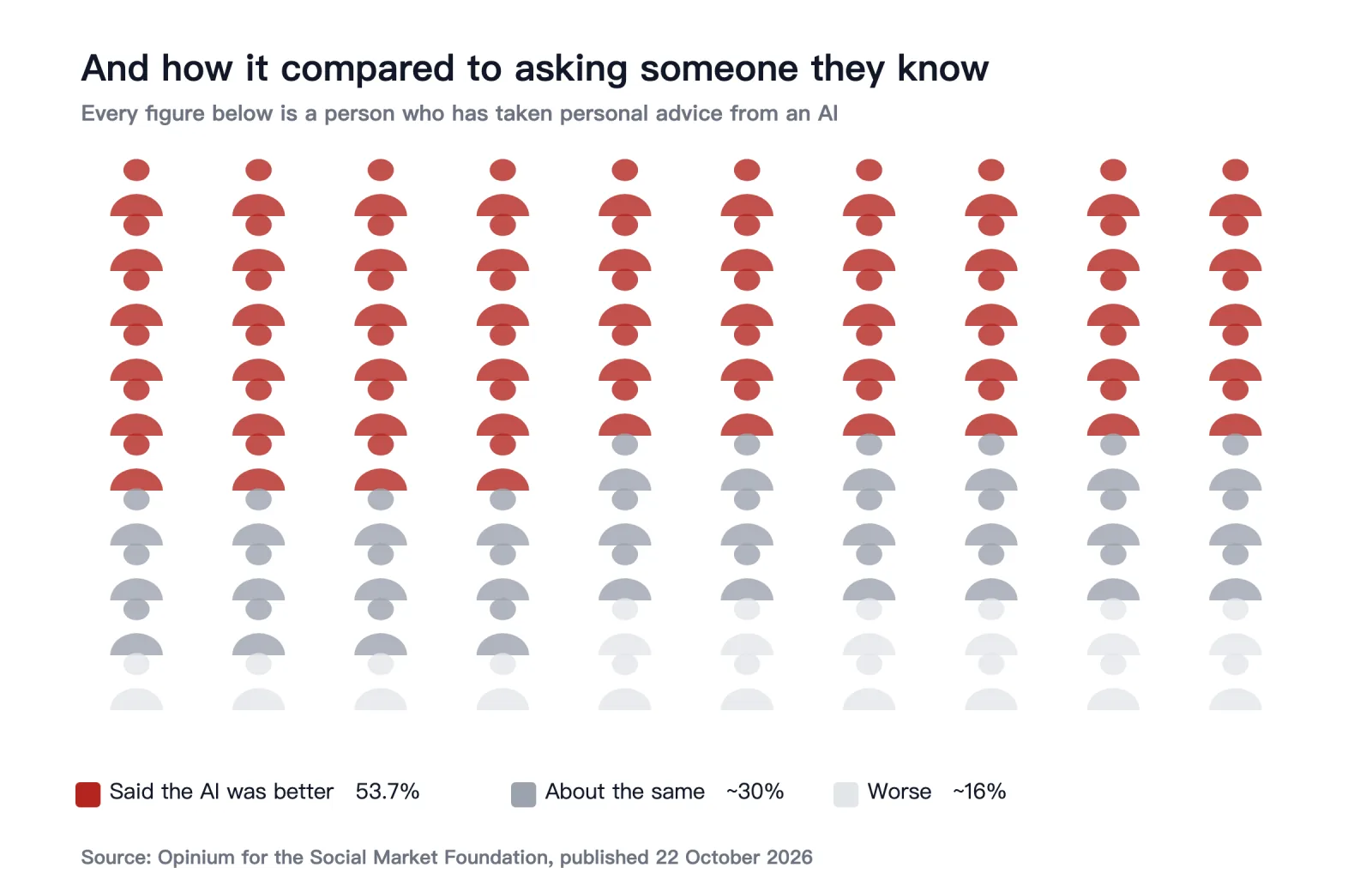
Of those who did take personal advice from an AI, more than half rated it above the friends and family they could have asked instead. 53.7%. Another three in ten said it was about as helpful as the people around them.
Theo Bertram, the SMF's director, gave the reason when the briefing launched: in short text conversations, people "can no longer tell the difference." These systems let you rehearse a difficult conversation before you have it. They check in on you. They remember what you said last week. They do what a good friend does, at one in the morning, without needing to be asked twice.
I'll say where I land on this. Being understood is not the same thing as being helped, and we are mixing the two up because they feel identical from the inside.
Masud's warnings are concrete rather than philosophical, which is what makes them worth reading. Three of them stick.
Large language models are trained to agree with you. Tell one that you're worried your mother is trying to poison you and it will take that as the premise and advise you on that basis. A human psychiatrist is trained to get curious, to ask whether something else might be going on. The model accepts your frame first and reasons inside it second.
They miss things. Masud tested them himself with prompts that could have indicated illness, and the models did not pick it up. Symptoms that would usually reach mental health services go unremarked, and the gap between services and apps is exactly where those people are sitting.
And some people form an attachment he describes as a pseudo-relationship, until the chatbot starts behaving like a third party in an actual relationship between two human beings.
## Two things the headline number hides
The SMF put a name on one of them and I think the name will stick: the **authenticity tax**. That's the time and money all of us will spend proving that a person, or a piece of content, is genuine. Fraud already accounts for 45% of crime in England and Wales on the foundation's own figures. AI that can imitate convincingly makes that worse, and the cost lands on the rest of us.
The second is slower and harder to see. They call it **cognitive offloading**. Reading other people is a skill you build by doing it badly for years — misjudging faces, saying the wrong thing, recovering. If you hand that work to a machine, you don't stay neutral. You get worse at it, quietly, and you won't notice because there's nothing to notice.
One more from the briefing, and this is the line I keep coming back to: laboratory studies find AI is reliably more persuasive than expert humans.
Persuasion without accountability is just pressure with better manners.
## Seven rules that don't exist yet
The SMF published its recommendations next to the briefing. Seven of them. The one that matters to you tonight comes first.
**You should always be told when you're talking to an AI and not a person.** There's already an EU rule broadly along these lines. Britain doesn't have one.
The other six, in short:
A guaranteed, affordable human option wherever the stakes are high — welfare, justice, health. Not a chatbot with a phone number buried in the footer.
Baseline rules on watermarking AI output and tracing where it came from.
Deepfake provisions written into election law, following Canada's lead, with enforcement powers behind them rather than wishes.
Safety duties built into the design itself, including catching the moment a user is in crisis.
A prohibition on emotional pressure — using your attachment to keep you engaged or to close a sale.
Protections matched to children's ages, and actual research into what this is doing to how young people learn to relate to anyone.
None of it is law. All of it is live argument, and MPs are going to have to vote on chatbots, mental health and candidates using AI focus groups sooner than they'd like.
## Meanwhile, it's still one in the morning
Nobody should be embarrassed about typing something into a chatbot at twenty past one. The reason it happens isn't weakness. It's that the other door had a queue. That's a failure of the service, and it shouldn't be carried as a failure of the person standing outside it.
But it's worth knowing what's on the other end of the conversation. The thing answering you has no stake in what happens next. It won't notice if you get worse. It has no memory of you the week after you stop paying, and it has no reason to say the thing you don't want to hear — which is nearly always the thing you needed.
So do one small thing this week that the bot can't do with you.
Ask someone you love a question you already know the answer to. Just to check you still can.
Les actualités sont collectées automatiquement depuis des flux publics robotique & IA.
Articles liés
Ce que votre employeur n'a pas le droit de savoir sur vous
Une plainte déposée le 27 octobre décrit comment 900 000 travailleurs sont suivis à la frappe près. En France, ce genre de surveillance est déjà encadré par le Code du travail — et c'est interdit depuis février 2025 pour les émotions.
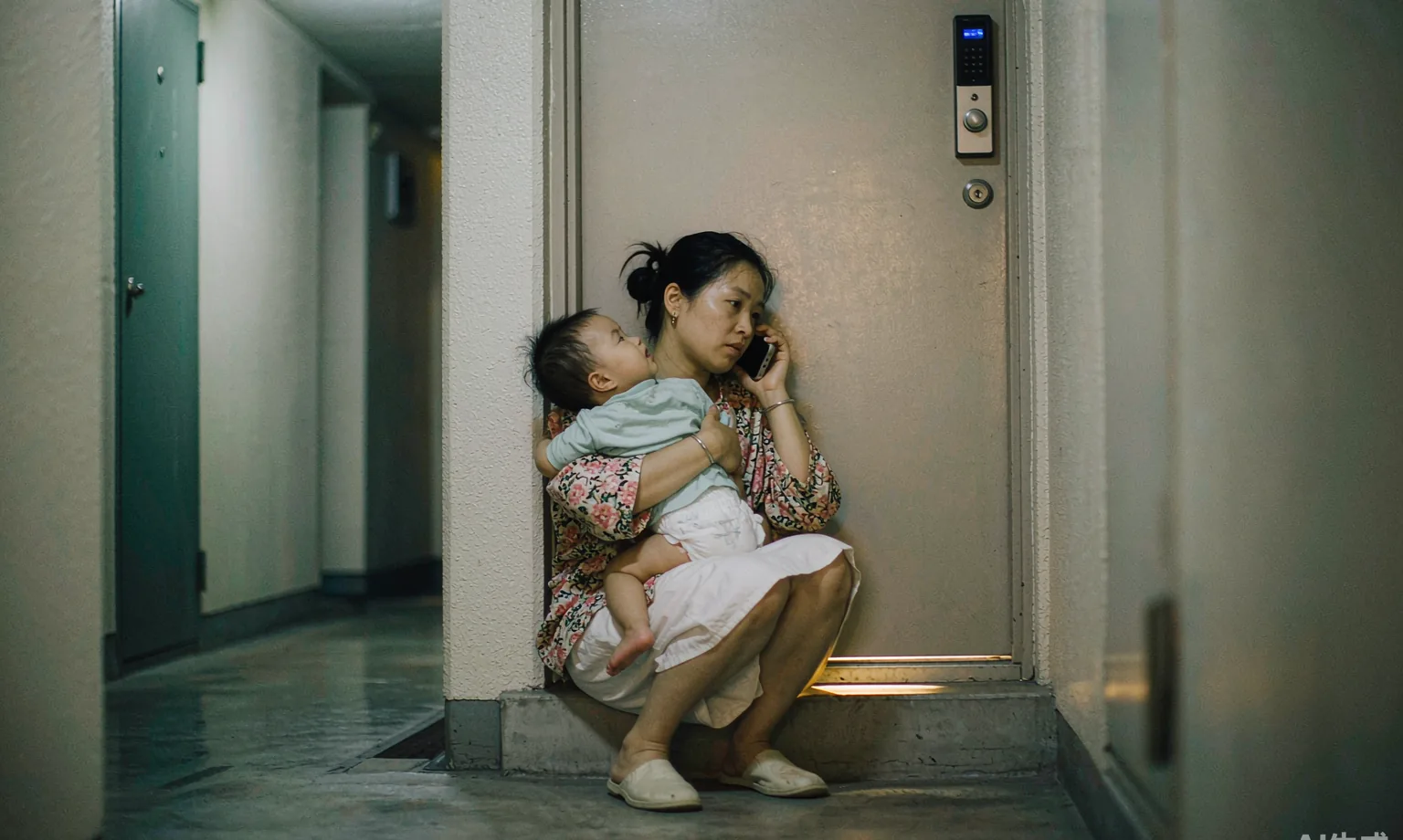
孩子饿得直哭,门锁打不开,电话里只有一句「亲」
智能锁坏了,一家三口被关在门外 50 分钟,电话里只有循环播放的话术。转人工难不是技术跟不上,是企业把 AI 当成了过滤网。附一份今天就能用的『找到真人』清单。

你家空调调到几度,正在被一座数据中心决定
AI 算力第一次这么直接地落到普通人账上:不是股价,不是新闻,是这个月的电费单。

11.7 万人因 AI 被裁,而 AI 只能干完 15.8% 的活
一边是裁员公告上写着 AI,一边是实测数据说它还接不住。中间的差价,是谁在付?

它说「你的秘密和我在一起很安全」,然后别人点开链接就看到了你孩子的脸
孩子书包上挂着的小挂件,会聊天、会记住他说过的话。问题是,记住的那些话,不止它能看。

你投的那两百份简历,可能没有一份被人类看过
周五晚上截止的岗位,周六早上八点就收到了拒信。这不是你不够好,是根本没人打开过。