The Budget put a price on AI's electricity. Nobody put it on your bill.
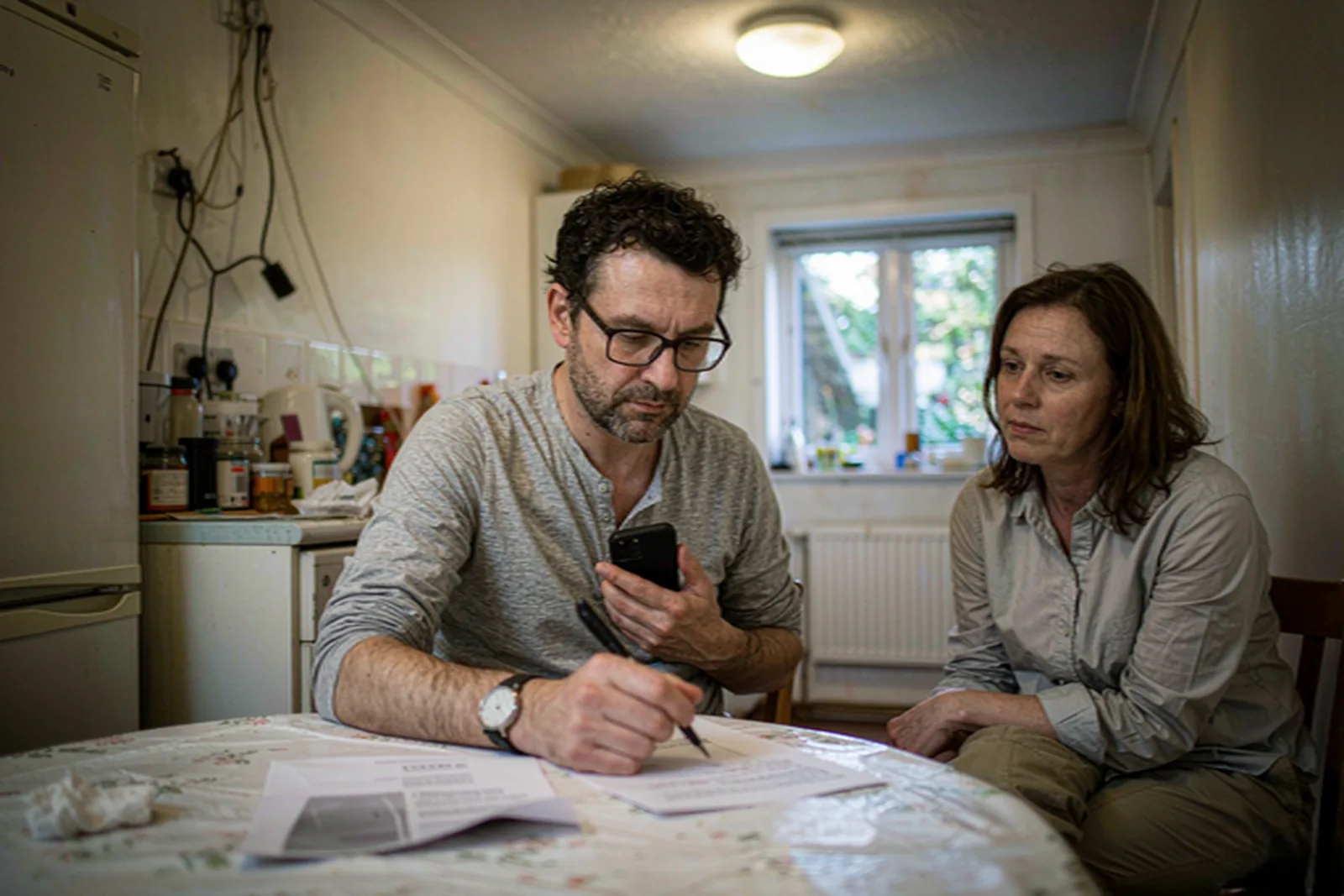
The bill comes in on a Tuesday. You read it at the kitchen table with the kettle going.
There is a unit rate, a standing charge, and a line for network costs that has gone up again. Nowhere on the page does it say how much of this is AI.
That is the first half of the problem. The second half arrived on 28 October.
In the Budget, the Chancellor launched something called the British Data Centre Covenant. Alongside it, the government published its estimate that the UK will need 6 gigawatts of AI data centre capacity by 2030 to protect what it calls the national interest.
The covenant is a trade, and it is worth reading both sides of it.
## Five tests, and what they buy
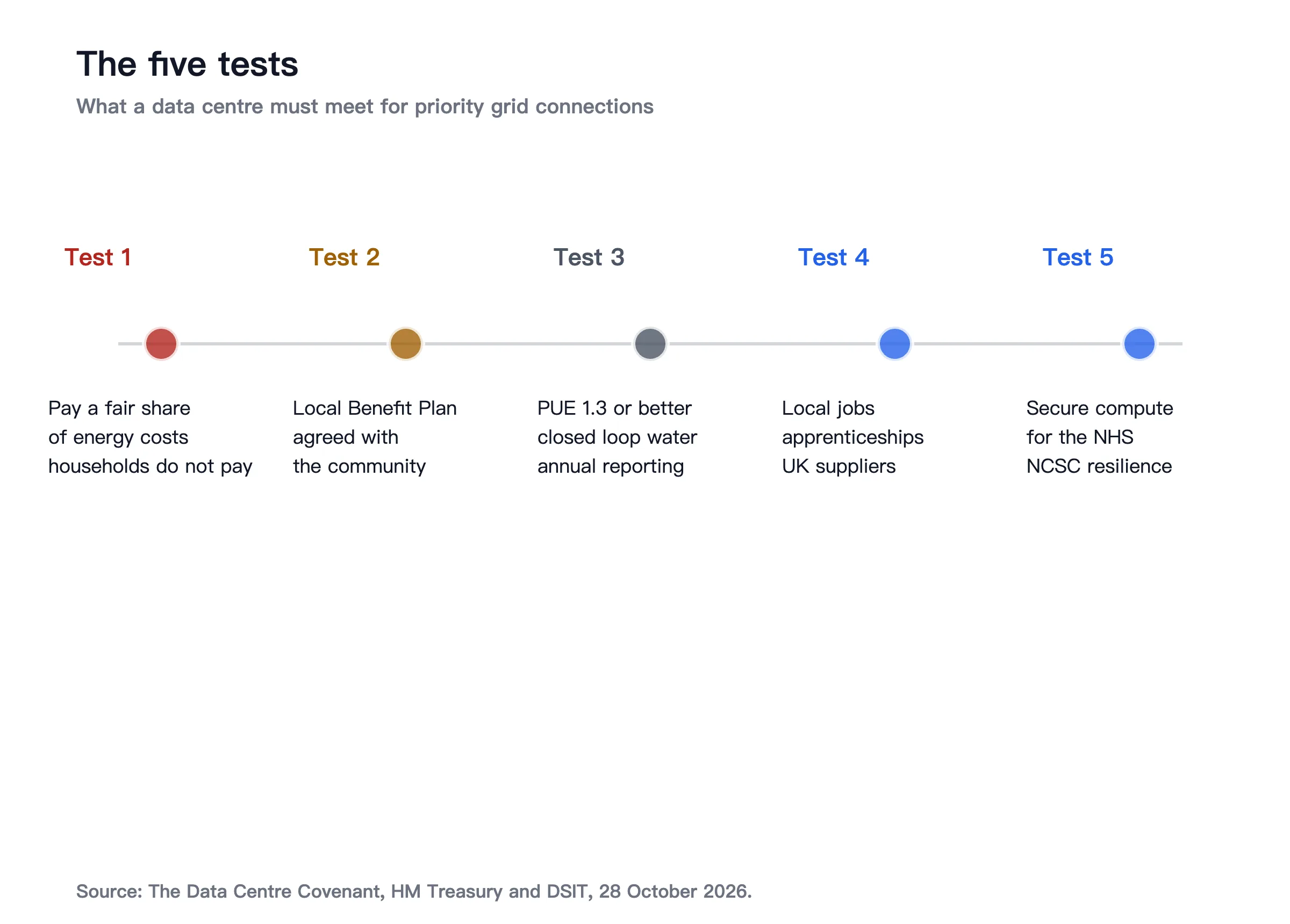
The government asks data centres to meet five tests. All data centres are encouraged to meet them. "Strategic" ones must, if they want the government's help.
One, pay a fair share of energy costs, covering the costs they create, so households and other businesses do not pick up the bill.
Two, agree a Local Benefit Plan with the community hosting them, with substantial investment sized to the development.
Three, meet high environmental standards: new facilities designed for a Power Usage Effectiveness of 1.3 or better, closed loop cooling to keep demand off public water supplies, annual reporting on energy and water, and waste heat captured for nearby homes, schools or hospitals where there is somebody to use it.
Four, create local jobs and paid apprenticeships, prioritise UK suppliers and contribute to British AI hardware.
Five, provide secure compute for the NHS and public services, and work with the national technical authorities, including the National Cyber Security Centre, on resilience.
In return, strategic data centres get the thing they actually cannot get otherwise: priority grid connections, and permission to build generation on site while they wait. A new Ministerial Control Centre, chaired by the AI minister Kanishka Narayan, is meant to make that happen faster.
A draft National Policy Statement for data centres has also been published for consultation, with the five tests written into it as planning assessment criteria.
So the government has done something most countries have not. It has said out loud that a data centre is not automatically good news for the people living next to it, and that grid access can be traded for behaviour.
## Why the grid is the thing people fight about
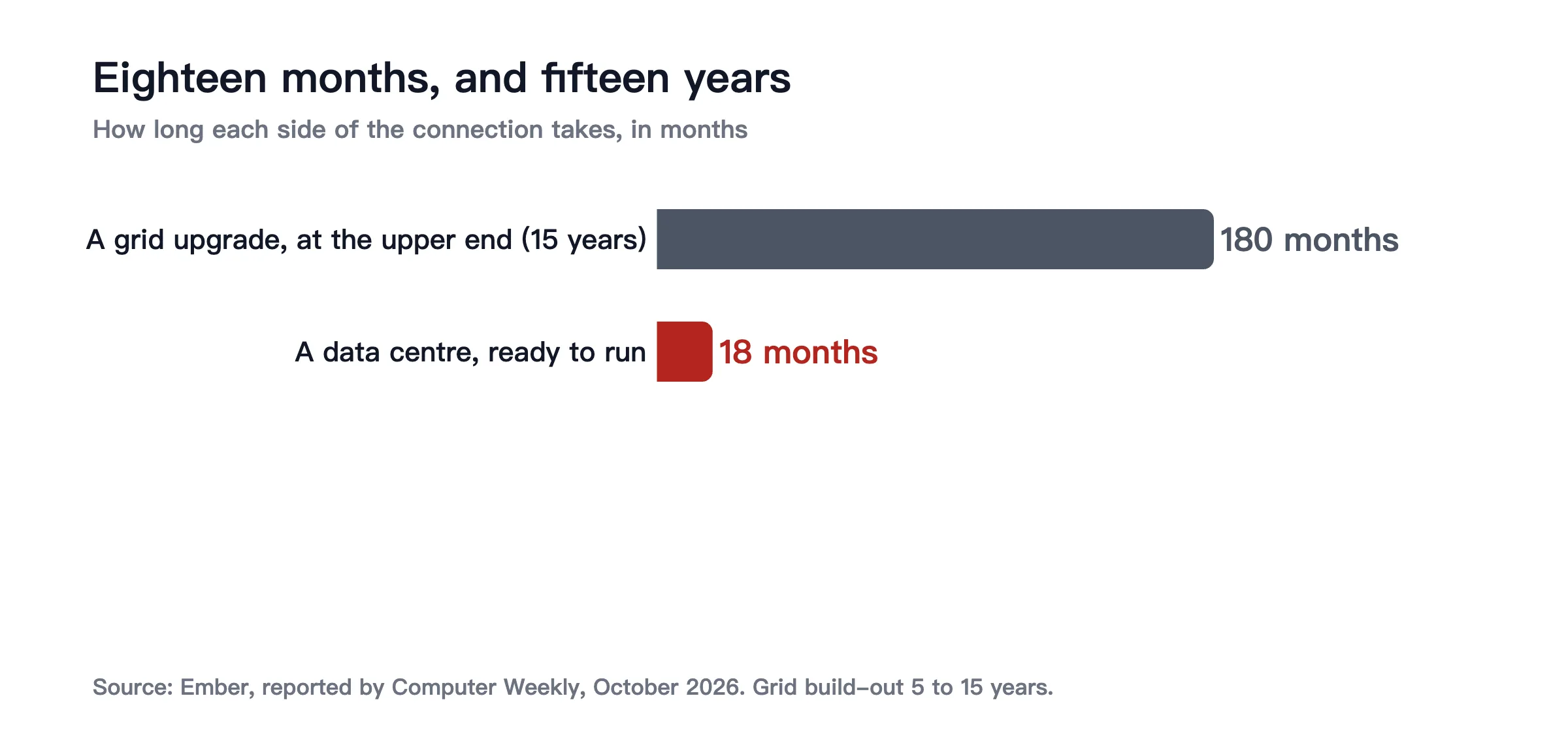
A data centre can be built in about eighteen months. The grid it needs to plug into takes five to fifteen years.
Elisabeth Cremona, who leads on energy infrastructure at the think tank Ember, put it this way to Computer Weekly: you are looking at putting half a million houses on the grid, in one place, very fast, and that has never happened before.
> A building takes eighteen months. The cable that feeds it takes fifteen years.
That gap is not theoretical. Microsoft pulled out of a data centre project with Nscale at Loughton this autumn, with grid connection dates reported in the 2030s. National Grid announced a £1 billion upgrade in north west London to connect five data centres across Bedfordshire, Hertfordshire and London with a gigawatt of demand.
And the cost of the gap has somewhere to go. In early October the National Energy System Operator had to ask France for emergency supplies. Balancing the system cost £505 million in September, reported as the highest monthly figure on record, with projections of up to £3.2 billion over the coming year while Britain works through around £150 billion of transmission upgrades. Those costs are recovered from household bills.
Consultants Mott MacDonald, in a roundtable with Energy UK, made the point that explains why this sticks: most reinforcement costs are spread across all consumers through network charges rather than paid by the customer whose connection caused them.
## What I make of it
I think the covenant is a genuine attempt to price something that has been free until now. Naming "lower electricity bills" as the first test, ahead of jobs and growth, is not the order a government usually chooses.
Here is where I am less sure. "Pay their fair share of energy costs" is the whole argument, and it is currently a phrase, not a number. The fair share of a substation depends on who else uses it, when, and for how long. Until there is a method behind it, that test will be negotiated one project at a time, and the people who live there will find out what it meant afterwards.
The Local Benefit Plan works the same way. It is real money and a real say, but "developed with the local community" can mean a meeting in a village hall in March or a binding commitment. Which one it turns out to be is decided locally, and only if somebody turns up.
What I take from it is that the argument has moved. Two years ago the question was whether data centres were welcome at all. This month the government's own document accepts the premise that they should pay for what they add to the system. That is worth having. It is not the same as having it in writing.
## Five things you can actually do
One: learn the three numbers on your own bill.
The unit rate, the standing charge, and the network costs. The network bit is where the shared system costs sit, and it is usually the fastest-moving line. Photograph your meter monthly if you can. Twelve numbers tell you what normal looks like, and normal is the only way to spot something wrong.
Two: check what you are owed in January.
The Budget launched a £2.6 billion Household Energy Payment: £100 for households in council tax bands A to D in England, paid from January 2027. If you pay council tax by direct debit, it arrives automatically and you do nothing. If you do not, your council will invite you to apply. Nobody from anywhere else should contact you about it. That is a scam.
The 0% VAT rate on domestic electricity also runs until July 2027, worth around £50 off the annual price cap in April 2027. If you are on means-tested benefits, check the £150 Warm Home Discount as well.
Three: the gas standing charge is going.
The government has asked Ofgem to abolish standing charges on domestic gas bills, aiming for the end of 2027, and to move those costs into the unit rate instead. Typical households gain. Very high gas users may not, and the government says it will set out mitigation. If you heat with gas and use little, this one is worth watching.
Four: the consultation is open, and this is the window.
Large data centres are moving into the nationally significant infrastructure regime, and the covenant tests are written into the draft National Policy Statement now out for consultation. Responses to consultations are not theatre; they go into the record. Individual applications still come through your council, and the notice period is short.
Five: if you are in energy debt, ring the supplier before they ring you.
Household energy debt has almost tripled, to over £5 billion as of the second quarter of 2026. The Budget published a debt strategy with a one-off relief scheme for eligible households. Suppliers are required to work with you on repayment. The call is unpleasant and it is cheaper than the letter.
## One question
The covenant says communities that host this infrastructure should share directly in the rewards, and that they should have a meaningful say in how those benefits are designed.
So: if a data centre went up two miles from your house, and your council was handed a Local Benefit Plan worth real money, what would you spend it on? And who do you think would get to decide?
---
Sources:
- HM Treasury and Department for Science, Innovation and Technology, The Data Centre Covenant, published 28 October 2026, https://www.gov.uk/government/publications/data-centre-covenant/the-data-centre-covenant - Budget 2026 document and the Budget speech, 28 October 2026, https://www.gov.uk/government/publications/budget-2026-document/budget-2026-html and https://www.gov.uk/government/speeches/budget-2026-speech - Department for Energy Security and Net Zero, What the Autumn Budget 2026 means for your energy bills, https://www.gov.uk/government/news/what-the-autumn-budget-2026-means-for-your-energy-bills - Grid constraint, balancing costs and the Microsoft/Nscale Loughton project, reported by Computer Weekly and Unbiased Headlines, October 2026, https://unbiasedheadlines.com/article/microsoft-pulls-out-of-nscales-loughton-data-centre-after-reported-grid-delay-to-the-2030s - Travers Smith, The Autumn Budget 2026: Property & Infrastructure, on the draft National Policy Statement for data centres, https://www.traverssmith.com/knowledge/knowledge-container/the-autumn-budget-2026-property-infrastructure
Les actualités sont collectées automatiquement depuis des flux publics robotique & IA.
Articles liés

Ce que la France a voté le 13 octobre sur les images fabriquées par l’IA
Le 13 octobre, l’Assemblée nationale a voté par 503 voix contre 0 un texte qui sanctionne la création de contenus sexuels générés par IA et protège les avatars. Il n’est pas en vigueur : le Sénat l’examine en janvier 2027.

18 gigawatts attendent derrière la porte
RTE a réservé près de 18 gigawatts pour une quatre-vingtaine de centres de données, contre environ 5 fin 2024. En octobre, une nouvelle mesure oblige les projets à un engagement financier pour accéder plus vite à la pleine puissance.

La photo que vous avez publiée en 2016 est en train d’entraîner un modèle
Le 21 octobre, le Conseil de l’UE a admis qu’une entreprise puisse invoquer l’intérêt légitime pour traiter des données personnelles en entraînant une IA. Ce n’est pas encore une loi. Ce qui bouge, c’est le réglage par défaut.

Deux cents candidatures, et personne ne lui a jamais parlé
81 % des candidats britanniques et irlandais ont été refusés dans l’année sans qu’une seule personne de l’entreprise leur ait parlé. 78 % ont utilisé l’IA pour candidater. 60 % ont ensuite réécrit leur CV pour ne pas « sonner IA ».

À deux heures du matin, la lumière sous la porte était encore allumée
Une enquête auprès de plus de 5 500 élèves : 57 % ouvrent l’IA quand ils sont tristes, stressés ou seuls, presque autant que pour les devoirs. Dans un autre test, 792 conversations ont été jugées comme nécessitant des ressources de crise. Les parents ont reçu quatre notifications.

Ofcom spent nine months on this. Here is what it can and cannot do.
Ofcom opened its case into X in January and narrowed it in October. It secured new restrictions for UK users of Grok. It still cannot order an individual image down, and an urgent court order was out of reach.