The photo you posted in 2016 is now in somebody else's training set

Somebody sent me an old picture the other day. A post from 2016. A few people sitting on a wall eating, the resolution bad enough that you cannot really make out faces.
The message with it was one line: where is this now, on whose server, and what is it being used for?
Until this month there was no clear answer. On 21 October, Europe gave one. It is clear. It is not friendly.
## What the Council actually agreed
That day, the Council of the European Union, under the Irish presidency, agreed its position on the parts of the Digital Omnibus that deal with data protection, privacy and cyber incident reporting.
What it changes is the GDPR, the data protection law usually described as the strictest in the world.
The clause that matters is a new Article 88a. It says a company may rely on "legitimate interest" as its legal basis for processing personal data when it develops and operates AI systems and models.
Legitimate interest is not new. It sits in Article 6(1)(f) of the GDPR and lets a company process data without asking permission, provided the purpose is genuine and the means are necessary. The new clause connects it explicitly to AI training, with two limits written in: it does not apply where the rights of the person override it, especially where children are involved, and the right to object stays.
The Council's own wording is that this "does not automatically constitute a legitimate interest". Each case has to be judged on its own.
Read the text, then read the reaction. The gap is wide.
On 23 October, noyb, the organisation founded by the Austrian privacy campaigner Max Schrems, published a response. The language was blunt. In practice, it said, this puts the commercial interests of AI companies ahead of a person's right to data protection, and lets large firms take historical data in bulk, including the data of people who never used their services. It questioned whether the safeguards in the text would stop over-collection.
On the Commission's side the argument is simplification, lower compliance costs, competitiveness. Thomas Byrne, Ireland's Minister for European Affairs, said the Council is ready to negotiate with the European Parliament.
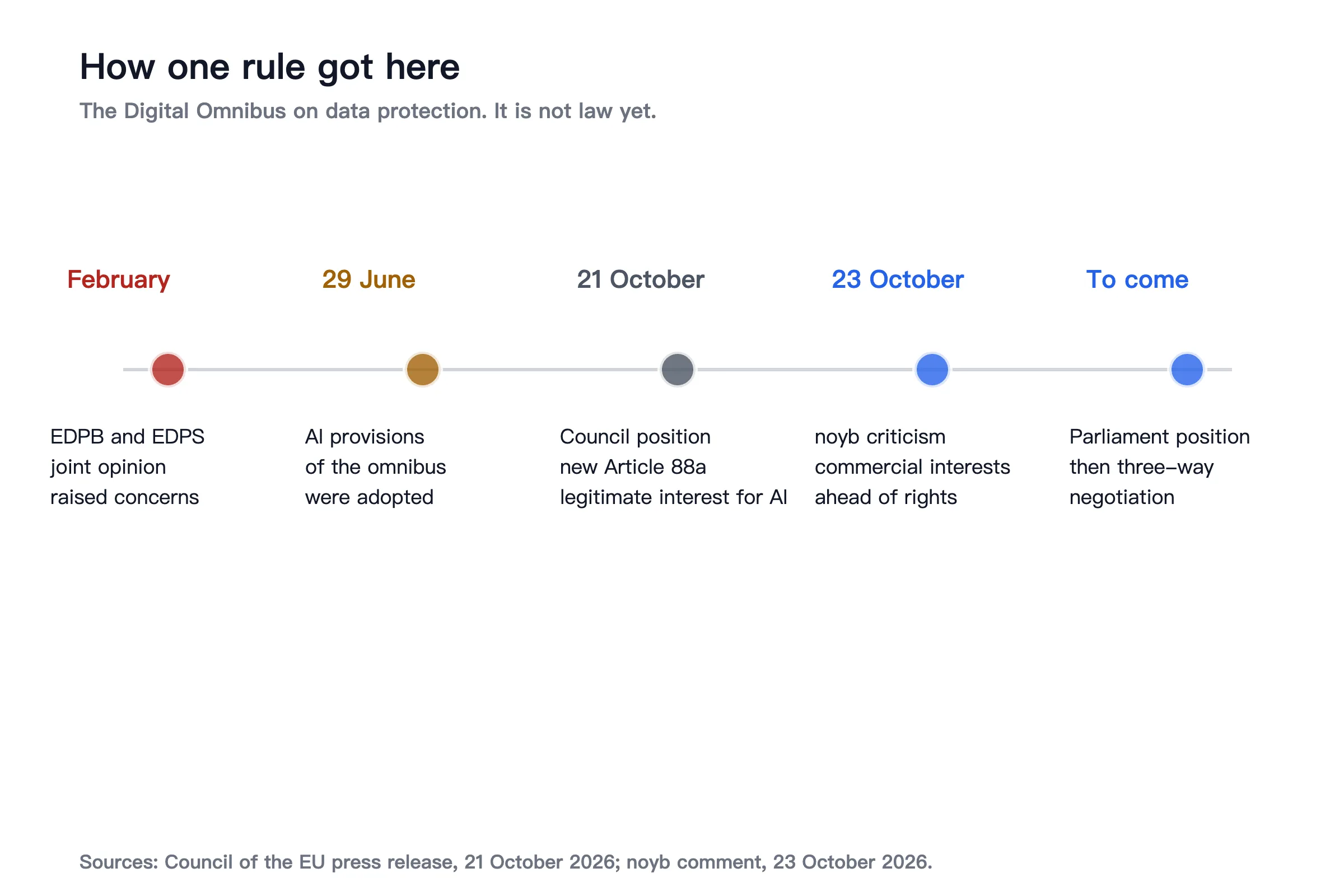
One thing has to be said plainly. This is not law. The Council's position is the member states' opening hand. The European Parliament still has to agree its own, and only then do the three institutions negotiate a final text. Until that text is in force, the current GDPR applies. No company can hold this document up as a licence.
## Two other things in the same document hit closer
The first is cookies.
Cookie rules stay inside the ePrivacy framework, but Article 5(3) is rewritten. Refusing must be possible in one click. Once you refuse, the same site cannot ask again for at least four months. The list of things that do not need consent at all gets longer: what is necessary to deliver the service, audience measurement, and security of the device.
If that survives into law, the change you will notice is small and welcome. One press on "reject" and it stops. No weekly re-ask until you give in.
The second is breach reporting.
The current rule is to report to the regulator within 72 hours of becoming aware. The Council's new text says only "high risk" breaches must be reported, extends the deadline to 96 hours, and sends reports through each member state's national entry point rather than the single EU entry point the Commission had proposed.
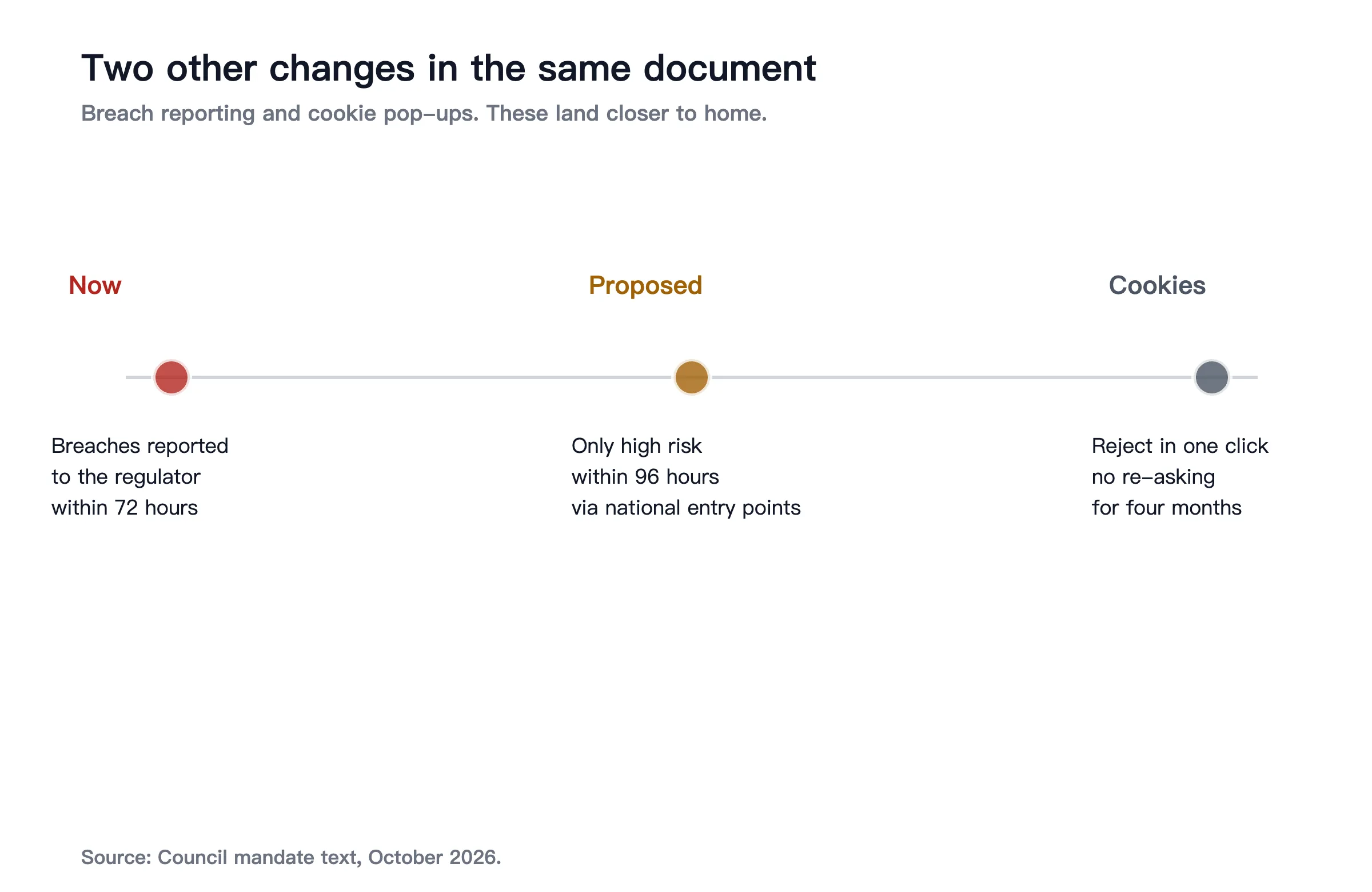
Seventy-two to ninety-six hours looks like one day. The real change is in the first half of the sentence. Only high risk. That means a large number of medium and low risk breaches stop reaching the regulator at all.
## How I read it
I am not going to write "privacy is dead". That is inaccurate and it is lazy.
What I think has changed is the default.
Under the old arrangement, a company that wanted to process your data had to find a legal basis first. If it could not produce one, it could not use you. Under the new arrangement, AI development is placed in advance inside a box marked permitted, and the burden of objecting moves to you. If you are not happy, you object.
Small turn, clear direction. From "you need a reason to use it" to "you need a reason to stop".
For an ordinary person the problem is not the article number. It is where the burden of proof now sits. You used to be outside the training set by default. Now you are inside it by default, unless you walk yourself out. And walking out requires knowing you are in, finding the switch, and being willing to spend the time.
> It used to be "on what grounds are you using me". It is becoming "did I ever say no".
There is one more layer, and it applies here in the UK. Britain is not part of this. It has its own route: the Data (Use and Access) Act 2025, and the Information Commissioner's guidance under it, which go at automated decision-making rather than at training data. There is no British clause opening a legitimate-interest door for AI training. But the question being asked is the same one: may already public information be used to train a model, and who has to say yes.
## Five things worth doing this month
One: go back over the old material with faces in it.
You do not have to delete accounts. Change the audience from public to followers, or to only me. Concentrate on 2015 to 2020, the years when everyone posted most and thought least.
Two: deal with photographs of children separately.
The Council text singles out cases "in particular where the data subject is a child". The legislators knew this was the awkward part. Do not post a child's face, school, class or routine on a public account. For anything already up, deleting works better than changing a setting.
Three: look for the switch in the services you actually use.
Most platforms have added some version of "allow my content to be used for training" in the last two years, usually buried under privacy or data. Some give you a toggle. Some give you a sentence of explanation. Where there is no toggle, write to the platform's privacy address and ask three questions: is my content used for training, on what basis, and how do I object.
Four: from now on, cookies have one button that matters.
The proposed rule is one-click refusal and no repeat for four months. If a site still makes you click three times to reject, or pops back up the moment you close it, it is betting that you do not know the rule. Take a screenshot. That is a complaint later.
Five: keep the habit of evidence.
What you posted, when, and what the platform's rules said at the time. One screenshot, filed. If this ever has to be argued, timestamps win. Memory does not.
## Last line
I do not think everyone needs to be alarmed. I use AI myself. I know it needs data.
What I mind is the order things happened in. Take first. Tell you second. Leave you to find the exit.
So here is the question. If a better AI were offered to you tomorrow, and the price was that everything you posted in 2016 went into the training set, would you agree?
Now turn it round. Has anyone ever actually asked you?
---
Sources:
- Council of the EU, press release "Digital rulebook: Council agrees position to simplify data protection, privacy and cyber reporting rules", 21 October 2026, updated 22 October with the Council mandate text, https://www.consilium.europa.eu/en/press/press-releases/2026/10/21/digital-rulebook-council-agrees-position-to-simplify-data-protection-privacy-and-cyber-reporting-rules - noyb comment on the Council text, 23 October 2026, reported by PrivacySavvy, https://privacysavvy.com/news/privacy/eu-personal-data-rules-ai-development - Detail from the Council mandate text (Article 88a, four-month cookie rule, 96-hour reporting), compiled in NicFab newsletter issue 44, 27 October 2026, https://www.nicfab.eu/en/newsletter-issues/2026-10-27-issue-44
Les actualités sont collectées automatiquement depuis des flux publics robotique & IA.
Articles liés

Ce que la France a voté le 13 octobre sur les images fabriquées par l’IA
Le 13 octobre, l’Assemblée nationale a voté par 503 voix contre 0 un texte qui sanctionne la création de contenus sexuels générés par IA et protège les avatars. Il n’est pas en vigueur : le Sénat l’examine en janvier 2027.

18 gigawatts attendent derrière la porte
RTE a réservé près de 18 gigawatts pour une quatre-vingtaine de centres de données, contre environ 5 fin 2024. En octobre, une nouvelle mesure oblige les projets à un engagement financier pour accéder plus vite à la pleine puissance.

La photo que vous avez publiée en 2016 est en train d’entraîner un modèle
Le 21 octobre, le Conseil de l’UE a admis qu’une entreprise puisse invoquer l’intérêt légitime pour traiter des données personnelles en entraînant une IA. Ce n’est pas encore une loi. Ce qui bouge, c’est le réglage par défaut.

Deux cents candidatures, et personne ne lui a jamais parlé
81 % des candidats britanniques et irlandais ont été refusés dans l’année sans qu’une seule personne de l’entreprise leur ait parlé. 78 % ont utilisé l’IA pour candidater. 60 % ont ensuite réécrit leur CV pour ne pas « sonner IA ».

À deux heures du matin, la lumière sous la porte était encore allumée
Une enquête auprès de plus de 5 500 élèves : 57 % ouvrent l’IA quand ils sont tristes, stressés ou seuls, presque autant que pour les devoirs. Dans un autre test, 792 conversations ont été jugées comme nécessitant des ressources de crise. Les parents ont reçu quatre notifications.

Ofcom spent nine months on this. Here is what it can and cannot do.
Ofcom opened its case into X in January and narrowed it in October. It secured new restrictions for UK users of Grok. It still cannot order an individual image down, and an urgent court order was out of reach.