Research could guide the future design of social robots
By the University of Glasgow
Giving robot companions animal-like or anime-style faces and voices could maximise their emotional appeal to users, according to new research which could help guide the growing field of social robotics.
Social robots can provide companionship and comfort to their owners by mimicking human or petlike behaviours. Although the robots are a fast-growing sector of the tech industry, surprisingly little academic research has explored how their designs can be optimised to make the robots as expressive and emotionally engaging as possible.
In a new paper set to be presented at a conference this week, researchers from the University of Glasgow show how they have been working to close that research gap.
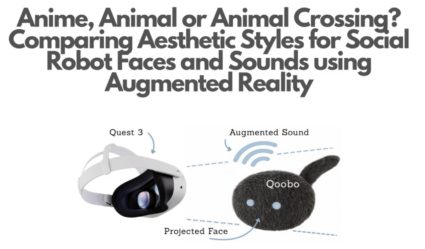
With the help of a group of volunteers, they used augmented reality technology to test dozens of different combinations of faces and voices overlaid on the body of an existing social robot called a Qoobo, which has a soft, cushion-like body and a swinging tail.
Dr Shaun Macdonald and Josh Yip of the University of Glasgow’s School of Computing Science used this rapid prototyping approach to explore how users felt about the virtual robots, and how effectively they were able to ‘read’ the robot’s emotional states to make them feel more like real creatures.
Dr Macdonald said: “Social robots can provide valuable experiences for a wide range of people. Older people have reported that they can help mitigate feelings of loneliness or social isolation, for example, and people living in spaces where they can’t keep a real pet have kindled some of that sense of companionship with what we call zoomorphic robots, which mimic animals’ appearances and behaviour.
“However, the aesthetic design of zoomorphic social robots so far has largely been the result of educated guesswork, with very little research available on what makes them appealing to users.
“What we’ve done here for the first time here is take a more systematic approach to designing the appearance of a zoomorphic robot by harnessing augmented reality to enable rapid, side-by-side design tests. In the future, these insights could help create a new generation of user-customisable robots which can tailor their appearances to better suit their owners’ preferences.”
The research builds on Dr Macdonald’s previous research in advancing the design of social robots. His work includes the development of a software system called Augmenting Zoomorphic Robotics with Affect , or AZRA, which can overlay augmented-reality sounds and animations over the bodies of real-world social robots to prototype new appearances and functionalities.
In this research, the team began by creating a ‘mood board’ of appealing images of animals and robots drawn from real life and from popular culture to help them design a series of prototype faces for virtual robots. They ended up with five prototype faces comprised of animal-like, robot-like, emoji-style, anime-inspired designs, with another comprised simply of eyes.
They chose five distinct vocalisations to enable the prototypes to express themselves to the volunteers: recordings of cat noises, human-like vocal sounds, abstract electronic noises, music and samples of ‘animalese’, the nonsense sounds used by the characters in the popular Nintendo game series Animal Crossing.
Then, 24 volunteers were given AR headsets and asked to rank different combinations of faces and voices overlaid on Qoobo for how clearly they expressed an emotion and how much empathy they felt towards the prototype robot, as well as how appropriate the combination of factors felt to them.
The results revealed that combinations of animal-like faces and vocalisations matched Qoobo’s animal-like body were well-liked by the volunteers, who found them more engaging and immersive. While that result might be unsurprising, the team also found that anime-like faces were just as highly-ranked despite not being based on real life.
Josh Yip said: “Anime-like faces are more expressive than animal faces could ever really be, giving the robot abilities to express themselves beyond those of a normal pet but in a way that didn’t feel uncanny. It still felt like it could be a pet-like creature to our study participants.
“We also found that faces consistently outperformed sounds at conveying emotion and creating connections. Interestingly, the study participants found that the human sounds were easier to read emotionally but were liked less than animal sounds, even though they found them harder to clearly identify with specific emotions.”
The team were surprised to find that, although the study participants insisted that they felt that being able to correctly read the robot’s emotions was very important to them, the data showed that readability had little influence on the designs they preferred. Along similar lines, ‘animalese’ sounds ranked highly with users despite being unintelligible, with some users feeling it suggested the robot had a greater sense of intelligence than other sounds.
The study’s participants reactions to the prototypes were also affected by whether they owned a real animal pet themselves. Pet owners were more likely to treat the animal-like prototypes as real pets, but to be more likely to treat robot-like faces as machines.
Dr Macdonald added: “Our research suggests that although there is no single face or voice that has universal appeal, the combination of the two can have a big effect on how well users feel that robots are able to communicate emotions.
“We hope our findings will help inform the design of future generations of zoomorphic social robot technology, but they could also extend the lifespan of existing devices by enabling users to overlay new faces, voices and functionality on them using augmented reality.”
The team’s paper, titled ‘ Anime, Animal or Animal Crossing? Comparing Aesthetic Styles for Zoomorphic Robot Faces and Sounds using Augmented Reality ’, will be presented at the ACM International…
Les actualités sont collectées automatiquement depuis des flux publics robotique & IA.
Articles liés
This Disembodied Hand Is All the Robot You Need
A hand attached to the end of an arm is a given for most humans, but what if robots didn’t have to play by the same rules as we do? Researchers from ETH Zurich have turned an off-the-shelf robotic hand into a completely self-contained robot that walks on its fingertips while using those same fingers

What three days building a robot taught me
Last month, I went to York to build a robot. I came back with a robot, a tiny trophy-shaped sense of achievement, and somehow a few new friends. From 25th-27th August, I joined the UK RAS STEPS MicroMaze Robot Hackathon at the Institute for Safe Autonomy, University of York. The brief sounded simple

Video Friday: Albatross Falls, Spins, Self-Rights, and Sails Away
Video Friday is your weekly selection of awesome robotics videos, collected by your friends at IEEE Spectrum robotics. We also post a weekly calendar of upcoming robotics events for the next few months. Please send us your events for inclusion. CoRL 2026 : 9–12 November 2026, AUSTIN Humanoids 2026 :

Robot Talk Episode 164 – Accelerating robot learning, with Michelle Lu
Claire chatted to Michelle Lu from Vsim Technology about using simulation and artificial intelligence to teach robots new skills. Michelle Lu is co-founder and CEO of Vsim Technology. She was previously a Director of Simulation Technology at NVIDIA, where she and her co-founder created the world’s f
Atlas Robot’s New Hand May Outperform Humanlike Designs
Today, Boston Dynamics is announcing a redesigned hand for its Atlas robot . The previous generation could do some crazy superhuman things with its three fingers, but it was never intended for mass production in the tens or hundreds of thousands. Switching from research hardware to a scalable produc

Robotics and automation? Informal reflections on familiar terms
By Emmet Cole “Robotics and automation” is a pairing heard often around these parts. It puts the “RA” in IEEE RAS, after all. The familiar combination shows up in conference titles, funding calls, and program descriptions. But what is actually meant by the two words? Is robotics a subdomain of autom