The rise of the machines is canceled: Why humanoids with AI are helpers, not enemies
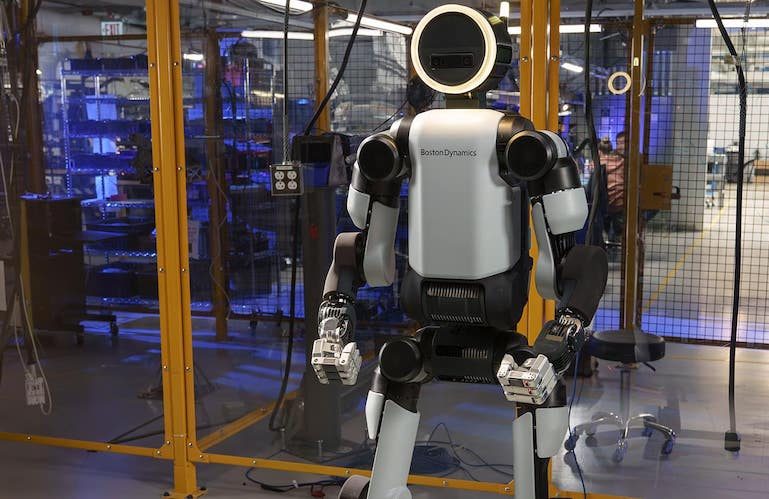
Boston Dynamics’ Atlas humanoid, shown here, is an example of a robot ready for AI.
For decades, engineers have been trying to create robots that look and act like humans. Now, rapid advances in artificial intelligence are bringing humanoid robots out of the lab and onto the factory floor. As fears grow that AI will displace workers, a global race is underway to develop humanoid robots capable of performing human work.
Competitors include Tesla , startups backed by Amazon and NVIDIA , and state-owned Chinese companies. Waltham, Mass.-based Boston Dynamics, valued at over $1 billion, is among the humanoid leaders with its Atlas robot. South Korean automaker Hyundai owns an 88% stake in the company .
Hyundai ‘s massive auto plant is arguably the most advanced in the world. More than 1,000 robots work alongside nearly 1,500 humans, lifting, stamping, and welding parts in robotic unison. Atlas, at 175 cm (68.8 in.) tall and 90 kg (198.4 lb.) in weight, has left the lab and is doing real work.
Atlas and AI learn with human help
Atlas’s development is led by Zach Jackowski . He holds two degrees in mechanical engineering from MIT , and his mission is to transform the robot into a productive worker on the factory floor. Atlas confidently helps sort roof racks for the assembly line without human intervention. It operates autonomously; many roboticists would have considered this insane five or six years ago.
In 2021, Atlas was a bulky, hydraulic robot that could only run and jump. Back then, Atlas relied on algorithms written by engineers. The next-generation Atlas, with its sleek, all-electric body and AI, runs on cutting-edge NVIDIA chips, making it intelligent enough to autonomously perform incredible stunts.
Scott Kindersma led robotics research department at Boston Dynamics before moving to Google DeepMind . He explained that modern robots have learned to master movements that until recently were considered too complex for a machine. This is largely due to how these robots are programmed: more emphasis is placed on demonstrations and machine learning than on manual programming.
This humanoid can learn. Atlas learns in a variety of ways. In supervised training, machine learning specialist Kevin Bergerman (now also at Google DeepMind), wearing a virtual reality headset, took direct control of the humanoid, guiding its hand and arm movements step by step through each task until Atlas masters it. If this teleoperator can perform the task we want the robot to perform, this generates data that is subsequently used to train the robot’s AI models to perform that task autonomously.
The stylish suit you wear will actually record all your body movements to train Atlas to accurately mimic your movements. In this way, you will serve as a physical prototype for a 200-lb. metal robot. All your movements—walking, hand gestures—are captured by these sensors.
Engineers then feed this data into a machine learning process. Atlas’s body is different from yours, so they had to teach it to virtually imitate human movements. Over 4,000 digital Atlases were trained for six hours in a simulation. The simulation added complex challenges for the avatars, such as slippery floors, bending, and stiff joints.
Ultimately, this could lead to many copies of Atlas, each having loaded new skills into the AI system. Once one robot is trained, they are all trained. Using the same processes, Atlas was taught to crawl and cartwheel. It wasn’t as good at duck walking.
Indeed, Atlas, or any other humanoid, can’t yet do most of the things a person does in their daily lives. For example, simply getting dressed in the morning or pouring a cup of coffee and carrying it around the house are too complex for Atlas.
What particularly stands out about Atlas is its brain. NVIDIA chips—the same ones that helped launch the AI revolution with GPT chat—process a stream of collected data, bringing this humanoid robot closer to a semblance of common sense. Atlas can see its surroundings and understands how the physical world works.
One day, you’ll be able to place such a robot in a factory and simply explain to it what you want it to do. It will have enough knowledge of how the world works to perform the tasks assigned to it.
Spot platform demonstrates legged robot utility
There’s currently a lot of excitement in the industry about the potential of creating robots smart enough to be truly versatile. Robert Playter, CEO of Boston Dynamics, led the company’s robotics development until stepping down earlier this year.
The cornerstone was the robotic dog Spot, introduced almost 10 years ago. The quadruped is trained to work in hot, cold, and rugged conditions, roaming the halls of Boston Dynamics.
It has multiple cameras, thermal sensors, acoustic sensors, and an array of sensors on its back that allow it to collect data on the plant’s condition. Spot conducts quality checks at the Hyundai plant, ensuring that cars are equipped with the necessary parts. They conduct safety checks and industrial inspections at hundreds of facilities around the world. What began with Spot has evolved into Atlas. This robot is capable of superhuman movement.
Therefore, it will be able to surpass what we can do. “So, you’re creating a robot that should surpass human capabilities.”
“Why not, right? We’d love to invent creatures that could be stronger than us, withstand higher temperatures than us, or enter dangerous places.” Superhuman capabilities—for many people, that sounds terrifying. You’re not envisioning a Terminator world.
Absolutely not. If you saw how hard it takes to get robots to perform some of the simple tasks required of them, it would allay fears about intelligent and out-of-control machines. Could people have more pressing concerns?
It’s guaranteed that there will be people who say, “I’ll lose my job to a robot.” Work is truly changing. So monotonous, grueling work will eventually be performed by robots.
But these robots aren’t so…
Les actualités sont collectées automatiquement depuis des flux publics robotique & IA.
Articles liés

梁圣又掀桌了!DeepSeek新模型斩杀GPT-6,许愿式编程时代降临
智东西 作者 | 杨京丽 编辑 | 李水青 智东西10月17日报道,刚刚,DeepSeek V4.1 Flash更新至 V4.1-Flash-1017版本 ,官方网页端、App与API已同步更新至新模型,模型权重也已在HuggingFace和ModelScope开放下载。DeepSeek还向公众开放自研搜索引擎的 Search(搜索)与Fetch(抓取)API ,两个接口均定价为 5元/千次 。 此次更新距离该模型发布仅过去一个多月。9月10日, DeepSeek正式推出V4.1-Flash ,在性能上超越了DeepSeek-V4-Pro。 开源地址: HuggingFace: https:/

Why opportunity charging is winning as robot fleets scale
Ben Waters explains why opportunity charging is becoming essential for keeping autonomous robot fleets moving, scalable, and operationally efficient. The post Why opportunity charging is winning as robot fleets scale appeared first on The Robot Report .
MassRobotics opens applications for Healthcare Robotics Startup Catalyst Program
The cohort will run February through June 2027, concluding with company showcases at the Robotics Summit and Expo in Boston. The post MassRobotics opens applications for Healthcare Robotics Startup Catalyst Program appeared first on The Robot Report .

2.99万元起!端侧跑超千亿大模型,联想YOGA Pro 15 RTX Spark发售
智东西10月16日消息,今日,联想YOGA Pro 15 RTX Spark超级AIPC全渠道正式开售,官方售价29999元起,这也是全球首批搭载NVIDIA RTX Spark N1X超级芯片的本地智能体AIPC。 联想YOGA Pro 15 RTX Spark超级AIPC由NVIDIA RTX Spark驱动,将NVIDIA AI与RTX图形技术集成到其中,专为创作、开发和游戏而设计。 一、NVIDIA RTX Spark驱动,集成6144核 这台AIPC搭载的芯片内部集成高达6144-core的NVIDIA Blackwell RTX GPU与高达20-core的NVIDIA Grace
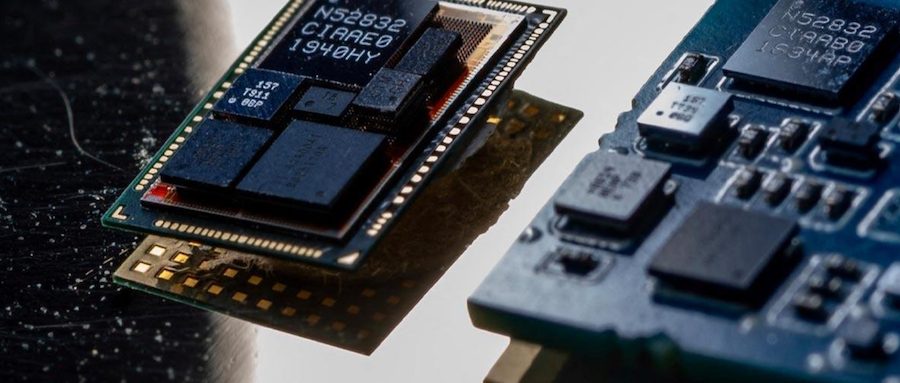
美国芯片创企拟融资6亿,另辟赛道对标英伟达、AMD
智东西 编译 | 黄菲 编辑 | 江宇 智东西10月16日消息,据路透社报道,10月15日,美国芯片设计初创公司Bolt Graphics正寻求融资约1亿美元(约合人民币6.72亿元),该公司目前估值约为7亿美元(约合人民币47.04亿元)。 该公司计划开发能够与英伟达和AMD竞争的GPU,重点面向高性能计算、专业渲染和游戏图形等领域。 目前,本轮融资仍在进行中,Bolt Graphics首席执行官达尔维什·辛格(Darwesh Singh)拒绝透露具体融资金额和条款,但称融资进展顺利。 与英伟达、AMD持续加码AI芯片不同,Bolt Graphics试图通过差异化的产品路线寻找市场机会。该公
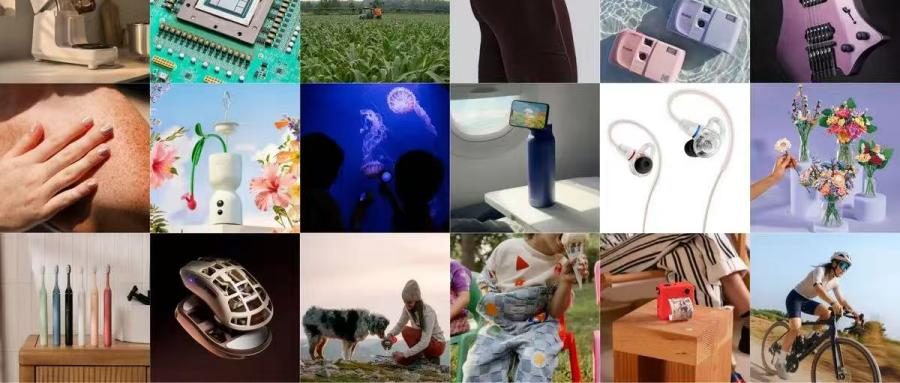
《时代》2026最佳发明揭晓:宇树领衔,联想荣耀TCL蚂蚁上榜,AI无处不在
智东西 编译 | 栗子 编辑 | 云鹏 智东西10月16日消息,《时代》周刊2026年度“最佳发明”榜单正式公布,共收录300项正式发明和100项特别提名。今年中国产品上榜数量明显增多,覆盖消费电子、机器人、健康AI和AI支付等多个赛道。 荣耀Robot Phone是2026年度唯一上榜的中国手机品牌;宇树科技GD01载人机甲与创始人王兴兴共同登上《时代》封面;蚂蚁阿福是今年唯一上榜的中国AI应用;支付宝AI支付是全球唯一上榜的支付服务;联想ThinkPad P1 Gen 9、TCL X11L、极壳Hypershell X Ultra S外骨骼也同步入选 与往年相比,今年榜单释放出两个清晰信号