This ER Doctor Became a Hospital’s First Clinical AI Engineer
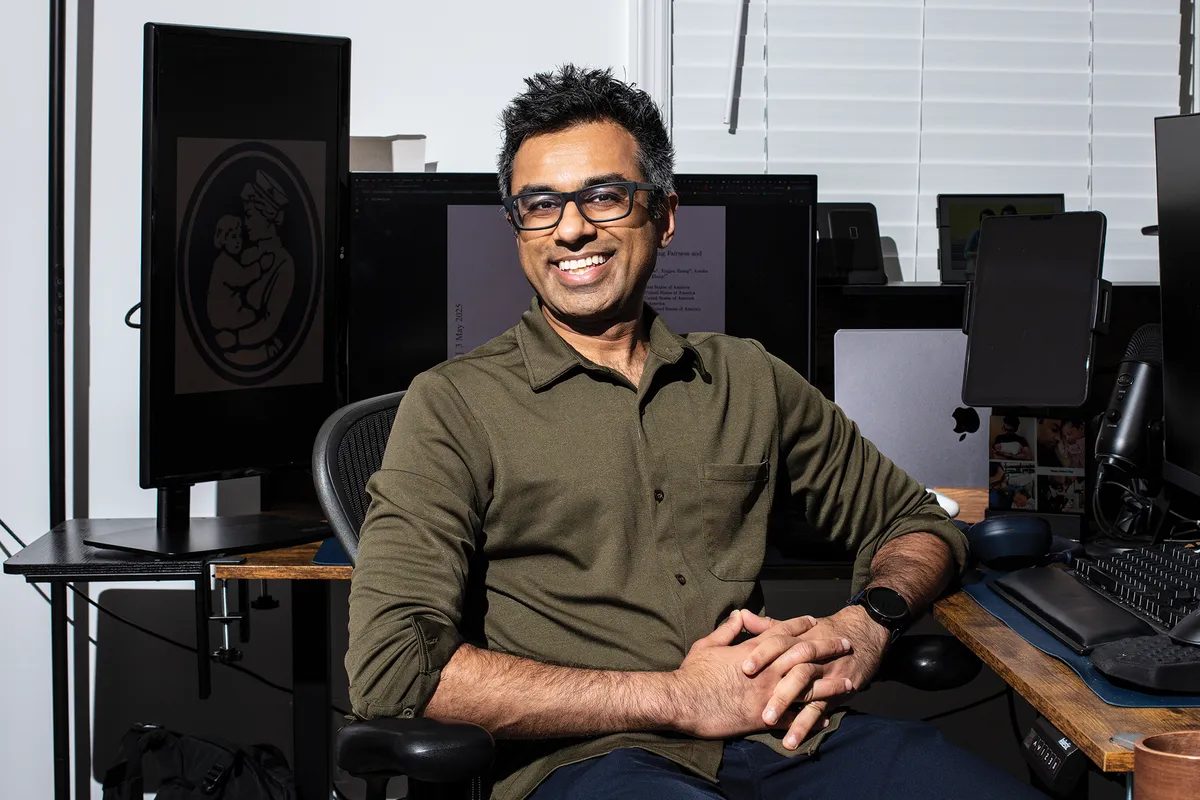
When Boston Children’s Hospital posted a job listing for a prompt engineer in 2023, Dinesh Rai decided to apply. He didn’t expect to get the job.
At the time, prompt engineering was being touted as one of the hot new jobs created by generative AI. Companies wanted people who knew how to coax the best answers from large language models (LLMs) by carefully wording instructions, supplying examples, and giving the systems personas or other context.
Dinesh Rai
Employer:
Boston Children’s Hospital
Occupation:
Clinical AI Engineer
Education:
Bachelor’s degree in supply-chain management and marketing sciences, Rutgers Business School; Doctor of Medicine, Albert Einstein College of Medicine
It was an unusual role for a hospital, but Rai had an unusual résumé. While he was trained as an emergency physician, he had also taught himself to code just before entering medical school. After completing a fellowship in clinical informatics—which focuses on the intersection of clinical practice and IT systems—he moved into health technology.
Boston Children’s brought him on board in August 2023. Three years later, Rai still works there. Prompt engineering, however, has become a much less important part of the job .
When he joined, the expectation was that prompting would become a job in itself. “Knowing how to prompt AI properly was going to be the job function of the future,” says John Brownstein , chief innovation officer at Boston Children’s.
Early on, the hospital needed internal expertise about how to begin using AI, Brownstein says. Now, better models have made elaborate prompting less important, so the harder work is building AI into actual health care systems—and determining whether its answers can be trusted. Brownstein says the questions they focus on these days have shifted: “How do you embed these tools in your day-to-day operations? How do you build agents to manage literally everything that you do?”
For Rai, that has meant embracing a job broader than the role that brought him to Boston. “I’m more like a clinical AI engineer now,” he says.
Between medicine and engineering
Rai originally studied business as an undergraduate and began teaching himself to code in 2014 (the same year he entered medical school), as neural networks and image recognition were starting to attract wider attention. He kept building software while training as a doctor. In medical school, for instance, he created a platform called Academius for students to track residency interviews and assemble their rank lists.
For Rai, the appeal of coding was its scale. In emergency medicine, he could make a direct difference for the individual patient in front of him. Software offered the possibility of building something that thousands of clinicians might use for many more patients.
His 2021–22 informatics fellowship made the possibility of doing that full-time feel real. In 2022, Rai took a job at Pieces , a health care AI company, where he led work to bring LLM-based medical summarization into clinical use.
That meant taking a break from practicing medicine altogether. “Stepping away was definitely a hard decision,” Rai says. But he wanted to give the technology work his full attention. He has since reactivated his medical license and hopes to return to clinical practice in some capacity within the next year.
At Boston Children’s, roughly half his day now looks like an engineer’s: working with developers, writing code, and advancing projects from the technical side. The other half is spent with clinicians, figuring out what they actually need. That combination has become the point of the job.
Uncovering “clinical doppelgangers”
One project, called clinical doppelgangers , is designed to help doctors treating complicated patients find similar cases buried in the hospital’s historical data. Medical guidelines are generally based on large populations, but at a hospital that handles rare and complex diseases, an individual child may not fit neatly into the populations represented in published studies.
The system is being developed to let clinicians identify previous patients with relevant similarities, examine their trajectories, and see how different interventions turned out. It is not meant to replace randomized clinical trials. Instead, it could provide another source of evidence when a physician is facing a case for which the published literature offers little guidance.
Projects like that require more than knowing how to ask an LLM the right question. They require understanding what hospital data means, how a clinician will use an answer, and how an AI system can go wrong.
Rai recently encountered some of those challenges while working on another project with a clinical team and a development team. They were deciding how much of a patient’s medical record to give an AI model when asking it to identify findings relevant to a particular clinical outcome.
Better models have made elaborate prompting less important, so the harder work is building AI into actual health care systems.
Both groups initially favored giving the model access to more information, but for different reasons. The developers assumed any data point could be useful. The clinicians assumed the model would recognize irrelevant findings and ignore them.
Rai saw a problem with both assumptions. Clinically, an abnormal lab result or vital sign is not necessarily relevant to the question being asked. And from a technical perspective, an LLM cannot be counted on to recognize that irrelevance. If the system asks the model whether a given abnormality matters, it may construct a plausible explanation for why it does, even when the record does not support the connection.
“That’s where the dual perspective has been valuable,” Rai says, “not just translating between teams, but recognizing when an approach that looks reasonable from either perspective rests on assumptions we shouldn’t make.”
After the prompt
In medicine, the challenges surrounding…
Les actualités sont collectées automatiquement depuis des flux publics robotique & IA.
Articles liés
人形机器人开发者集合!众擎开放大小脑,10亿产业级生态支持计划也来了
一支团队在真机上验证的成果,可以成为下一支团队继续开发的起点。
全国首批首家!商汤大装置获Token工厂智算能力最高评级
商汤大装置Token工厂获得中国信通院Token工厂智算能力评估“全栈服务型·领先级”评级认证
韦东奕再获大奖!攻克近140年数学难题,获两位院士共同提名
淡泊名利,实至名归🎉
DeepSeek APP突然更新账单,网友:要收费了?
网页App双端亮出聊天账单
刚刚,首个带跨任务空间记忆的原生基模开源!机器人端侧就能跑
地图能随时修,记忆能跨任务用
A New Breed of Chip Runs AI Models Using Waves of Light
German company Q.ANT is trying to cut the amount of energy required to run AI models by using light to perform the toughest calculations.