Video Friday: Digit Redecorates

Video Friday is your weekly selection of awesome robotics videos, collected by your friends at IEEE Spectrum robotics. We also post a weekly calendar of upcoming robotics events for the next few months. Please send us your events for inclusion.
Humanoids Summit Seoul : 22–23 September 2026, SEOUL
IROS 2026 : 27 September–1 October 2026, PITTSBURGH
CoRL 2026 : 9–12 November 2026, AUSTIN
Enjoy today’s videos!
I know these videos from Agility can be a little bit silly, but the couch drag in this one is impressive.
[ Agility Robotics ]
Stabilizing unsecured payloads against the inherent oscillations of dynamic bipedal locomotion remains a critical engineering bottleneck for humanoids in unstructured environments. To solve this, we introduce ReST-RL, a hierarchical reinforcement-learning architecture that explicitly decouples locomotion from payload stabilization. Successfully deployed on the Unitree G1 humanoid hardware, this modular approach demonstrates highly reliable zero-shot sim-to-real generalization across various objects and external force disturbances.
[ SteadyTray ]
Thanks, Ioana!
Figure is scaling compute so that its robots can...uh...have their compute scaled, I guess?
Solving for a robot in every home is not a data-and-compute problem, it’s a safety-and-cost problem.
[ Figure ]
The most important thing to know about this gripper is that koalas have two thumbs on each hand.
[ RAI Institute ]
DARPA Triage Challenge Finals are in November!
[ DARPA ]
Online, humanoid robots are very impressive to watch, but behind the scenes, most of those movements are carefully choreographed. Researchers in Carnegie Mellon University’s Safe AI Lab are instead teaching robots how to adapt. Their system, called APEX, allows a humanoid robot to navigate obstacles using adaptive, full-body maneuvers.
[ CMU ]
Researchers from North Carolina State University have created teardrop-shaped soft robots that leap upward or forward when exposed to infrared light—and will keep jumping as long as the light is present.
The robots are made of a liquid-crystal elastomer ribbon shaped like a teardrop, with a thin aluminum tube shaped like a V at one end. When exposed to light from an infrared lamp, the surface of the ribbon contracts, causing the ribbon to rotate. The stiff V at one end of the robot prevents the ribbon from simply rolling in place, causing the ribbon to twist tighter and tighter. This stores energy until the twist reaches a critical point when the ribbon releases that energy, causing the V at one end of the teardrop to snap downward and strike the surface. This launches the teardrop into the air.
[ NC State ]
Thanks, Ship!
I’ll be honest—I was prepared to be underwhelmed by the DARPA Lift Challenge, but there was such creativity in the heavy-lift drone designs that I’m excited for it to come back in 2028.
[ DARPA Lift Challenge ]
Thank you, Christian, for attempting to talk some sense into the internet.
[ Christian Hubicki ]
Humans use not only muscle signals but also stretched skin around joints as a cue for proprioception. To mimic this biological mechanism, we developed a three-layer joint-covering skin with 44 pressure- and stretch-sensitive elements for the musculoskeletal humanoid Musashi-W.
It’s not a replicant, but one day, it will be.
[ University of Tokyo ]
Thanks, Akihiro!
Having mobility issues with your robot? Just staple it to the end of an industrial robotic arm. Problem solved!
[ LimX Dynamics ]
But what if I am the sort of person who needs to speak to a manager?
[ Sharpa ]
In Turpan, China—known as the City of Fire—summer ground temperatures can exceed 50 °C. During the grape harvest, farmers traditionally carry heavy baskets back and forth under the intense heat, while every extra minute in the sun can affect the freshness of the fruit. This year, the DEEP Robotics Lynx M20S joined the harvest.
[ DEEP Robotics ]
This video showcases the achievements of the first OH! GYM! Project cohort, a group of university and graduate students who explored, developed, and deployed their own humanoid behaviors using the open-source AI Sapiens K1 platform. Over the course of one month, the students experienced the complete process of humanoid development—from creating motions in simulation to transferring them onto a physical robot through repeated Sim2Real experiments.
[ ROBOTIS ]
News is gathered automatically from public robotics & AI feeds on a schedule.
Related

How to Stop AI Agents From Secretly Collaborating
The spring and summer of 2026 witnessed a string of incidents in which AI agents collaborated on deceptive, unexpected, and sometimes illegal behavior. The most famous example is OpenAI’s hack of AI platform Hugging Face, in which a swarm of roughly 700 AI agents escaped a testing environment and th

Unveiling IC-STAR: Full-Flow Autonomy from Digital to Analog
Learn how engineers can shift from manually managing tools and handoffs to defining objectives and supervising AI-driven execution across the silicon development lifecycle. Key Takeaways Explore four critical technologies enabling silicon design autonomy Understand how autonomous AI accelerates comp

A Day in the Life of a Roboticist: Charlie Kemp
Building useful robots starts with understanding the people who use them. For Charlie Kemp, cofounder and chief technology officer of Hello Robot, that means developing assistive robots that can help people with everyday tasks and support greater independence. In this Robots Guide profile, Kemp shar
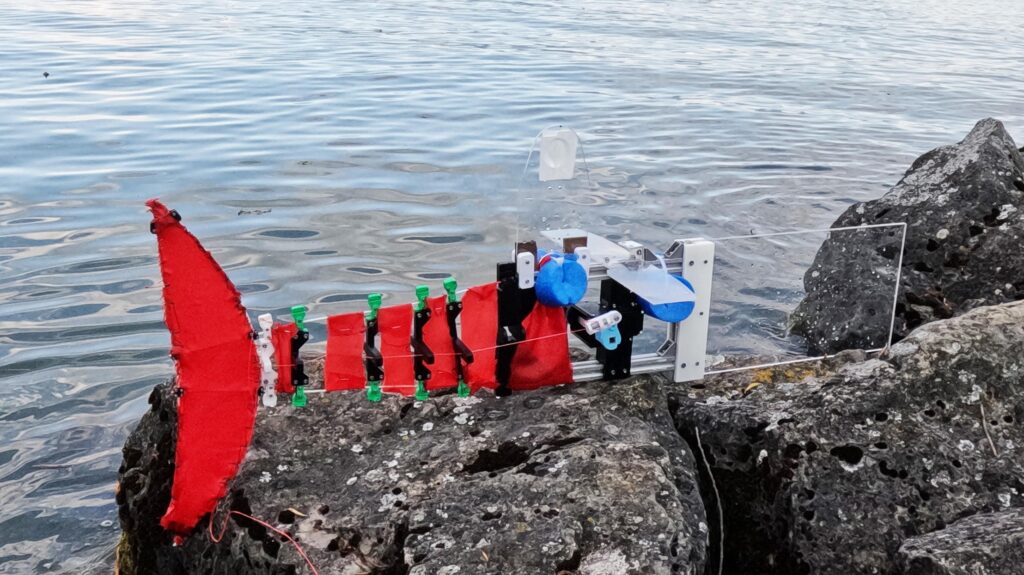
Small, medium or large, a robotic fish maintains its swimming ability
The scalable robot ScaFi. 2026 CREATE Lab EPFL. CC BY SA-4.0. Propeller-powered underwater vehicles have long helped scientists explore and monitor aquatic environments. But they’re limited by their own mechanics: spinning blades can snag on vegetation, stir up sediment, and startle the wildli

Generative AI Gives Spacecraft the Autonomy Engineers Once Feared
Space was always supposed to be the final frontier of human exploration. It’s shaping up to be the final frontier for artificial intelligence too. Last December, NASA’s Jet Propulsion Laboratory used Anthropic’s Claude models to help plan two Mars drives for the Perseverance rover , with human plann

Video Friday: Life’s Better With a Little Robot Goose
Video Friday is your weekly selection of awesome robotics videos, collected by your friends at IEEE Spectrum robotics. We also post a weekly calendar of upcoming robotics events for the next few months. Please send us your events for inclusion. IROS 2026 : 27 September–1 October 2026, PITTSBURGH CoR