The Best Way to Explore Lunar Craters Is a Giant Robot Ball

On a good day, the rock quarry in central Texas is about 370,000 kilometers (230,000 miles) from the moon. But last February, when Rishi Jangale watched his 1.8-meter-wide, 150-kilogram inflatable robot roll effortlessly over rocks, gravel, and wet clay, his imagination turned the quarry into the lunar surface instead.
Jangale is an upbeat mechanical engineer nearing the end of his Ph.D. at Texas A&M University, in College Station, Texas. He and his labmates have been working on this big tan “RoboBall” for about five years. Their goal: create a vehicle capable of exploring some of the most inaccessible terrain in our solar system, such as the 21 km-wide Shackleton crater on the moon’s south pole.
The Shackleton crater is 4 km deep and contains many smaller, deeper craters within. Some parts of the crater never see the sun, and within these perpetually dark, frigid pockets lie mysterious substances that planetary scientists have long struggled to examine, including layers of ancient lunar geology and stores of frozen water that could potentially support a future lunar base.
“The moon is like an archive of what happened to the Earth,” says Sara Russell , a cosmic mineralogist with London’s Natural History Museum who is not involved with Texas A&M’s work. “Robotic collection works brilliantly well, and it’s great to see that being explored more in this context.”
“NASA is not going to let astronauts get anywhere near these craters, because if someone falls in, you’re not going to be able to get them out,” Jangale says. “So we thought, what better shape to roll down a hill than a ball?” In a recent paper published in IEEE Transactions on Field Robotics , Jangale’s team reports on the design of RoboBall, a hypothetical lunar mission, and the results from initial tests in the Texas quarry.
Getting Rolling
RoboBall is the brainchild of Jangale’s advisor, former NASA robotics engineer Robert Ambrose , who first conceived of the design in 2003.
Ambrose figured that a ball could address a pesky mobility risk that robots face on lunar terrain, especially in low gravity: tipping over . An inflatable sphere can’t tip over, and the form factor also insulates its internal components from sharp rocks, dust, and the huge temperature swings from over 93 °C in sunlit spots to minus 240 °C in the shade inside lunar craters. Ambrose imagined a wheeled rover parking at a crater’s edge and releasing a RoboBall to explore its depths. Unlike a small tethered rover , the RoboBall wouldn’t roll its way back up—but with no strings attached, it would have a far greater range to collect geological samples, and then be able to launch them back to the rover outside the crater with small rockets.
A robotic rover would ferry RoboBall across the lunar surface to the edge of a crater. R. Jangale, D. Pravecek, et al.
NASA hasn’t brought lunar samples back to Earth in over 50 years. Some morsels of moon geology find their way to Earth as meteorites, but Russell says these lack the “gold standard” field work—context about where that sample actually came from. Even as NASA reboots its crewed moon missions, many lunar sites remain inaccessible.
In 2022, Ambrose’s lab finished a proof of concept, the 0.5-meter-wide RoboBall II. Creating the full-size RoboBall III then took about 11 months. “We were building these robots really quickly,” Jangale says. “Ambrose really encourages us to use and break these robots.” And designs did go awry. Jangale remembers software errors and a drivetrain that proved too weak to roll over soft bumps in initial tests.
Texas A&M RAD Lab/YouTube
How to Slow Your Roll
RoboBall drives by moving a pendulum within its shell, shifting its entire center of mass. On flat ground, if the pendulum’s arm points forward, the shell rolls forward to compensate, and as long as the pendulum keeps the center of mass in front of the center of the ball, RoboBall will keep rolling forward. If the pendulum leans a few degrees to the left or right, RoboBall steers left or right to match. “The robot wants to go where you point the pendulum,” Jangale says. The 340-pound ball is just soft enough to bounce lightly over bumpy obstacles, but its slight overpressure keeps it relatively firm. On steep slopes, this mechanism also lets the ball control its downhill speed by simply angling the pendulum uphill.
“The beauty here is the simplicity,” says Hiro Ono, an aerospace engineer who worked on robot mobility at NASA’s Jet Propulsion Lab for 13 years before joining Georgia Tech. For space robots, Ono describes simplicity in terms of the number of actuators. RoboBall has just two, and both are fully inside of the shell, shielded from environmental risk factors like dust, a feature that Ono describes as “unique.”
After the first quarry tests, it took about seven months for the team to design and build an upgraded RoboBall III with 2.5 times more torque—enough to fling itself over small obstacles and roll up 20 degree slopes.
A small rocket can launch out of the center of the RoboBall to return a sample back to a rover outside the crater. R. Jangale, D. Pravecek, et al.
Getting Mission Ready
In the new paper, the remotely operated RoboBall III descended the quarry’s slopes, navigated soft terrain, and launched hypothetical payloads back out of the crater with small rockets. Powered by a large battery, the robot would inflate itself during a lunar mission and charge up from a robotic rover at the edge of a crater before heading out on its own.
RoboBall is probably not the right platform for all kinds of missions—its slightly bumbling nature means that it’s not ideal if you want to collect a sample from a very specific rock, for example. For now, the team hopes to work with scientists designing lunar science instruments to physically fit into RoboBall’s carry-on-luggage-size interior, while also fitting in with how RoboBall operates. “The robot is not the mission,” Jangale says. “The robot is a way for you to complete…
News is gathered automatically from public robotics & AI feeds on a schedule.
Related

How to Stop AI Agents From Secretly Collaborating
The spring and summer of 2026 witnessed a string of incidents in which AI agents collaborated on deceptive, unexpected, and sometimes illegal behavior. The most famous example is OpenAI’s hack of AI platform Hugging Face, in which a swarm of roughly 700 AI agents escaped a testing environment and th

Unveiling IC-STAR: Full-Flow Autonomy from Digital to Analog
Learn how engineers can shift from manually managing tools and handoffs to defining objectives and supervising AI-driven execution across the silicon development lifecycle. Key Takeaways Explore four critical technologies enabling silicon design autonomy Understand how autonomous AI accelerates comp

A Day in the Life of a Roboticist: Charlie Kemp
Building useful robots starts with understanding the people who use them. For Charlie Kemp, cofounder and chief technology officer of Hello Robot, that means developing assistive robots that can help people with everyday tasks and support greater independence. In this Robots Guide profile, Kemp shar
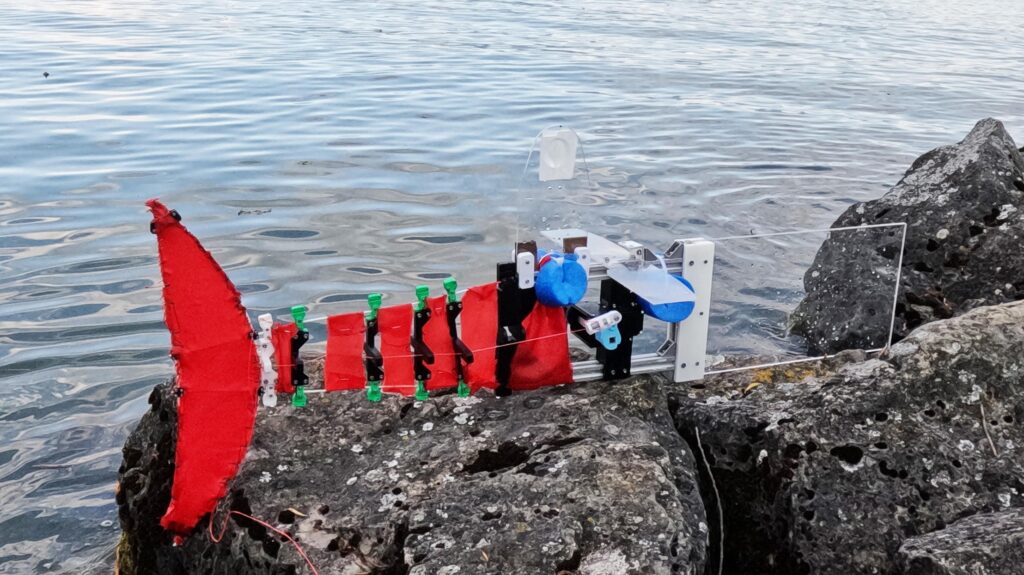
Small, medium or large, a robotic fish maintains its swimming ability
The scalable robot ScaFi. 2026 CREATE Lab EPFL. CC BY SA-4.0. Propeller-powered underwater vehicles have long helped scientists explore and monitor aquatic environments. But they’re limited by their own mechanics: spinning blades can snag on vegetation, stir up sediment, and startle the wildli

Generative AI Gives Spacecraft the Autonomy Engineers Once Feared
Space was always supposed to be the final frontier of human exploration. It’s shaping up to be the final frontier for artificial intelligence too. Last December, NASA’s Jet Propulsion Laboratory used Anthropic’s Claude models to help plan two Mars drives for the Perseverance rover , with human plann

Video Friday: Life’s Better With a Little Robot Goose
Video Friday is your weekly selection of awesome robotics videos, collected by your friends at IEEE Spectrum robotics. We also post a weekly calendar of upcoming robotics events for the next few months. Please send us your events for inclusion. IROS 2026 : 27 September–1 October 2026, PITTSBURGH CoR