Exploring the Moon will require rovers that can think for themselves – an upcoming NASA mission will test whether they can

By Wanjiku Chebet Kanjumba , University of Florida
NASA is planning to send three small rovers to the Moon with a single instruction: Work out among yourselves how to explore a patch of ground.
The Cooperative Autonomous Distributed Robotic Exploration mission, or CADRE, will land on the side of the Moon facing Earth as part of NASA’s IM-3 launch , planned for late 2026. These rovers will spend roughly two weeks mapping the terrain as a self-guided team. No joystick will control them, and no human will approve each turn.
Engineers test whether the CADRE rovers can drive and coordinate on their own at NASA’s Jet Propulsion Laboratory in Pasadena, Calif. NASA/JPL-Caltech .
The rovers will elect a leader among themselves, assign their own tasks and redraw their plans as a group when one of them runs low on charge. If it succeeds, CADRE will be the first time NASA has operated multiple rovers beyond Earth as a single autonomous system.
That achievement will matter well beyond this mission, because NASA is scoping out future missions to the lunar South Pole , where water in the form of ice sits locked in craters that haven’t seen sunlight in billions of years. If researchers can chemically split that ice apart and turn it into propellant and breathable air, it could become the feedstock for a lunar economy built around fuel depots and life support made on the Moon.
Right now, the only demand for that ice comes from government contracts. And an operation that must be babysat from 239,000 miles (384,000 kilometers) away will not easily scale into a market. So, while a full-blown lunar economy is still far off, CADRE is testing whether robots can work unsupervised long enough, and in enough numbers, to keep a lunar operation running month after month.
I’m an aerospace engineering Ph.D. candidate researching guidance, navigation and control for spacecraft in-orbit servicing and active debris removal. I work on the same problem these rovers face: how a machine decides what to do next when it cannot call home for instructions.
Why Earth cannot drive
At the Moon’s South Pole, the terrain itself can cause communication disruptions. Commands reach a rover by way of relay satellites, and crater rims can block the line of sight to those relays. A rover that ventures down into a shadowed crater may lose contact for its entire trip.
Spotty communication doesn’t just make trying to drive annoying. It can cost the rover power it cannot recover.
A polar rover runs on a finite illumination budget . Solar panels charge the battery only while the Sun is up, and on the Moon sunrise is not a daily event. Night lasts about two Earth weeks , and at the poles, only a few ridges stay lit for long stretches. So for every minute a rover spends idle, awaiting new instructions, it is spending stored energy it cannot replace until the Sun comes back.
In the top image, a rover’s stored energy climbs while it charges in sunlight, then falls at the same rate whether it is working or waiting idly. In the bottom image, the gray bands are communication blackouts. A team waiting on commands from Earth stops until the link returns, while an autonomous team keeps assigning itself work, and the gap that opens between the two lines is work recovered from what would otherwise be dead time. Credit: Wanjiku Chebet Kanjumba.
Why the pole is the hard case
The lunar poles also come with unique challenges. Sunlight can swing from direct glare to absolute shadow as a rover drives down from a sunlit crater rim to the shadowed floor below, so a camera that worked at the top could go blind at the bottom.
The Moon also doesn’t have GPS satellites like Earth does, so rovers can’t know exactly where they are. They need to build their own maps from what their cameras and sensors see.
Temperatures inside permanently shadowed regions drop below minus 274 degrees Fahrenheit (minus 170 degrees Celsius). And the Moon’s dust is more dangerous than it sounds. An electric charge lifts it off the ground, and billions of years of tiny meteorite strikes have left every grain sharp and jagged .
That dust grinds at the wheel bearings and works past the seals. Keeping it out of the rover’s moving parts is still an unsolved problem . The dust can also film over the camera lenses that navigation depends on, leaving a rover unable to see where it is going or move safely.
Why one rover is not enough
Sending a single rover to check out a crater on the Moon is a risky mission. If it gets stuck, the campaign ends. If its instruments fail, no second machine can take the measurements. Multirobot teams distribute that risk and split up the jobs. One rover might carry the sensors and another the drill, while a lander positioned on a sunlit ridge acts as the power and communications hub.
Under a communications blackout, a rover team that waits for its commands from Earth has to stop. An autonomous team reassigns tasks among itself, selecting the next objective that it can reach and complete with the amount of power it has left. Dead time becomes work time.
In ground testing at NASA’s Jet Propulsion Laboratory, the CADRE rovers achieved this coordination. Faced with unexpected obstacles, they replanned paths as a group, and when one rover’s battery ran low, the whole team paused so they could continue together .
A prospecting team splits the work. A lander on the sunlit rim supplies power and relays communications, while a rover and a drill work the permanently shadowed crater floor below, where water ice may be trapped and no sunlight reaches. Once they drop past the rim’s radio horizon, they are out of contact and have to divide the tasks and manage their own power. Credit: Wanjiku Chebet Kanjumba.
What remains uncertain
A campaign at the lunar South Pole would need to run for months, and no robot team has yet worked that hard, for that long, that far from help. Engineers are developing ways for rovers to navigate without satellite positioning and…
News is gathered automatically from public robotics & AI feeds on a schedule.
Related
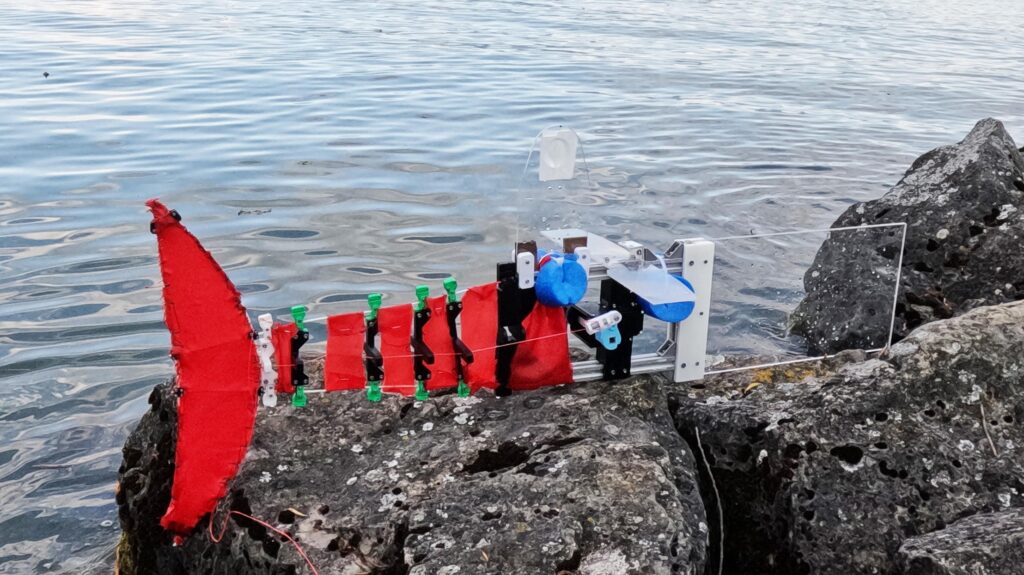
Small, medium or large, a robotic fish maintains its swimming ability
The scalable robot ScaFi. 2026 CREATE Lab EPFL. CC BY SA-4.0. Propeller-powered underwater vehicles have long helped scientists explore and monitor aquatic environments. But they’re limited by their own mechanics: spinning blades can snag on vegetation, stir up sediment, and startle the wildli

Video Friday: Life’s Better With a Little Robot Goose
Video Friday is your weekly selection of awesome robotics videos, collected by your friends at IEEE Spectrum robotics. We also post a weekly calendar of upcoming robotics events for the next few months. Please send us your events for inclusion. IROS 2026 : 27 September–1 October 2026, PITTSBURGH CoR

Robot Talk Episode 163 – Robots helping people, with Aaron Edsinger
Claire chatted to Aaron Edsinger from Hello Robot about their Stretch robots that can help people with mobility issues live more independently. Aaron Edsinger is CEO and Co-Founder of Hello Robot, a robotics company dedicated to developing practical, safe, and accessible robots for people. With a pa
An open source approach to physical AI from Intrinsic
Deborah Lupton / Pop Chips / Licenced by CC-BY 4.0 Intrinsic (an AI robotics group at Google) announced that the company is making parts of its platform open source. Intrinsic Core™ is a set of ROS-compatible capabilities for building sophisticated robotic applications. The capabilities included in

Mexican EPICS in IEEE Team Builds Portable Educational Platform
In Guadalajara, Mexico, many high schools have motivated teachers and talented students with an interest in science, technology, engineering, and mathematics, but they lack access to advanced tools such as robotics laboratories. The resources shortfall limits the students’ opportunities for hands-on

What’s coming up at #IROS2026?
The 2026 IEEE/RSJ International Conference on Intelligent Robots and Systems (IROS 2026) will be held from 27 September – 1 October in Pittsburgh, USA. The programme includes plenary and keynote talks, workshops, tutorials, forums, competitions, and a debate. Keynote talks The keynote talks wi