How green is your robot? And other awkward questions

Deborah Lupton / Servers in a Landscape / Licenced by CC-BY 4.0
By Emmet Cole
Robots clean rivers and sort waste , monitor ecosystems , and inspect renewable-energy infrastructure . But even the greenest robot has an environmental footprint.
If robotics is going to help build a more sustainable world, the robotics community has to answer some potentially awkward questions, starting with this one: How sustainable are robots themselves?
Across a full lifecycle, from rare earth mineral extraction and manufacturing to operation and end-of-life, robots have an environmental impact. But the robotics community has, until now, lacked dedicated tools for calculating it.
The Robotics Eco-Label project, led by Bram Vanderborght at Belgium’s Vrije Universiteit Brussel, is an attempt to address that gap with a lightweight, web-based Toolkit that provides roboticists with a way to quantify robot sustainability.
Separating a robot’s core technologies into materials, energy sources, sensors, processors, actuators, design, and recyclability, the Robotics Eco-Label Toolkit then evaluates each based on five metrics : resource conservation, lifecycle extension, carbon footprint, energy efficiency, and circularity. The numbers are combined in a weighted matrix to yield a 0–100 Eco-Score for Robots. The weights used are not currently fixed; that will be one of the targets of further research and collaboration. (For an indicative score on your robot, try the project’s interactive self-assessment tool here .)
A low score in one area might point to energy-hungry actuators, limited repairability, hard-to-recycle materials, or a lack of end-of-life planning. A higher score, by contrast, suggests that sustainability has been considered across the system. One of the project’s stated goals is to make environmental trade-offs visible early enough in the development process to shape sustainable robot design choices.
The project also includes educational content and community features so researchers and developers can compare approaches, share case studies, and turn broad sustainability goals into improved design decisions. For companies, Eco-Label could well turn out to be a way to achieve competitive advantage, while it could also help buyers make more informed decisions.
Robotics Eco-Label is just one of the IEEE RAS Sustainability Grant-funded projects showcased at ICRA in June. The grants are a key component of IEEE RAS’ broader effort to make sustainability a more visible part of robotics research, education, design, and deployment.
Are you buying more robot than you need?
Sometimes, sustainable robotics starts with better purchasing decisions. This includes avoiding overspecification; that is, buying robots that are larger or more capable than necessary.
Matching robots to their intended workload can reduce unused capacity, avoid unnecessary material use, and cut wasted energy over a robot’s life cycle.
That principle underpins the work of an IEEE RAS-funded team, led by Antun Skuric , that has developed an open-source platform for assessing the sustainability of collaborative robots.
To use it, you define a required workspace, payload, and trajectory, and the platform identifies the minimum-mass robot that satisfies your application requirements.
The application features interactive tools that enable users to visualize and jog the robot, inspect task-related variables and requirements, view the reachable space, and observe important robot configurations. This enables robot performance to be calculated based on specific task conditions and requirements.
Can robots really help communities overcome energy poverty?
Energy poverty and inefficient solar energy utilization are major challenges in Nigeria, where more than 90 million people lack reliable electricity access.
The SolarPeer 360 project, led by Umar Adetola Abdulganiyy , a student at the Federal University of Technology, Minna, Nigeria, takes on this challenge through a combination of robotic solar tracking, AI-assisted optimization, and peer-to-peer energy distribution.
A timely reminder that robots can help support sustainability goals directly, SolarPeer addresses two connected problems, inefficient small solar installations and the lack of transparent, affordable mechanisms for sharing surplus renewable energy among households and small businesses.
According to the team, SolarPeer 360 is built on a sustainability logic in which “energy captured more efficiently can be shared more fairly, and energy shared more transparently can create local economic value while reducing waste and fossil-fuel dependence.”
SolarPeer links smart solar capture through tracking, controlled and metered distribution through embedded electronics, and behavior optimization through data, interfaces, and AI guidance.
Early results indicate meaningful gains: The team reported a 60.3 percent gain in average power in one tracked-versus-fixed solar comparison, with measured average power rising from 3.83 W to 6.14 W. Meanwhile, AI-guided energy advisory and optimization contributed to a ~25 percent reduction in energy wastage in the testing environment.
Beyond the lab, the team deployed five community mini-systems and ran a solar training and empowerment workshop that reached more than 500 students.
Can Caretta work faster?
Sustainability in robotics is not just a technical challenge. It’s also a cultural and educational challenge for the next generation of engineers, researchers, teachers, and users.
That’s part of the reasoning behind the ‘Caretta’ project, led by Mustafa Kemal Ambar , which brought robotics and sustainability education to students aged 8 to 16 on the island of Cyprus.
Inspired by the Caretta sea turtle, the project produced a functional robot prototype designed to reduce coastal pollution. Two successful coastal clean-up events were held and more than 30 students were engaged in the project through seminars and hands-on learning.…
News is gathered automatically from public robotics & AI feeds on a schedule.
Related
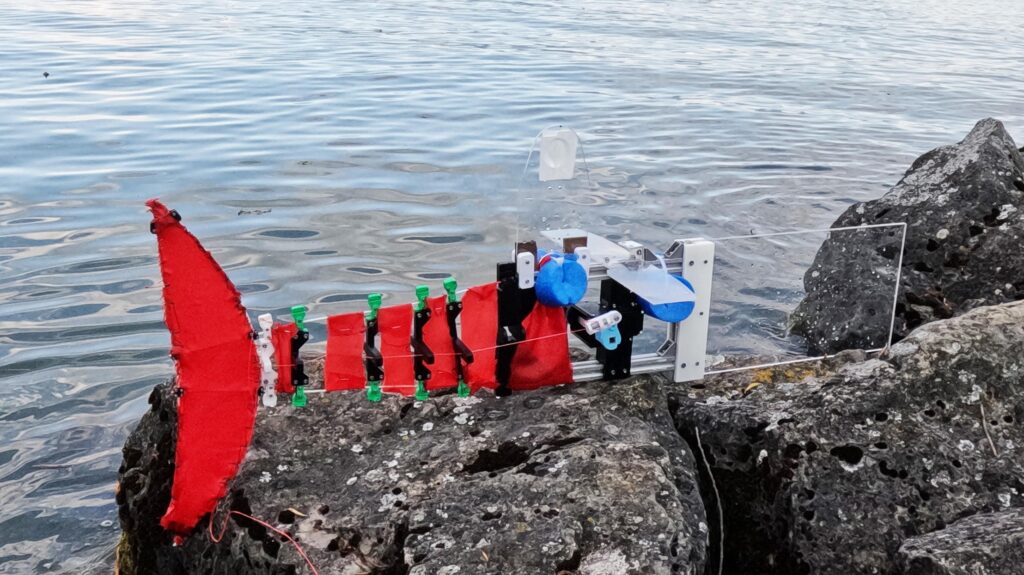
Small, medium or large, a robotic fish maintains its swimming ability
The scalable robot ScaFi. 2026 CREATE Lab EPFL. CC BY SA-4.0. Propeller-powered underwater vehicles have long helped scientists explore and monitor aquatic environments. But they’re limited by their own mechanics: spinning blades can snag on vegetation, stir up sediment, and startle the wildli

Video Friday: Life’s Better With a Little Robot Goose
Video Friday is your weekly selection of awesome robotics videos, collected by your friends at IEEE Spectrum robotics. We also post a weekly calendar of upcoming robotics events for the next few months. Please send us your events for inclusion. IROS 2026 : 27 September–1 October 2026, PITTSBURGH CoR
Robot Talk Episode 163 – Robots helping people, with Aaron Edsinger
Claire chatted to Aaron Edsinger from Hello Robot about their Stretch robots that can help people with mobility issues live more independently. Aaron Edsinger is CEO and Co-Founder of Hello Robot, a robotics company dedicated to developing practical, safe, and accessible robots for people. With a pa
An open source approach to physical AI from Intrinsic
Deborah Lupton / Pop Chips / Licenced by CC-BY 4.0 Intrinsic (an AI robotics group at Google) announced that the company is making parts of its platform open source. Intrinsic Core™ is a set of ROS-compatible capabilities for building sophisticated robotic applications. The capabilities included in

Mexican EPICS in IEEE Team Builds Portable Educational Platform
In Guadalajara, Mexico, many high schools have motivated teachers and talented students with an interest in science, technology, engineering, and mathematics, but they lack access to advanced tools such as robotics laboratories. The resources shortfall limits the students’ opportunities for hands-on
What’s coming up at #IROS2026?
The 2026 IEEE/RSJ International Conference on Intelligent Robots and Systems (IROS 2026) will be held from 27 September – 1 October in Pittsburgh, USA. The programme includes plenary and keynote talks, workshops, tutorials, forums, competitions, and a debate. Keynote talks The keynote talks wi