Soft robotic heart offers new way to study disease and test life-saving devices
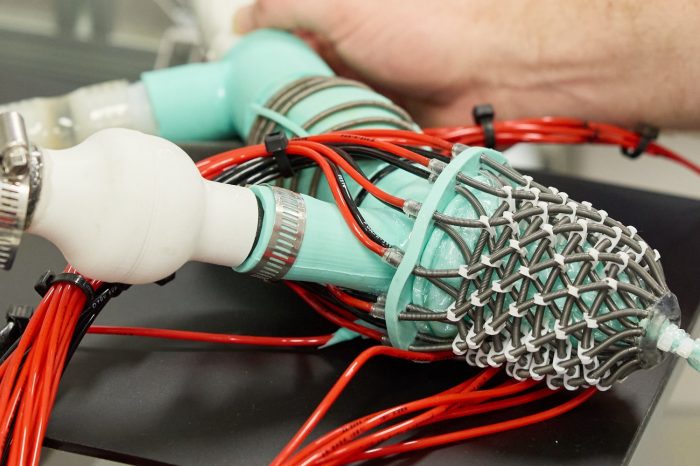
The soft robotic model of the human heart, developed at UNSW. Credit: UNSW/Richard Freeman.
UNSW researchers have developed a soft robotic model of the human heart that can mimic disease and provide a realistic environment for testing the next generation of cardiac devices.
Researchers at UNSW Sydney have developed a fully synthetic soft robotic heart that reproduces the complex movements and internal structures of the human heart, opening the door to better treatments, safer medical devices and more personalised care.
Published in Nature Communications and Advanced Science , the research introduces a beating model of the left side of the heart that includes artificial valves, papillary muscles and chordae tendineae – structures that are critical to healthy heart function and are frequently affected by disease.
The device is able to accurately reproduce the process in a real heart where cardiac valves leak and blood flows backwards, which increases the risk of heart failure and other life-threatening complications.
In that way, the research team say the new soft robot can eventually help provide a better understanding of heart conditions, reduce reliance on animal testing and provide doctors with patient-specific models to plan treatments before procedures are performed.
Team leader, Scientia Associate Professor Thanh Nho Do , from UNSW’s School of Biomedical Engineering and UNSW Medical Robotics Lab , says the work is important because cardiovascular disease remains the world’s leading cause of death.
“Heart failure with preserved ejection fraction (HFpEF) is a complex heart condition that often occurs alongside other health problems such as high blood pressure, irregular heartbeats, kidney disease, obesity, and diabetes,” Professor Do says.
“Because it affects people in different ways, developing medical devices to improve heart function is challenging.
“The valves in the heart are also crucial for cardiac efficiency, but disease can cause them to become leaky or stiff. This can increase the workload of the heart and contribute to heart failure.
“Our broader goal is to build realistic artificial heart models that can help researchers understand disease and develop safer, more effective devices before they are tested on animals or reach patients.”
Recreating the beating heart
The model developed at UNSW is a soft, flexible replica of the left side of the heart. Silicone membranes form the internal chambers, while soft robotic artificial muscles wrapped around the structure reproduce the way the heart naturally contracts and twists.
Unlike conventional laboratory models, the soft robotic heart contains the structures responsible for controlling the mitral valve, which in real life acts like a pair of swinging doors that open and close with each heartbeat to ensure oxygen-rich blood flows to the body while preventing backward leakage.
The inclusion of this specific physiological feature of the heart in the model will allow researchers to reproduce diseases in which the valve does leak and blood starts to flow backwards.
“The model is made from flexible materials and powered by artificial muscles that are arranged to mimic the layered muscle architecture of the human heart,” Dr James Davies, a postdoc in Do’s group, says.
“We found a way to model this muscle fibre architecture using soft robotic artificial muscle fibres. They are powered by hydraulic pressure which we control to make our ventricular muscle model move like the real thing.
“We then wrap this artificial musculature around silicone membranes which model the inner surface of the human left heart, forming our left heart, atrioventricular model. These membranes contain the simulated blood within the left heart allowing simulated pumping of blood in and out of the model.”
The system allows researchers to actively adjust the tension in the artificial papillary muscles that support the mitral valve.
By doing so, the team was able to recreate disease-like conditions including mitral valve prolapse and regurgitation, where blood leaks backwards instead of flowing efficiently through the heart.
Mimicking human heart disease
Using ultrasound imaging and measurements of pressure and blood flow, the researchers showed that the artificial heart behaves in ways remarkably similar to a human heart.
Healthy valve function produced normal pressure and flow patterns, while introducing disease caused characteristic changes seen in patients.
“In the first study reproducing the internal valving of the human heart, we were able to generate pressure and flow waveforms similar to that of the real thing,” Professor Do says.
“Critically, we were able to adjust mitral valve function by controlling papillary muscle length.
“We validated this using invasive pressure and flow measurements in and out of the heart, but we were also able to demonstrate compatibility of the model with non-invasive clinical measures of heart function such as ultrasound imaging, or echocardiography.
“Simulated healthy mitral valve function followed physiological expectations in heart pressure and flow, while inducing disease showed increased regurgitation, or backflow, and a decrease in outlet pressure and flow, also consistent with human heart valve disease.”
Scientia Professor Nigel Lovell , Head of School of Biomedical Engineering & Director of Tyree IHealthE, added: “The ultrasound imaging also resembled human cardiac imaging owing to the biomimetic form and function of our model. We were able to observe human-like valve leaflet motion and visualise blood flow across the valves, including the formation of regurgitant jets leaking out of valves with induced disease.”
The researchers also used the system to test a newly developed soft robotic cardiac catheter inside the beating model.
The catheter was able to navigate within the artificial heart and detect when it came into contact with moving cardiac structures, demonstrating how the…
News is gathered automatically from public robotics & AI feeds on a schedule.
Related
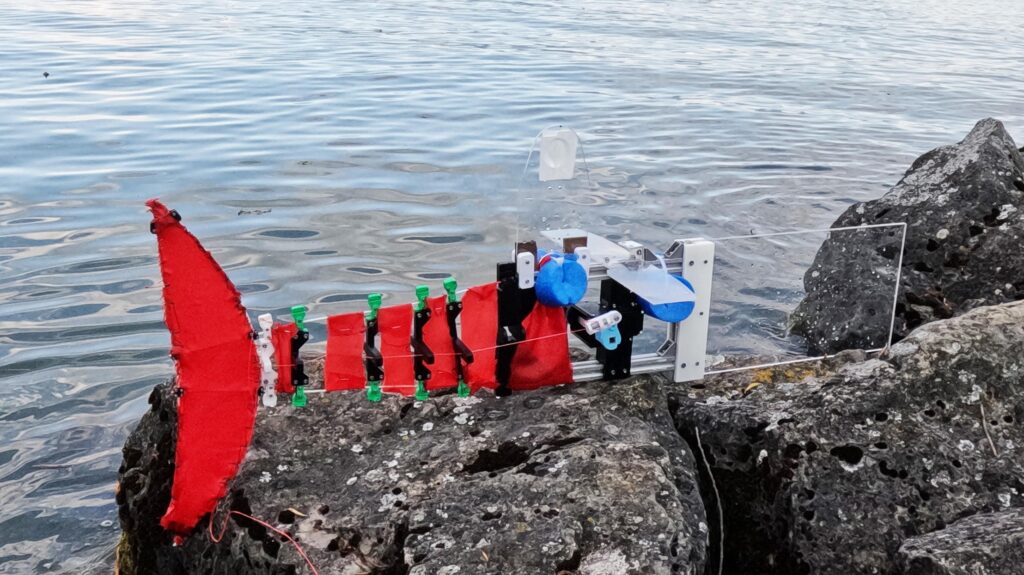
Small, medium or large, a robotic fish maintains its swimming ability
The scalable robot ScaFi. 2026 CREATE Lab EPFL. CC BY SA-4.0. Propeller-powered underwater vehicles have long helped scientists explore and monitor aquatic environments. But they’re limited by their own mechanics: spinning blades can snag on vegetation, stir up sediment, and startle the wildli

Video Friday: Life’s Better With a Little Robot Goose
Video Friday is your weekly selection of awesome robotics videos, collected by your friends at IEEE Spectrum robotics. We also post a weekly calendar of upcoming robotics events for the next few months. Please send us your events for inclusion. IROS 2026 : 27 September–1 October 2026, PITTSBURGH CoR

Robot Talk Episode 163 – Robots helping people, with Aaron Edsinger
Claire chatted to Aaron Edsinger from Hello Robot about their Stretch robots that can help people with mobility issues live more independently. Aaron Edsinger is CEO and Co-Founder of Hello Robot, a robotics company dedicated to developing practical, safe, and accessible robots for people. With a pa
An open source approach to physical AI from Intrinsic
Deborah Lupton / Pop Chips / Licenced by CC-BY 4.0 Intrinsic (an AI robotics group at Google) announced that the company is making parts of its platform open source. Intrinsic Core™ is a set of ROS-compatible capabilities for building sophisticated robotic applications. The capabilities included in

Mexican EPICS in IEEE Team Builds Portable Educational Platform
In Guadalajara, Mexico, many high schools have motivated teachers and talented students with an interest in science, technology, engineering, and mathematics, but they lack access to advanced tools such as robotics laboratories. The resources shortfall limits the students’ opportunities for hands-on

What’s coming up at #IROS2026?
The 2026 IEEE/RSJ International Conference on Intelligent Robots and Systems (IROS 2026) will be held from 27 September – 1 October in Pittsburgh, USA. The programme includes plenary and keynote talks, workshops, tutorials, forums, competitions, and a debate. Keynote talks The keynote talks wi