Can you trust Meta’s Muse or OpenAI’s Dots to run your life?
My Decoder guest today is Hayden Field, The Verge ’s senior AI reporter, and we’re discussing the new wave of consumer-friendly AI agents.
If you’ve been paying attention to this space, you know AI enthusiasts have been using agents for a minute now — homebrew OpenClaw setups led to a surge in Mac Mini sales earlier this year. But the launches of Meta’s Muse, OpenAI’s Dots, and xAI’s Grok Bot have brought easy-to-use agents to millions.
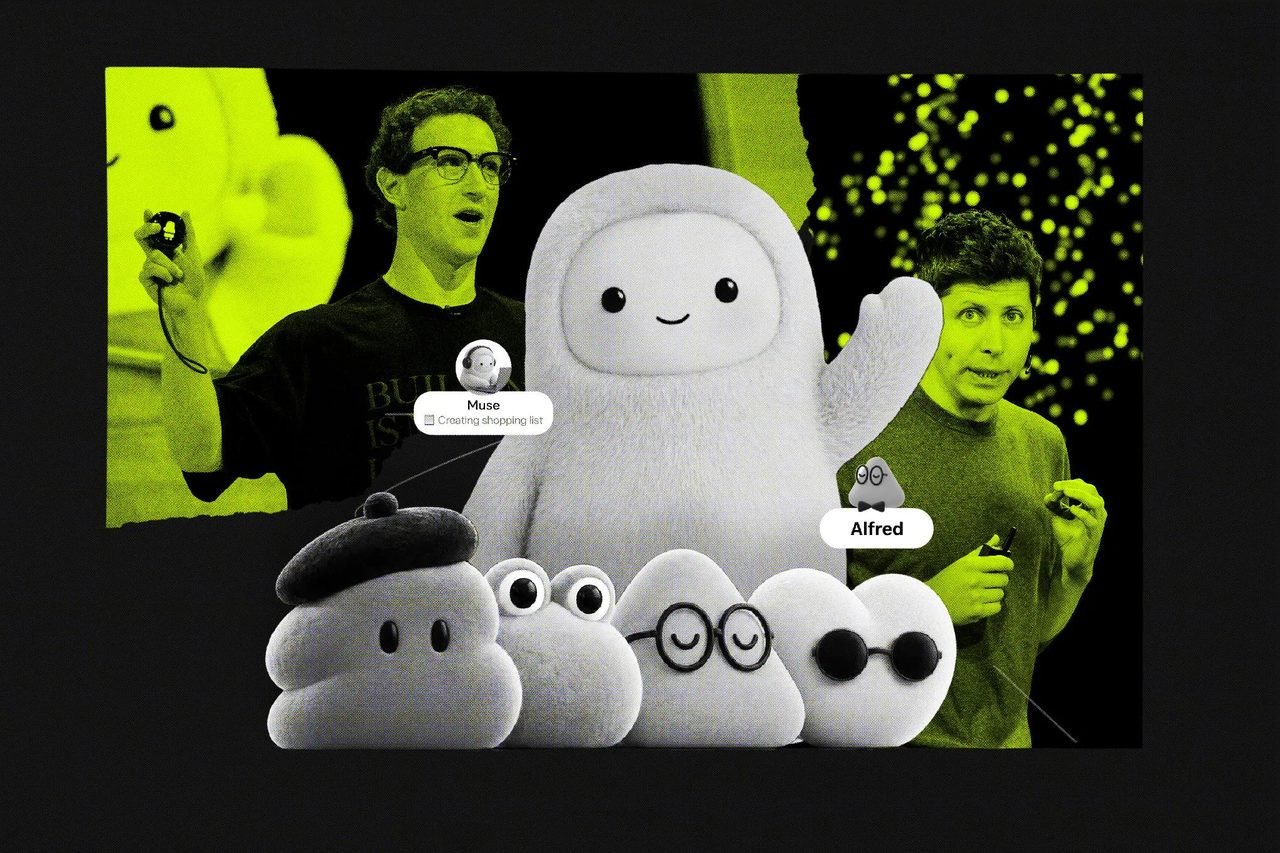
Muse and Dots have had the highest-profile product launches, and they’re fascinating to pit against each other. Both Meta and OpenAI have decided to pitch these agents to mainstream users and businesses in the form of cute animated mascots .
Verge subscribers, don’t forget you get exclusive access to ad-free Decoder wherever you get your podcasts. Head here . Not a subscriber? You can sign up here .
These can do everything from the boring — restaurant reservations and inbox triage — to more sophisticated tasks. In OpenAI’s cases, the company is even offering “specialist” Dots for marketing, legal work, and accounting.
Muse, notably, is free, while Dots are not. So you’ll hear Hayden and me get into why Meta, which still doesn’t have a frontier model of its own, might have a meaningful edge here because it’s so much better at making and distributing consumer products.
There’s also a huge Decoder -style tension wrapped up in the agent race: a conversation about what AI is good at today, what it still can’t do, and then the privacy and security implications of handing over your credit card information, your email inbox, and other sensitive hard drive data to an AI that might be able to do things for you without even requiring an app or a phone in your hand.
That might be the future of all computing, but it’s not at all clear if most people want to hand over the data to make it happen.
Okay: The Verge ’s Hayden Field on Muse, Dots, and trusting AI agents. Here we go.
This interview has been lightly edited for length and clarity.
Hayden Field, you’re the senior AI reporter here at The Verge . Welcome back to Decoder .
Thanks so much.
I’m excited to talk to you. This time there isn’t any wild interpersonal drama. No one’s feelings have been hurt. I would say Elon Musk tried to hurt some feelings and didn’t get there. Alexandr Wang from Meta has maybe been taking some shots, but none of the Real Housewives stuff we usually end up talking about when you’re on the show.
It’s been a bit of a pause in the soap opera antics for now, which I’m really grateful for.
Yeah, just some good old-fashioned product competition in the marketplace. Let’s see who wins and loses, and maybe everything will kill us all in the end. But, for now, cute mascots.
There’s a lot going on. Let’s start at the start. Hayden, you were at OpenAI DevDay in San Francisco. The company announced Dots, which is their new agent platform with a cute mascot. That happened just a few weeks after Meta Connect, at which the company was all in on Muse, their agent platform with an adorable mascot.
Tell us about the state of the industry right now. Everyone’s very excited about agents. What’s going on?
It’s funny to me because I’ve been covering agents for so long. I remember that in 2022, it was the year of ideation — that’s what tech leaders called it, referring to agents. They were just ideating. They were thinking about what it could look like. There were a lot of references to Jarvis from the Marvel Universe.
They called 2023 the year of deployment: “Let’s try things, let’s deploy and learn more about what’s failing.” Which meant pretty much all of them were failing at the time. Then we had 2024 and 2025. They didn’t have any names for those years, but agents were still pretty bad, as we saw.
2026 seems, to me, like the year of the beginnings of actually useful AI agents for the consumer, like always-on autonomous agents. Obviously, OpenAI was the start of all of this. But what’s interesting to me is that one man, Peter Steinberger, was able to create an actually useful AI agent for the consumer with OpenClaw — an always-on tool, despite its privacy flaws. It had a lot of privacy and security issues.
But it was an agent that was useful enough that people still wanted to use it anyway and try to find ways around these privacy issues that it was having. That inspired these companies to say, “If one man can do this over the course of one weekend, we’ve really been slacking. We have to get it together.”
OpenAI hired that guy, and now we have Dots. Meta, of course, was working on its own version of this and put it out sooner with Muse. They’re basically both always-on, autonomous AI agents that these companies are peddling as a way to be your personal assistant in a lot of ways.
The idea is to use them for booking flights, booking dinner reservations, buying gifts for people, but not only that. Some of them, Dots in particular, are kind of going further to be your work personal assistant and we’ll get into that in a minute.
But this is where OpenAI and Meta are warring right now. They’re trying to present these two AI agents as a little bit different from each other, even though they’re essentially the same.
Just broadly speaking, to define some terms, we’re gonna keep saying “agent,” and what we mean here is an AI model wrapped in a harness that lets it use a computer.
Right. The way that I describe AI agents usually is an AI tool that can complete multi-step complex tasks on your behalf without you hand-holding it the whole time.
I was a personal assistant in one of my first jobs in New York, so I would’ve gotten fired if every time my boss asked me to book a flight for her, I said, “What time? Also, what’s your SkyMiles number? Also, what’s your loyalty number again, for this other thing? Oh, do you want me to try to get you first class?”
They want you to have common sense and just book the flight. This is what they’re pitching these AI agents as — things that can work on…
News is gathered automatically from public robotics & AI feeds on a schedule.
Related
Anthropic launches free AI security scans for open-source projects
Anthropic's offering to help open-source projects track down security vulnerabilities with a new service called OSS Scanner. It says open-source projects that opt-in will get "thorough, periodic security scans by our strongest models at no cost." That could mean open-source projects get alerted abou
Inside Elon Musk’s Midterm Spending Spree
This week on “Uncanny Valley,” we discuss where Elon Musk’s PAC is spending millions, the latest ideology Trump claims is dangerous, and the backlash against the designer behind Muse’s logo.
Pretend you’re sitting at Elizabeth Holmes’ desk on this weirdly detailed website
With over a thousand emails, slides, texts, and documents from the United States v. Elizabeth Holmes trial, Extend engineer Bo Lau created a website that simulates what it might have been like to rifle through the Theranos founder's desk.
California is trying to shut down robot vs. human cage matches
The California State Athletic Commission sent a cease-and-desist letter to a startup that hosted a match between a human and a robot last month, as reported by The New York Times. The fight, which took place on September 18th, pitted a human, Frankie LaPenna, against a humanoid robot owned by a tech
Fired OpenAI safety researchers dispute misconduct claims, warn of chilling effect
Three fired OpenAI safety researchers dispute allegations of mishandling sensitive information, warning in an open letter that their dismissals are creating a chilling effect on the company’s AI safety culture.
She Designed Meta’s New AI Logo. Then Came the Hate
Jessica Hische knew working for Meta might upset some people. But she didn’t anticipate just how angry they would get.