Your son is crying on the phone. It isn't your son.

Your phone rings at twenty past seven on a Tuesday. A voice you would know anywhere is on the other end, and it is crying.
It says it has been in a crash. It says please, don't tell Mum yet. It says there isn't much time. Then a second voice comes on, calm and official, and it tells you where to send the money.
Three seconds of audio. That is what it takes now. McAfee put a number on it: three seconds of clean speech gets you an 85 per cent voice match. Starling's head of security said the same thing. Three seconds of you saying your own name into a voicemail is enough.

Nobody needs to break into anything. They scrape the audio off a Facebook video, a voice note in a family WhatsApp group, a clip of a child singing happy birthday. Criminals are not looking for your password. They are looking for your voice, and you have already published it.
## The need figure and the real one
Here is a number that should stop you: Starling Bank found that 28 per cent of British adults believe they have been targeted by an AI voice-cloning scam in the past year. Nearly half the country has never heard of it.
That gap is the business model. A quarter of us think someone has had a go, and half of us don't know the method exists, so when it happens we don't have a word for it. We just have a panicking child on the telephone.
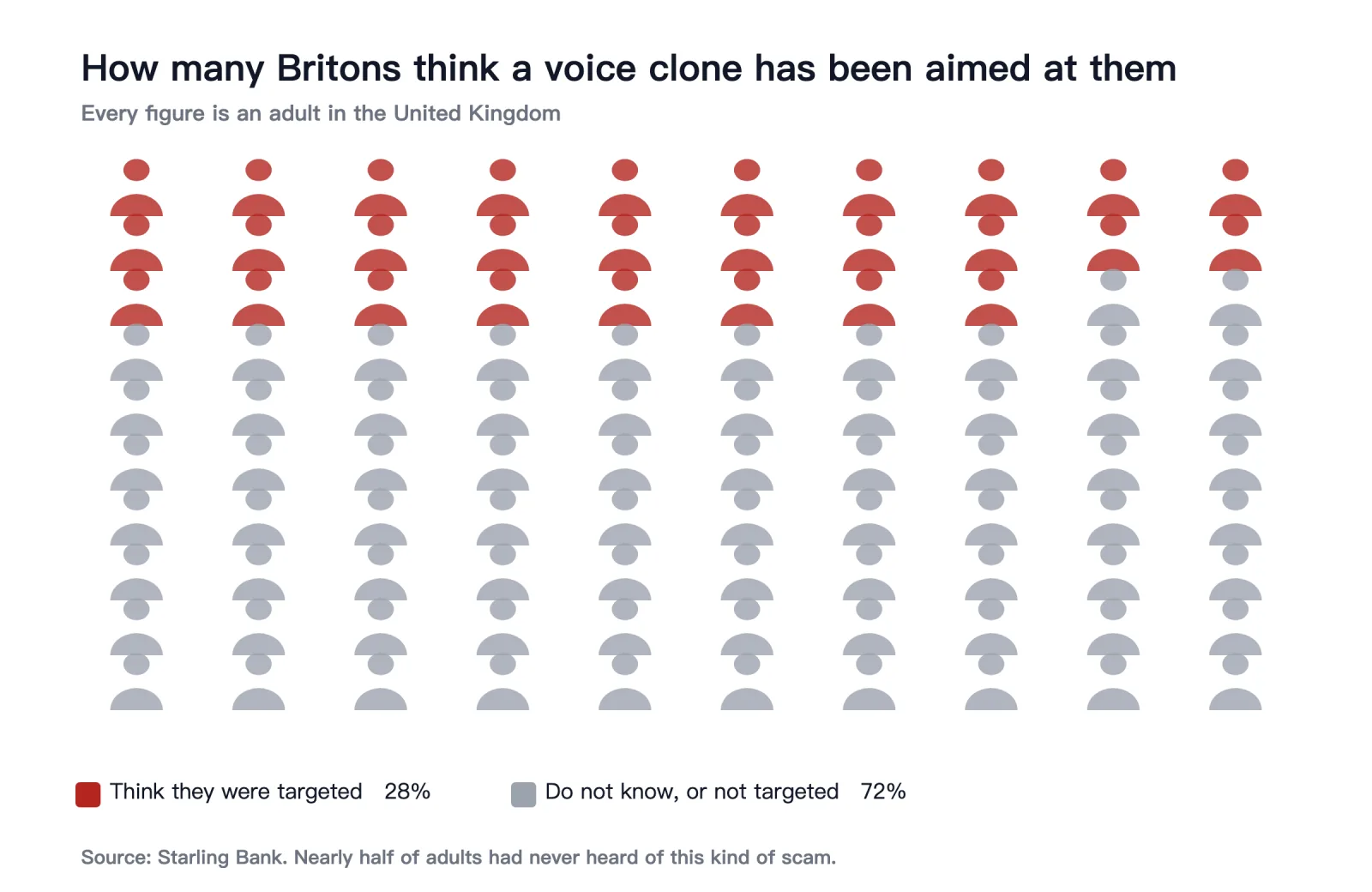
Santander says its customers lost about £160,000 to "Hi Dad" scams in the first half of this year alone, by text and by cloned voice, and the figure only runs to mid-June. Chris Ainsley, who runs fraud risk at the bank, said criminals impersonate the organisations and the people you trust because urgency does the work for them.
> A familiar voice is no longer proof of anything.
National Trading Standards warned in February this year that victims' voices were being cloned. There is a newer trick worth knowing, because it does not look like a crime at all: someone rings up and says they are doing a short lifestyle survey, or a health survey. They are polite. They ask you to talk about yourself. They are recording every second of it, and a second does later become your son's voice asking for money.
## The line that isn't in the ledger
Here is my own judgment, and it is the reason I wanted to write this down.
UK Finance published its annual fraud report in June. It does not mention voice cloning. There is no category anywhere in it for family-emergency scams. Which means there is no official figure for what this costs people in Britain, at the very moment banks and police agree the method is growing.
We are good at counting in this country. We count card fraud to the penny. We have whole teams counting romance fraud. But a crime that borrows your child's voice dies in the paperwork, because it lands in whatever box the person filling in the form happens to reach for. A thing nobody counts is a thing nobody has to fix.
## What you actually get back
Britain is better than most places here, and it is worth knowing exactly why.
Since October 2024, payment firms have had to refund most victims of authorised push payment fraud, the kind where you were tricked into sending the money yourself. The cap is £85,000 per claim. There is a £100 excess. Sending and receiving banks split the cost. You lose the refund only if you were grossly negligent, if you committed the fraud yourself, or if your claim falls into a narrow exempt category. If a bank refuses you, you can take it to the Financial Ombudsman.
The Canadians do not have this. A CBC investigation this autumn put one Briton and one Canadian side by side after near-identical bank impersonation calls: the British victim got her money back within days, and the Canadian got nothing and eventually settled for part of it. Reimbursement rules change behaviour. They change the bank's behaviour most of all.
So Britain has teeth. It also has holes, and they are moving.
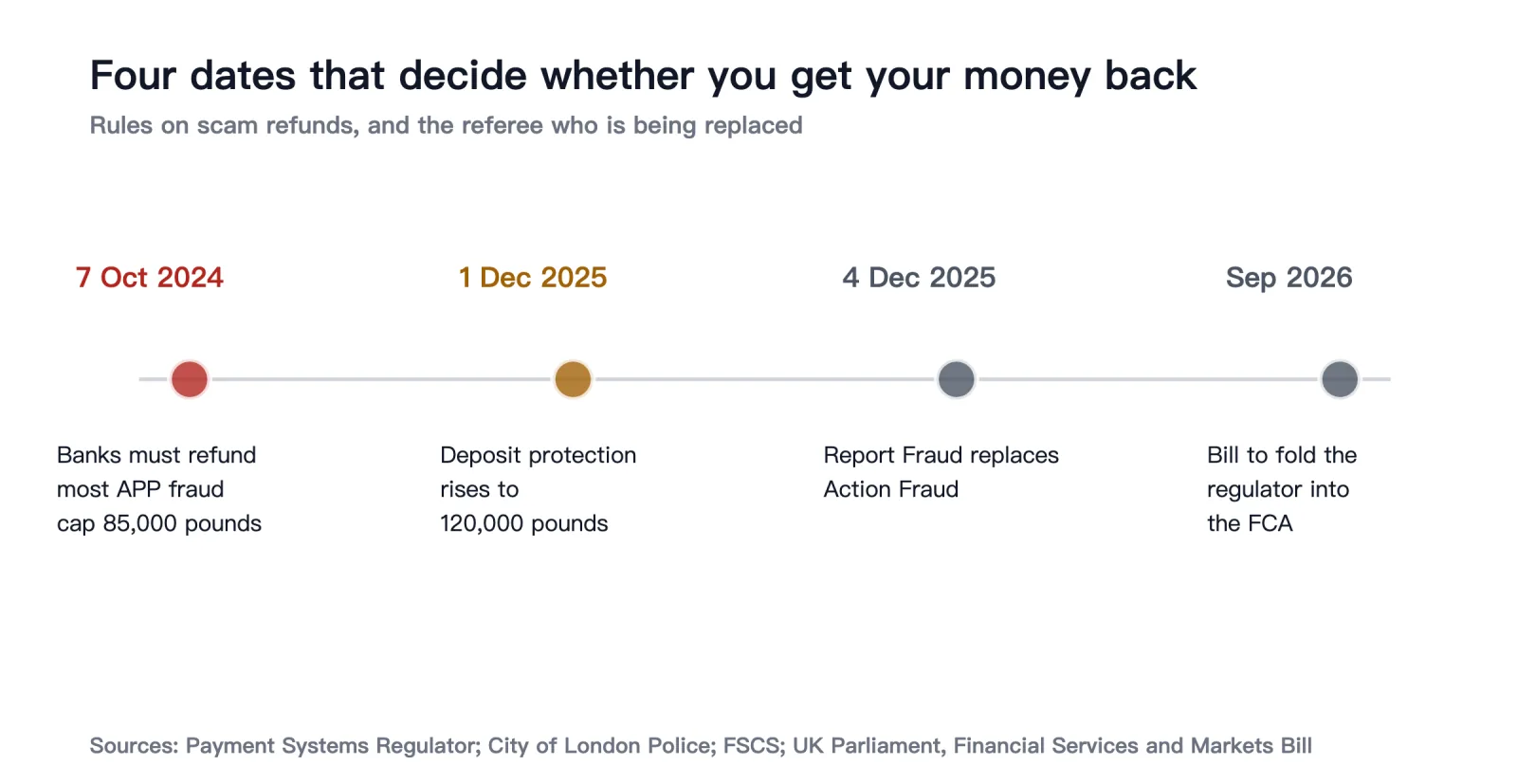
Three dates, and none of them lines up. The refund scheme arrived in October 2024. Action Fraud was replaced by Report Fraud in December 2025. The deposit protection limit rose to £120,000 that same December, so the safety net under your savings is now bigger than the cap on refunding a scam you were talked into. And in September this year a bill went before Parliament to abolish the Payment Systems Regulator and fold it into the Financial Conduct Authority. The rules still stand while that happens. The referee is changing mid-match.
Then there is the £784 figure from Hiya's State of the Call report, the average loss for a UK victim of this kind, the highest of any country they surveyed. One bank's ledger says six figures a year. No national ledger says anything at all.
## Four things to do tonight
None of this needs technology. It needs a conversation you have before you need it.
Agree a safe word. One word, known only to the people in your house, never typed anywhere, never said on video. A clone can reproduce a voice. It cannot produce information it was never trained on. Ask for the word. Hang up if you don't get it.
Make hanging up the polite default. Hang up, then ring them yourself on the number already saved in your phone. Not the number they give you. If you cannot reach your son, ring his flatmate, his girlfriend, his office. A real emergency survives a five-minute callback. A scam usually does not.
Watch the surveys. If a stranger wants you to talk for two minutes about yourself, you are the product. Say nothing and put the phone down.
Learn two numbers before you need them. 159 connects you to your bank's fraud team and cannot be spoofed. If a scam text or call comes in, forward it to 7726, which is free. If money has gone, ring 159 first, then report it to Report Fraud at reportfraud.police.uk or on 0300 123 2040. In Scotland, Police Scotland on 101.
And tell your mother. Not with a lecture. Say this much: if I ever ring you crying for money, hang up and ring me back on my usual number, because it might not be me.
> The technology improved faster than the paperwork.
I keep coming back to the silence around the numbers. We hand over our voices all day long to anyone who asks, on video calls and voicemails and voice notes, because the idea that someone could borrow them belongs to films. Meanwhile a quarter of British adults think someone may have already tried it on them, and the annual fraud report has no line for it.
The thing I want to ask is simple, and I don't have a good answer to it: if your own voice can no longer prove you are you, what do you have left that can?
News is gathered automatically from public robotics & AI feeds on a schedule.
Related
The robot answered. Again.
Seven out of a hundred problems get solved by the automated system. 7.4 million adults could not get through to their provider at all. Here is what still works.

Nobody rejected you. A list did.
Nobody rejected you. A list did. Since February you can ask for a person to review an automated rejection, and almost nobody does.
Prove you are forty, or you cannot read this
Prove you are forty, or you cannot read this. The checks are real, the children who want past them are past them, and the people handing over passports are adults.

You can't get a GP appointment. So you tell the chatbot instead.
One in five adults in Britain now turns to an AI for personal advice. This isn't a story about loneliness — it's a story about the waiting list, and about what the thing on the other end can and cannot do for you.

Ce que votre employeur n'a pas le droit de savoir sur vous
Une plainte déposée le 27 octobre décrit comment 900 000 travailleurs sont suivis à la frappe près. En France, ce genre de surveillance est déjà encadré par le Code du travail — et c'est interdit depuis février 2025 pour les émotions.

孩子饿得直哭,门锁打不开,电话里只有一句「亲」
智能锁坏了,一家三口被关在门外 50 分钟,电话里只有循环播放的话术。转人工难不是技术跟不上,是企业把 AI 当成了过滤网。附一份今天就能用的『找到真人』清单。