How to choose a BLDC motor for robotic arms and mobile robots
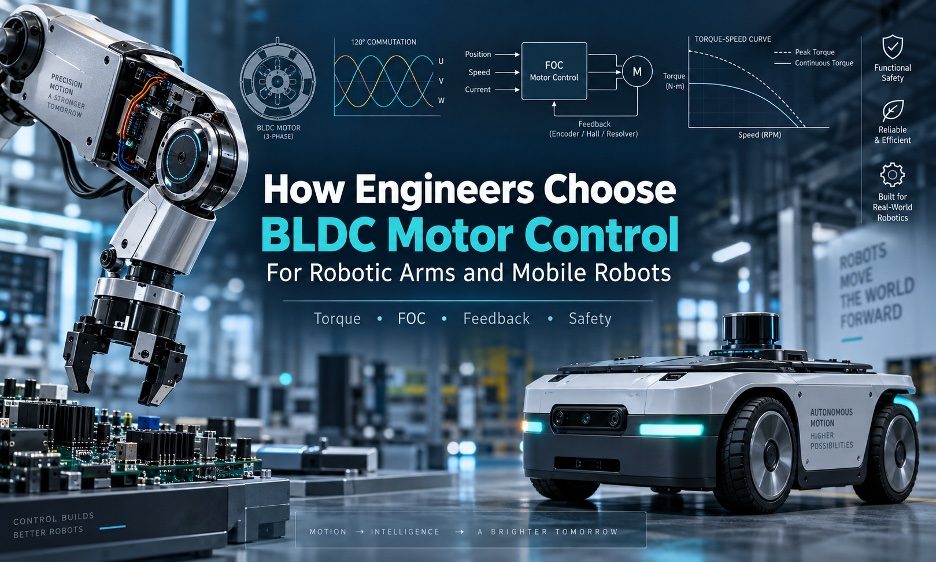
There are several factors to choosing brushless DC or BLDC motors for robots. Source: Faisal Mahmood
Selecting a brushless DC, or BLDC, motor for robotic arms or mobile robots starts with the mechanical system, not the controller catalog. A motor rated for a particular voltage and wattage does not tell an engineer whether it can deliver the required torque at low speed, regulate position accurately, absorb regenerative energy, or survive the thermal duty cycle.
The actuator is a system. The motor, inverter, current sensors, rotor position feedback, gearbox, brake, output encoder, thermal path, communications interface, and higher level robot software all influence the result.
An industrial or collaborative robotic arm joint generally prioritizes controllable torque, low-speed smoothness, position accuracy, collision response, backdrivability, and thermal performance. A mobile robot drive motor generally puts more emphasis on efficiency, starting torque, braking, traction, battery utilization, speed regulation, and synchronization between drive channels.
The terminology also deserves care. Commercial robotics literature often uses “BLDC” and “PMSM” (permanent magnet synchronous motor) somewhat interchangeably because both are three-phase, permanent-magnet machines driven by electronic inverters. Their back EMF waveform, winding design, controller algorithm, and feedback method still determine how a particular motor behaves.
For example, STMicroelectromics treats three-phase BLDC and PMSM control as related application areas and describes both six-step and field-oriented control architectures.
Start with the mechanical load, not the controller catalog
The first selection exercise is to establish what the motor actually has to do. For a geared robotic joint, a useful first order relationship is: τ_joint = (τ_motor × gear ratio × η_gear) − τ_losses
Motor speed follows the transmission ratio: ω_motor = ω_joint × gear ratio
Mechanical power is: P_mech = τ × ω
And a first approximation of battery side electrical power is: P_elec ≈ P_mech / η_total
These equations do not replace a dynamic model, but they expose the parameters that matter before a controller is selected. Considerations include continuous torque, peak torque, peak duration, acceleration torque, gravity torque, and reflected inertia. In addition, regenerative braking, stall or near stall operation, duty cycle, thermal resistance, battery voltage range, and cable and connector current limits should all be established.
For robotic arms, the load calculation has to account for link inertia, payload, gravity compensation, gearbox ratio, backlash, compliance, counterbalance, and encoder location. A motor side encoder can report the rotor position accurately while the joint output still contains transmission error.
For mobile robots, the equivalent exercise starts with vehicle mass, wheel radius, rolling resistance, slope, acceleration, terrain, wheel slip, and drive configuration. Differential-drive platforms impose different synchronization requirements from four wheel drive vehicles. An outdoor uncrewed ground vehicle ( UGV ) can also spend much more time in high load operation than a lightweight indoor delivery robot .
Regenerative energy deserves particular attention. During deceleration or downhill travel, the motor can return energy to the DC bus. The battery, controller, braking strategy, and bus capacitance all have to accommodate that energy. A controller that handles acceleration correctly can still create an over-voltage problem during aggressive regenerative braking.
Register now and help us celebrate 20 years of RoboBusiness!
Choose the commutation method according to motion quality
Six-step, sinusoidal, and field-oriented controls are not interchangeable labels for the same behavior.
Six-step, or trapezoidal, commutation switches the inverter through six electrical states according to rotor position. It can be attractive where implementation simplicity and cost matter or torque ripple is acceptable. It can also be suitable when the motor spends much of its operating time at moderate or high speed and precise low speed torque is not a central requirement. Hall sensors can provide the rotor position information needed for straightforward sensored implementations.
Sinusoidal control drives the phases with continuously varying current or voltage references rather than the discrete commutation states associated with basic six-step operation. It can reduce torque ripple and acoustic effects compared with a simple trapezoidal strategy, although actual performance depends on motor construction, feedback, current regulation, and tuning.
Field-oriented control, or FOC, takes the control problem further by transforming the measured phase currents into a rotating reference frame. The Clarke transformation converts the three phase quantities into a stationary two-axis representation, while the Park transformation rotates that representation into d axis and q axis components.
The controller can then regulate the components independently through current loops before transforming the command back into phase voltages and generating pulse width modulation (PWM).
In a typical PMSM application, q axis current is closely associated with torque production, while d axis current can be used for flux related control and, at higher speeds, field weakening. TI ‘s motor control reference material illustrates the practical structure with Clarke and Park transformations, PI regulators, position and speed loops, and space vector PWM.
FOC is commonly attractive when the application requires smooth low-speed motion, fast torque response, or accurate speed regulation. It can also help with reduced torque ripple, regenerative braking, field weakening, or torque control for impedance and force-related behavior. FOC can therefore be a natural fit for many robotic joint and traction applications.
FOC does not automatically create a…
News is gathered automatically from public robotics & AI feeds on a schedule.
Related
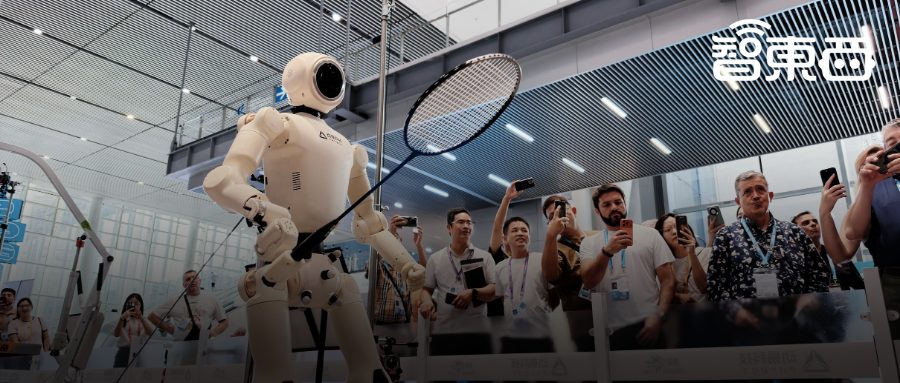
广交会上的机器人,正在从“秀一场”走向“用一程”
智东西 作者 | 独林 编辑 | 漠影 能自主与人连续打羽毛球的双足人形机器人,到了新的任务中,原有的能力还有多少能复用? 智东西10月18日报道,在今年的第140届广交会上, 动易科技在多处安排了人机羽毛球、乒乓球对打,并在广交会发展史陈列馆提供中英双语导览。 同时,在企业展位,动易科技则展示了重载运输、特种巡检与灵巧操作等场景应用方案。 在此之前,今年4月的第139届广交会上,这家广州企业以羽毛球互动为重点,参加了第一期5天的活动。第140届广交会,动易科技则计划将导览服务与体育互动持续三期,一直到11月4日。 任务增加、服务时间延长,对人形机器人的要求也便更多、更高: 它要解决的不只是一

DeepSeek 新模型上线,价格更低能力更强;传华为将推新品牌「星芒」主打性价比;天文学家发现第一颗绿色恒星|极客早知道
DeepSeek V4.1 Flash 新版本上线:许愿式编程一键成真 10 月 17 日,DeepSeek V4.1 Flash 更新至 V4.1-Flash-1017 版本,官方网页端、APP 与 API 模型已同步变更为新模型。相比上一版本的 DeepSeek V4.1 Flash,新模型在各方面的基准测试中取得了长足的提升。 在提升性能的同时,模型的任务运行时间与输出长度还缩短了,让用户能够以更低成本、更快速度完成任务,在多个 Harness 下达到了新的性能-费用帕累托最优。 特别地,此次优化着重针对 DeepSeek Harness、腾讯 CodeBuddy、WorkBuddy 等

ADI explains the race to make AI physical
A new ADI whitepaper examines the challenges and opportunities in moving physical AI out of labs into production machinery. The post ADI explains the race to make AI physical appeared first on The Robot Report .
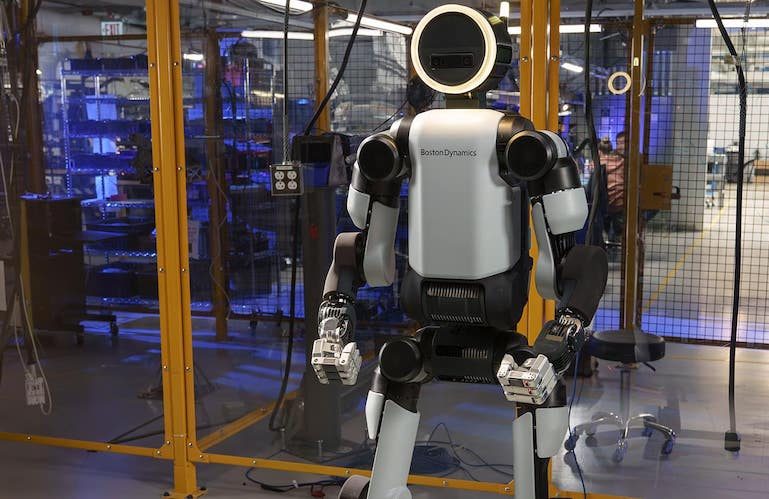
The rise of the machines is canceled: Why humanoids with AI are helpers, not enemies
Humans play a key role in developing humanoid robots and training AI models, so we can maintain control, writes a columnist. The post The rise of the machines is canceled: Why humanoids with AI are helpers, not enemies appeared first on The Robot Report .

梁圣又掀桌了!DeepSeek新模型斩杀GPT-6,许愿式编程时代降临
智东西 作者 | 杨京丽 编辑 | 李水青 智东西10月17日报道,刚刚,DeepSeek V4.1 Flash更新至 V4.1-Flash-1017版本 ,官方网页端、App与API已同步更新至新模型,模型权重也已在HuggingFace和ModelScope开放下载。DeepSeek还向公众开放自研搜索引擎的 Search(搜索)与Fetch(抓取)API ,两个接口均定价为 5元/千次 。 此次更新距离该模型发布仅过去一个多月。9月10日, DeepSeek正式推出V4.1-Flash ,在性能上超越了DeepSeek-V4-Pro。 开源地址: HuggingFace: https:/

1 分钟售罄、发货排到明年,iPhone Duo 卖爆背后的真相
人们已经很多年没见过,苹果的新品被这样抢了。 10 月 16 日晚 8 点,苹果首款折叠屏 iPhone Duo 开启预购。社交媒体上流传的说法是, 开售 1 分钟,全型号库存就空了,京东、天猫页面相继显示售罄 。 大约 40 分钟后, 苹果官网的预计送达时间已经跳到了 2027 年 1 月底 。 几个小时后,大洋彼岸的美国东部时间上午 8 点,同样的剧情再演一遍。分析师 Max Weinbach 在 X 上说,纽约及周边、康涅狄格州的门店大约 3 分钟就被抢光。半小时内,美国所有配置的交付日期都变成了 1 月 25 日。eBay 上,一台 2TB 版的预购机挂出了 5000 美元的成交价,比