Industrial Intelligence: The next growth opportunity for manufacturing
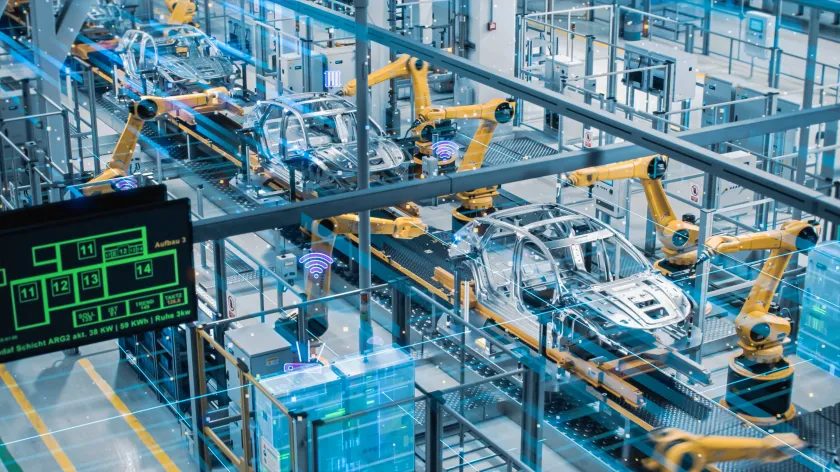
Every manufacturer has its own industrial intelligence. Some is documented, and some resides in the knowledge of experienced workers.
Consider an experienced operator preparing to restart a line after a changeover. The machine settings matter, but so does knowing how a particular material behaves, what happened during the previous shift, and when an apparently minor variation deserves a closer look. A procedure can describe the sequence, but successful execution depends on the judgment that comes from experience and the organization’s accumulated know-how.
That combination is industrial intelligence: a manufacturer’s accumulated know-how, operating practices, production data, and understanding of its own business.
The opportunity now is to make more of that intelligence available wherever decisions are made, then connect it to the physical world of manufacturing. The strategic destination is not more agents, but rather to turn the existing business intelligence into an engine for profitable growth.
Individual knowledge can be translated into organizational advantage
Expertise has limited reach when it stays with one person, inside one system, or within one plant. Leaders now must determine how to extend that reach without stripping away the context that makes the knowledge useful.
For example, an engineer evaluating a process change needs more than a production record. They need to understand the circumstances behind it: the equipment configuration, the quality requirements, and the trade-offs an operator made. Connecting those elements can help people apply experience beyond the place where it originated.
When individual knowledge becomes widely accessible, innovation can spread to the maintenance workshop, the planning office, the engineering team, and the production floor. More people can contribute because more people can work with what the organization knows.
But access to knowledge is only part of the opportunity. Manufacturing ultimately is physical, and it depends on materials, machines, and products.
When intelligence participates in action
Physical AI describes systems that can perceive conditions, reason about them, and take action within the physical world. By connecting machines and processes, manufacturers get a clearer view of what is happening on the factory floor. Agents can then reason on top of that information to identify patterns, predict problems, and determine the best course of action. Physical AI brings business intelligence into the physical process, allowing machines and systems to respond to changing conditions.
Consider a robotic-handling operation encountering variation in the parts arriving at its station. Vision can help the system assess a part’s position. A model informed by the material and task can help determine an appropriate movement. Connected controls can then execute an adjustment within validated limits. The value is not merely seeing the variation; it is responding appropriately.
The same principle applies to quality operations. When Toyota Industries connected previously fragmented paint shop data, engineering and operations teams were given the context needed to understand defect drivers. The company reports that analysis cycles fell from five days to under four hours, while its pilot reduced relevant paint defects by about 25%. The breakthrough was not simply identifying another signal; it was helping people understand why defects were occurring and respond before the outcome was locked in.
This is the type of situation where industrial intelligence has become essential. Data may reveal what is happening, but industrial intelligence provides the context for what should happen, which constraints cannot be breached, and when uncertainty requires human judgment.
Simulation offers a way to examine proposed actions before applying them to equipment. Manufacturers can explore how a change might affect a process in a digital environment. That does not remove the need for physical validation, but it creates room to learn without treating the production line as the first experiment.
Responsible deployment, therefore, begins with operational discipline. Leaders need to establish clear authority or what systems may change, reliable connections to equipment, defined safety boundaries, and a record of decisions and actions. People must be able to recognize uncertainty, intervene, and bring equipment to a safe state. Trust rests on those practical arrangements, not on confidence in a model alone.
More capable machines, more capable people
Manufacturing has long combined human ingenuity with increasingly capable tools. Physical AI extends that relationship. Intelligent equipment can take on suitable repetitive or physically demanding tasks, while agent-assisted operations can help people navigate information-intensive decisions and changing conditions.
The aim is not to make machines smarter; it is to see what people can build when knowledge can travel, intelligence can act, and ambition has more room to become reality.
Rockwell Automation illustrates the point. At its Singapore plant, technicians use a maintenance copilot that combines manufacturing data, machine manuals, and knowledge captured from experienced workers. This system has reduced the time required for new workers to learn how to troubleshoot hundreds of machines from nine months to three. An engineer could explore more process alternatives before committing to a change. An operator could help improve the system’s response rather than repeatedly managing the same exception.
This type of progress requires investment in equipment but also in people: training, time to learn, and playing a meaningful role in shaping how systems work. Machines become more capable so people can become more capable.
Industrial Intelligence is the answer to sustainable growth
Industrial intelligence connects what a manufacturer knows: the experience of its people, the signals from its…
News is gathered automatically from public robotics & AI feeds on a schedule.
Related
UK Home Office May Face Investigation Over Use of OpenAI Tools
A government watchdog is considering a probe into the Home Office’s use of ChatGPT technology to process asylum claims amid concerns over the tools’ accuracy and secrecy surrounding their use.
Meta AI director Rohit Patel leaves to take on Microsoft Office and Google Workspace
Rohit Patel is departing Meta after eight years working on AI evaluations and reinforcement learning, TechCrunch has exclusively learned. His startup, Ndoc, aims to take on Microsoft Office Suite.

Apple is adding an AI chatbot to Pages, Keynote, and Numbers
Apple is bringing an AI assistant to its suite of productivity apps, including Keynote, Pages, and Numbers. The assistant, which is built on AI models from Apple and OpenAI, can understand a document's context to perform tasks like designing, animating, and refining slides in Keynote. In Pages, Appl
Japan internet giant GMO says hackers posted stolen customer data
Japan's GMO Internet is verifying alleged customer data posted by suspected hackers following a cloud service breach.

I Used AI to Fake a Scientific Paper. Here’s What Happened
Science has a spam problem. And the spam filter is getting clogged up. According to all reports, academic publishing is drowning in what has come to be called AI slop: low-quality, mass-produced content generated with AI. By 2025, an estimated 57 percent of all published academic articles exhibited
General Compute raises $100 million Series A, countering the neocloud disaster narrative
General Compute is betting on inference chips from outside the Nvidia ecosystem.