Intermittent swimming promotes the energy efficiency of fish-like robot movements
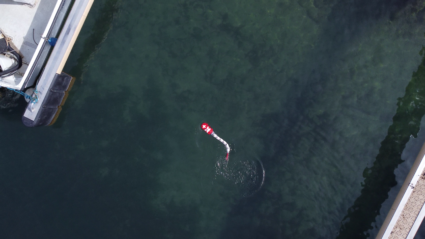
Image credits: Xiangxiao Liu, Francois A. Longchamp, and Louis GeverBiorobotics Laboratory, EPFL
Improving energy performance can effectively extend the time a robot can operate and reduce battery load, enabling lighter, more flexible, and more durable robotic systems. Nature has evolved optimal energy-saving locomotion strategies through billions of years of natural selection, providing unparalleled blueprints for robotic optimization. Among diverse modes of aquatic locomotion, intermittent swimming, also called bout-and-glide swimming, is a widespread adaptive behavior in aquatic organisms of a wide range of sizes, including larval zebrafish, red-nose tetra, koi carp, and even whales.
This natural bout-and-glide gait features alternating motion phases: short periods of active body and tail undulation for propulsion, followed by passive gliding with a streamlined, straight body posture. It is widely recognized that this intermittent swimming gait is closely associated with optimizing biological energy, making it of great research value to transplant and explore such natural motion mechanisms into robotic control systems.
In this study, an international joint team comprising researchers from EPFL (Switzerland), Duke University (USA), and Instituto Superior Tecnico (Portugal) developed a larval zebrafish-inspired robotic platform (ZBot) to systematically investigate the intrinsic characteristics and performance advantages of bout-and-glide intermittent swimming compared to continuous swimming.
This research focused on four scientific questions:
1. Which neural control mechanism underlies intermittent swimming locomotion?
To validate the bioinspired energy-saving mechanism of fish intermittent swimming, the team developed a biomimetic robot, ZBot (Figure 1), scaled up 200 times from a larval zebrafish, with a body length of 80 cm and a weight of 2.8 kg. The ZBot replicates the larval zebrafish’s morphological features, segmented body structure, and center-of-mass distribution. Its flexible tail consists of six servomotor-driven segments to simulate natural fish undulation, while the head integrates core devices, including a central controller that serves as its nervous system, high-precision cameras, and real-time power meters. Equipped with expandable sensor interfaces, ZBot supports diverse experimental needs, including visual-motor processing [2] and vestibular system research.
Figure 1. ZBot and real larval zebrafish.
2. Can intermittent bout-and-glide swimming achieve higher energy efficiency than continuous tail-beating swimming, and if so, under which conditions?
The team from EPFL and Duke University collaborated to build a neurocomputational model simulating zebrafish neural circuits, centered on Central Pattern Generators (CPGs), bout-gate modules, and ventral spinal projection neurons (vSPNs). The CPGs generate continuous rhythmic oscillation signals to generate basic swimming undulations, with the bout gate acting as a core switching unit: it accumulates input signals via a leaky integrator and triggers CPG-driven tail undulation only when reaching a fixed threshold, forming the natural intermittent “active bout + passive glide” swimming rhythm. The simulated vSPNs further adjust tail deflection angle, enabling flexible maneuver swimming direction..
By adjusting parameters such as tail oscillation frequency, amplitude, and bout gate threshold, ZBot can accurately replicate multiple swimming gaits of larval zebrafish, including slow straight swims, routine turns, and J-turns (Figure 2). The EPFL-Duke team extended the model to construct an end-to-end framework for the larval zebrafish’s visually guided optomotor response, transforming the retinal input into motor output. This framework successfully reproduced the optomotor response in both ZBot and a digital twin simulation, simZFish .
Figure 2. Top view of ZBot bout-and-glide swimming in water (1 cP, 64000 ≤ Re ≤160000), moderately viscous liquid (213.9 cP, 37.4 ≤ Re ≤ 448.8, intermediate flow regime), and highly viscous liquids (457.0 cP, 1.0 ≤ Re ≤ 87.5, close to viscous flow regime). Recorded at 5 frames per second.
3. Are the energy-saving advantages of intermittent swimming constant in viscous fluid regimes, e.g., with low Reynolds number, as seen for tiny larval zebrafish and microbionic swimming robots?
Reynolds number is a dimensionless quantity that quantifies the relative magnitude of inertial forces and viscous forces acting on a fluid flow or a solid object moving through fluid. A lower Reynold number ( 1000) indicates the fluid dynamics in inertial-dominated regime, where inertial forces overwhelm viscous forces.
Large creatures, such as whales, swim in turbulent flow regimes with a high Reynolds (Re) number. Small creatures, such as tiny larval zebrafish, swim in an intermediate flow regime that is more strongly influenced by viscous drag. Thus, it is interesting to examine the effects of different flow regimes on dynamic behavior during intermittent swimming gaits. Leveraging the inverse relationship between Reynolds number (Re) and fluid viscosity, the team changed the fluid environments to mimic aquatic organisms of varying sizes by adjusting liquid viscosity (Figure 2 and Video 1). The moderately viscous fluid has a viscosity of 213.9 cP, comparable to fruit topping syrup; the highly viscous liquid has a viscosity of 457.0 cP, comparable to the standard makeup cleansing oil. Increased viscosity significantly shortens ZBot’s traveling distance, with the displacement in highly viscous fluid (473.0 cP, 1.0 < Re < 87.5) only 1/30 of that in normal water (1 CP, 64000 < Re < 16000. Intriguingly, viscosity has minimal impact on turning performance: ZBot’s turning angle per bout is approximately 60 degrees in normal water and remains at 45 degrees in highly viscous fluid.…
News is gathered automatically from public robotics & AI feeds on a schedule.
Related
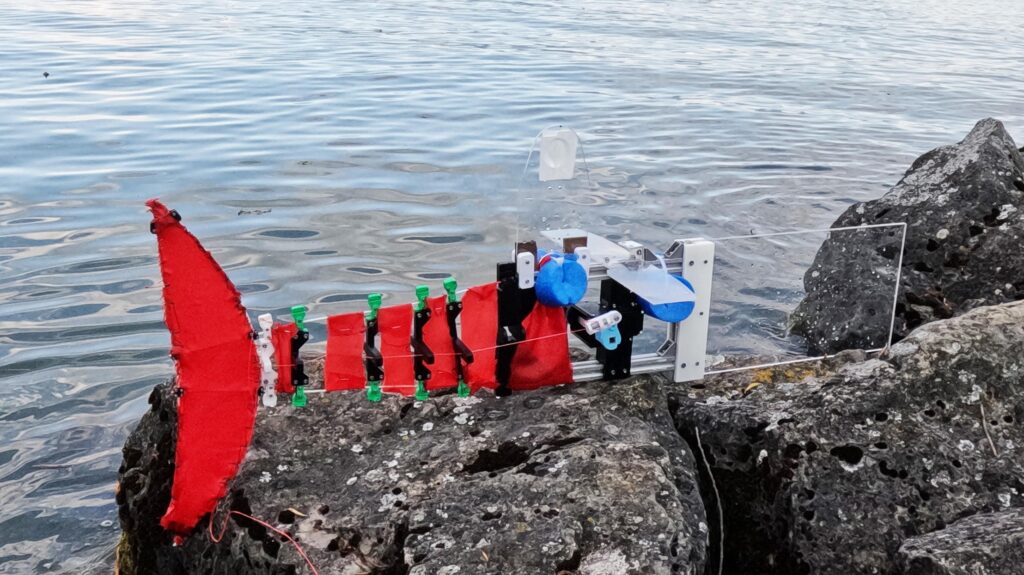
Small, medium or large, a robotic fish maintains its swimming ability
The scalable robot ScaFi. 2026 CREATE Lab EPFL. CC BY SA-4.0. Propeller-powered underwater vehicles have long helped scientists explore and monitor aquatic environments. But they’re limited by their own mechanics: spinning blades can snag on vegetation, stir up sediment, and startle the wildli

Video Friday: Life’s Better With a Little Robot Goose
Video Friday is your weekly selection of awesome robotics videos, collected by your friends at IEEE Spectrum robotics. We also post a weekly calendar of upcoming robotics events for the next few months. Please send us your events for inclusion. IROS 2026 : 27 September–1 October 2026, PITTSBURGH CoR

Robot Talk Episode 163 – Robots helping people, with Aaron Edsinger
Claire chatted to Aaron Edsinger from Hello Robot about their Stretch robots that can help people with mobility issues live more independently. Aaron Edsinger is CEO and Co-Founder of Hello Robot, a robotics company dedicated to developing practical, safe, and accessible robots for people. With a pa
An open source approach to physical AI from Intrinsic
Deborah Lupton / Pop Chips / Licenced by CC-BY 4.0 Intrinsic (an AI robotics group at Google) announced that the company is making parts of its platform open source. Intrinsic Core™ is a set of ROS-compatible capabilities for building sophisticated robotic applications. The capabilities included in

Mexican EPICS in IEEE Team Builds Portable Educational Platform
In Guadalajara, Mexico, many high schools have motivated teachers and talented students with an interest in science, technology, engineering, and mathematics, but they lack access to advanced tools such as robotics laboratories. The resources shortfall limits the students’ opportunities for hands-on

What’s coming up at #IROS2026?
The 2026 IEEE/RSJ International Conference on Intelligent Robots and Systems (IROS 2026) will be held from 27 September – 1 October in Pittsburgh, USA. The programme includes plenary and keynote talks, workshops, tutorials, forums, competitions, and a debate. Keynote talks The keynote talks wi