LiberAI Unveils Liber-0, a World Action Model That Grounds Human Experience in Robot Action
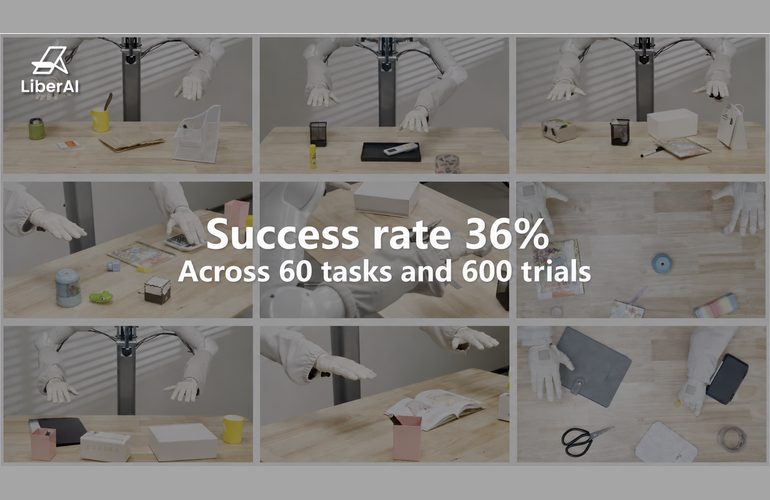
LiberAI introduces Liber-0, a world action model pretrained on more than 2.2 million hours of human experience to support zero-shot robot manipulation. In an evaluation of 60 tasks proposed by GPT-6, it achieved 36.0% overall success without robot demonstrations collected specifically for those target tasks. The model combines large-scale human video, glove-recorded hand motion and embodiment alignment to transfer human manipulation experience to robots.
Liber-0 achieves 36.0% overall success in a zero-shot evaluation of 60 tasks proposed by GPT-6.
LiberAI has introduced Liber-0, a world action model (WAM) pretrained on more than 2.2 million hours of human experience. The Beijing-based startup said the model combines human video with glove-recorded motion and embodiment-conditioned learning to transfer human manipulation experience to robots.
A central test of Liber-0’s generalization is whether it can perform target tasks without robot demonstrations collected specifically for them. LiberAI evaluated the model on a separate suite of 60 GPT-6-proposed tasks, distinct from its internal scaling benchmarks: 20 pick-and-place (PnP) tasks, 20 non-PnP manipulation tasks, and 20 challenging non-PnP and long-horizon tasks.
Examples from the suite include placing a pen in a pencil case, pushing a drawer closed, and a longer sequence in which a pen is placed in a pouch and the pouch is stored in a drawer.
LiberAI reported task success rates of 63.5% on pick-and-place tasks, 34.0% on non-pick-and-place manipulation tasks and 10.5% on challenging non-pick-and-place and long-horizon tasks, with an overall success rate of 36.0% across 600 trials.
Here, zero-shot means the evaluated checkpoint was not trained on robot demonstrations collected specifically for these target tasks; pretraining still included robot data.
Why learn from people?
Robot manipulation has traditionally relied heavily on demonstrations recorded on a specific robot for a specific task, usually by a human operator teleoperating the machine. That data closely matches deployment, but collecting it can be slow and expensive, particularly when new tasks or robot platforms require additional demonstrations. Human activity is far more abundant, and much of it is already on video.
The obstacle, according to LiberAI, is that human video does not translate directly into robot commands. Cameras sit in different places, hand poses estimated from video are noisy, and human bodies move differently from robots.
Liber-0 connects human experience with robot action in three ways. First, LiberSense Glove, LiberAI’s data-collection system, directly records hand movements, helping link human video to the motions behind it. Second, LiberAI’s robot platform uses camera views and hand, wrist and waist movements that more closely match those of humans, making skills easier to transfer. Third, a Unified Embodiment Representation gives the model information about body shape and joint movement, so it can adapt actions to the body performing them.
Liber-0 jointly predicts future video frames and actions. This lets it learn from ordinary videos without action labels alongside glove and robot recordings that include measured motion.
Human-to-robot transfer. Conceptual illustration of how action-grounded human recordings and visual and kinematic alignment support transfer to LEO.
Learning actions that robot data lacked
Glove data can also introduce behaviors missing from a policy’s robot data. LiberAI trained policies whose robot demonstrations covered only pick-and-place, while glove demonstrations included actions such as folding, pressing and opening. Performance was measured as a progress score, a 0 to 100 measure that credits partial completion, across four pick-and-place and six non-PnP tasks. With robot data alone, the non-PnP progress score was 2.2. Adding glove recordings of those actions raised it to 47.5, and to 54.6 when the glove set also included pick-and-place, close to the 56.3 scored by a policy trained on robot demonstrations of every action. This controlled experiment is separate from the 60-task suite: the actions appeared in the glove demonstrations but not in the policies’ robot demonstrations.
A quarter of the robot data
A separate experiment examines whether glove recordings can reduce the need for robot demonstrations. In an eight-task evaluation on LiberAI’s robot platform, where the full robot and glove pools contained equal numbers of demonstrations, a policy trained on 25% of the robot pool plus 100% of the glove pool reached a progress score of 75.6. A policy trained on 100% of the robot pool scored 72.8.
In that setting, glove recordings delivered comparable performance with 75% fewer robot demonstrations. The saving applies to robot demonstrations specifically, as the mixed policy still drew on the full glove pool. Because glove collection does not require a robot at each site, LiberAI says experience can be gathered from more people, in more places, and potentially at lower cost.
Evaluating the pretrained model directly
On LiberAI’s internal benchmarks, the pretrained checkpoint achieved progress scores of 81.4 on pick-and-place and 72.3 on non-PnP tasks when evaluated directly. Robot post-training added 2.2 and 1.5 points, to 83.6 and 73.8. LiberAI said the small gain indicates the pretrained model already captures much of the capability needed for the evaluated tasks.
LiberAI has developed an interactive simulation in which users can upload their own objects and watch Liber-0 manipulate them in a virtual environment. The simulation demonstrates object-level generalization: that version of the model was post-trained on 100 hours of simulated teleoperation data and receives no further object-specific training.
“Human video shows what people do, but not exactly how their hands move or how that movement fits a different body,” said Songming Liu, founder and CEO of LiberAI. “Grounding that experience in…
News is gathered automatically from public robotics & AI feeds on a schedule.
Related

Robot integration brings high-precision production to midmarket manufacturers
Properly integrated industrial and collaborative robots can help midmarket manufacturers, according to a columnist. The post Robot integration brings high-precision production to midmarket manufacturers appeared first on The Robot Report .

刚刚,OpenAI被曝又拿730亿,估值超8.3万亿
智东西 编译 | 毕伟豪 编辑|云鹏 智东西11月7日消息,刚刚,据彭博社报道, OpenAI已完成新一轮融资的首批资金交割 ,金额约为 110亿美元(约合人民币734.4亿元) ,公司估值达到 1.25万亿美元(约合人民币8.35万亿元) 。 据知情人士透露,截至当地时间周五,相关融资款项已经汇入OpenAI账户。 本轮融资总额最高可能达到200亿美元(约合人民币1335.3亿元) ,剩余部分预计将在未来几周内完成,截至目前,OpenAI尚未公布本轮融资的最终金额。 参与首批资金交割的投资方包括 Coatue Management和普信集团(T. Rowe Price) 。本轮其他投资方还包

How Point One turned GPS accuracy into a robotics platform
Aaron Nathan explains how precise location technology like GPS is enabling robots to navigate, coordinate, and scale across real environments. The post How Point One turned GPS accuracy into a robotics platform appeared first on The Robot Report .
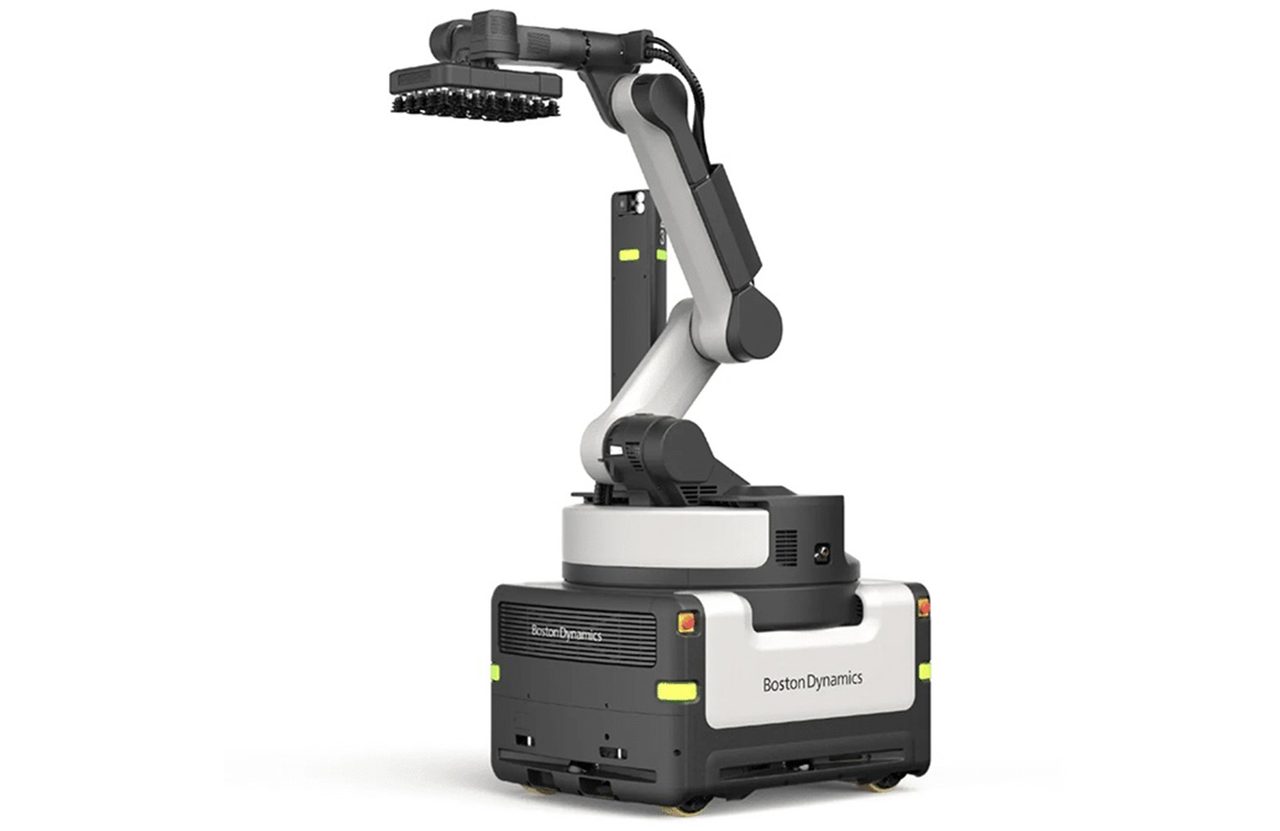
Boston Dynamics built Stretch Gen 2 for reliable, consistent performance
Brian Donnelly, the VP and GM of logistics robotics at Boston Dynamics, said the new version of Stretch has been in the works for two and a half years. The post Boston Dynamics built Stretch Gen 2 for reliable, consistent performance appeared first on The Robot Report .
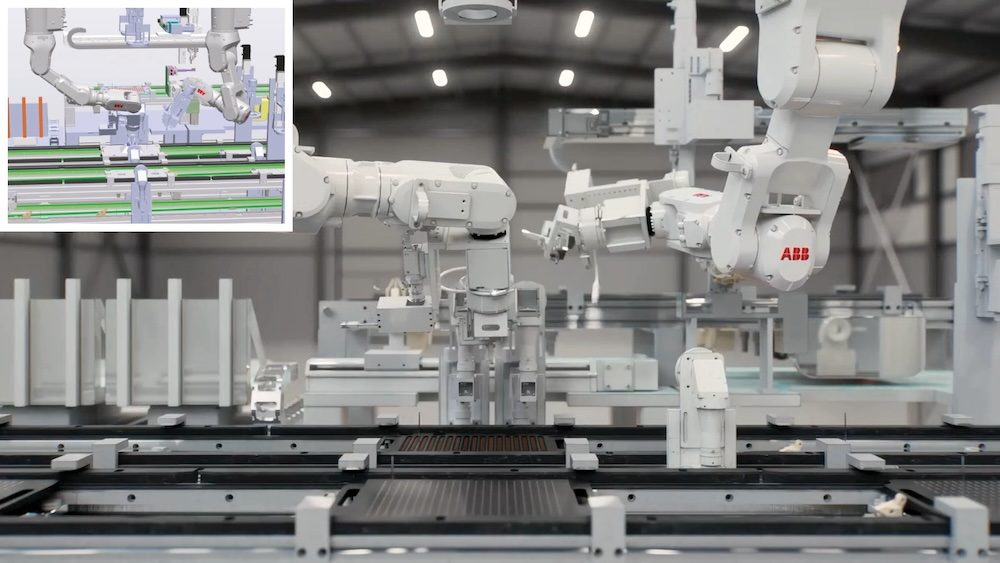
Industry experts discuss China blocking SoftBank acquisition of ABB Robotics
China's prohibition of SoftBank's purchase of ABB Robotics reflects wider concerns about data and AI, say experts. The post Industry experts discuss China blocking SoftBank acquisition of ABB Robotics appeared first on The Robot Report .

前OpenAI CTO推新模型,让用户自己训AI!创企估值被曝冲刺2600亿
智东西 作者 | 孙小雯 编辑 | 程茜 智东西11月6日消息,今日,前OpenAI首席技术官米拉·穆拉蒂创办的美国AI创企Thinking Machines Lab发布 通用多模态模型Inkling 2 Small ,并将于 下周 开放权重 。该模型重点改善定制训练表现,支持开发者用自己的数据进一步训练,也支持自行调用工具对其他模型进行微调。 ▲Thinking Machines官方公告(图源:X) 该模型在第三方评测机构Artificial Analysis(AA)的智能指数中获得31分,前代Inkling-Small为13分。按当前榜单,新模型开放权重后,将在该指数中位列 中国以外开放权