Researchers develop modular nanorobot

Illustration of the versatile nanorobot. It is 150 times smaller than the diameter of a human hair. (Illustration: Marina Bräm)
By Angelika Jacobs
Nanorobots sound like science fiction: tiny machines for medicine, the environment, or industry. In fact, nanorobotics has become a rapidly growing field of research. It is considered a promising approach, for example, for delivering active substances to specific locations in the body. Unlike their larger-scale counterparts, they are not made of electronics, computer chips, and software, but rather of biomolecules and nanoparticles.
Researchers led by Prof. Dr. Cornelia Palivan from the University of Basel are now reporting on a sophisticated modular nanorobot with greater functional flexibility than many existing systems. “Previous nanorobots are often designed for a specific task only,” says Cornelia Palivan. “Our modular system, on the other hand, can be adapted to different applications.” The technology could be used not only in medicine but also in industry and environmental technology.
Propulsion module and payload capsule
The nanorobot, which the team describes in the journal Advanced Functional Materials , resembles a lunar rocket with multiple modules. A magnetic propulsion module moves the nanorobot, while a second module serves as a payload capsule, safely transporting therapeutic agents or enzymes to their target location.
In previous work, Palivan’s team developed nanoscale polymer vesicles that protect encapsulated enzymes. Molecules can enter the vesicle through pores, be processed by the enzymes and then their products are released into the environment. The payload capsule of the nanorobot contains four such enzyme-loaded polymer vesicles, providing the desired functionality. Depending on the design, the vesicles inside the payload capsule can also be selectively opened, for example to release bioactive compounds.
A DNA-based molecular Velcro system
One of the nanorobots, imaged with a Transmission Electron Microscope. (Image: Voichita Mihali) .
The two modules are connected by a DNA-based “Velcro fastener”: complementary DNA strands on both modules ensure that the propulsion module and the payload capsule self-assemble in a programable manner and remain stably coupled.
To enable the nanorobot to dock onto specific cells or materials, the payload capsule is also equipped with additional biomolecules that facilitate docking. In the lab, the team tested this using a human cancer cell line known as HeLa cells. They loaded the nanorobots with fluorescent molecules and observed under the microscope that they accumulated on the surface of the cells.
Targeted attack on cancer cells and other applications
Equipped with the necessary enzymes, the nanorobots successfully produced an anticancer drug which reduced the viability of the HeLa cells to 16 percent within 72 hours. “The drug can have a concentrated local effect if we use our nanorobot to specifically target it to the cancer cells,” explains Dr. Voichita Mihali, the first author of the study.
Illustration of the nanorobot sitting on a surface. The enzymes in its payload capsule catalyze reactions, converting molexules from the environment into the desired product.
The nanorobot can attach itself to specific surfaces and carry out enzymatic reactions there. The enzymes (purple) inside the payload capsule convert molecules from the surrounding environment (left, dark gray) into the desired product (right, light gray). (Illustration: Marina Bräm) .
For other applications outside the medical domain, for example catalysis, another feature might prove particularly valuable: Since the propulsion module is magnetic, the nanorobots can be retrieved and reused after their task is completed. The researchers were also able to separate the two modules, refill the payload capsules, and recombine them with the propulsion modules.
The modular nanorobot represents an important step toward a multifunctional tool for a wide range of applications. Although its use in humans remains a long-term goal, the system can be readily adapted for other domains simply by modifying the payload capsule.
The work was conducted within the framework of the National Center of Competence in Research – Molecular Systems Engineering and the Swiss Nanoscience Institute. The University of Basel team collaborated with researchers from Heidelberg University.
Reference
Multiplex Modular Nanorobotic Systems with Catalytic Activity under Magnetic Navigation , Voichita Mihali et al. , Advanced Functional Materials (2026).
News is gathered automatically from public robotics & AI feeds on a schedule.
Related
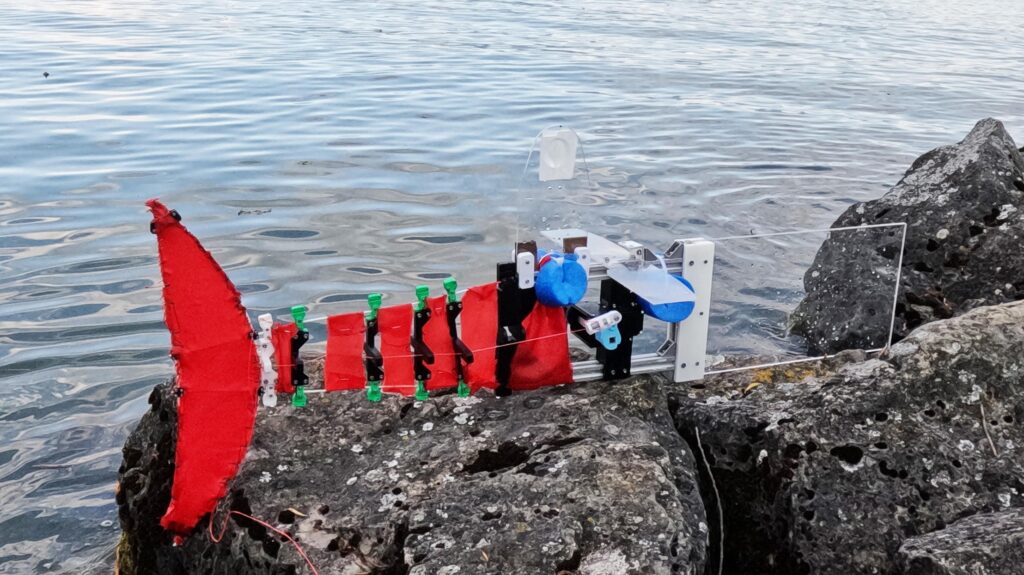
Small, medium or large, a robotic fish maintains its swimming ability
The scalable robot ScaFi. 2026 CREATE Lab EPFL. CC BY SA-4.0. Propeller-powered underwater vehicles have long helped scientists explore and monitor aquatic environments. But they’re limited by their own mechanics: spinning blades can snag on vegetation, stir up sediment, and startle the wildli

Video Friday: Life’s Better With a Little Robot Goose
Video Friday is your weekly selection of awesome robotics videos, collected by your friends at IEEE Spectrum robotics. We also post a weekly calendar of upcoming robotics events for the next few months. Please send us your events for inclusion. IROS 2026 : 27 September–1 October 2026, PITTSBURGH CoR

Robot Talk Episode 163 – Robots helping people, with Aaron Edsinger
Claire chatted to Aaron Edsinger from Hello Robot about their Stretch robots that can help people with mobility issues live more independently. Aaron Edsinger is CEO and Co-Founder of Hello Robot, a robotics company dedicated to developing practical, safe, and accessible robots for people. With a pa

An open source approach to physical AI from Intrinsic
Deborah Lupton / Pop Chips / Licenced by CC-BY 4.0 Intrinsic (an AI robotics group at Google) announced that the company is making parts of its platform open source. Intrinsic Core™ is a set of ROS-compatible capabilities for building sophisticated robotic applications. The capabilities included in

Mexican EPICS in IEEE Team Builds Portable Educational Platform
In Guadalajara, Mexico, many high schools have motivated teachers and talented students with an interest in science, technology, engineering, and mathematics, but they lack access to advanced tools such as robotics laboratories. The resources shortfall limits the students’ opportunities for hands-on

What’s coming up at #IROS2026?
The 2026 IEEE/RSJ International Conference on Intelligent Robots and Systems (IROS 2026) will be held from 27 September – 1 October in Pittsburgh, USA. The programme includes plenary and keynote talks, workshops, tutorials, forums, competitions, and a debate. Keynote talks The keynote talks wi