Robotics roadmaps from around the world spotlight of the month: United States of America
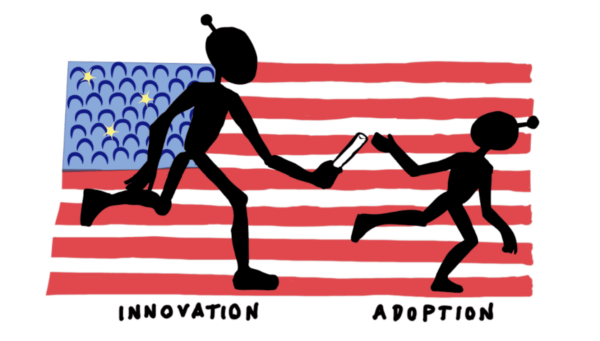
US robotics researchers and industry are looking for a cohesive national robotics strategy that will maintain basic research and innovation while improving domestic production and adoption of robots.
By Ellen H. Rumley and Allison Okamura
A leader in tech innovation
Robots are a crowd-pleasing example of American innovation and global technological leadership. The latest press release of Boston Dynamics’ Atlas executing the ‘Ghost Rabona’ soccer kick highlights the increasingly natural movements of humanoids ( 1 ). At the other end of the spectrum, academic researchers are redefining the limits of miniaturization and building robots at the micrometer scale ( 2 ). Private and government funding propel foundational research forward, leading to breakthroughs in both hardware and software across U.S. labs and corporations ( 3 , 4 ). Such progress reaffirms the U.S. as an intellectual and innovative powerhouse, a reputation that carries large geopolitical weight.
But retaining a lead solely in the R&D phase yields diminishing returns if the U.S. fails to manufacture robotic hardware at scale within its own borders. Critics fear this dynamic prevents the U.S. from reaping the economic benefits of the very technology it pioneers ( 5 , 6 ). Ramping up domestic production will require a heavily coordinated effort between government, industry, and academics – a pivot from traditional U.S. technology strategy.
Free market and military capital
Historically, the U.S. has maintained a laissez-faire approach to technological innovation, allowing corporate and private investors driven by the free market to shape the course of advancement. This innovation-first strategy is largely credited with fueling the growth of global tech giants and the rise of Silicon Valley, which altogether represents roughly 12% of the national GDP ( 7 ). America’s leadership in artificial intelligence can be largely attributed to this free-market engine, which prioritizes high projected profit margins and rapid scalability of software ( 8 ).
When it comes to U.S. robotics hardware, the Department of Defense/War (DoD/DoW) has stepped in as one of the primary catalysts for innovation and investment. The Pentagon’s fiscal year 2026 budget requested an unprecedented $13.4 billion for developing autonomous systems; a major increase from years prior. The DoD/DoW is requesting an additional $53.6 billion for autonomous systems and drones for 2027 ( 9 ). Private capital has quickly mirrored federal priorities; in the first quarter of 2026 alone, defense technology venture capital investments reached a record $19.8 billion. This surge is tightly bound to contemporary geopolitical conflicts, such as the hybrid warfare seen in Ukraine, where the U.S. plays a key role in funding drone production and in recent times deploying humanoids ( 10 , 11 ). The significant role that autonomous systems have played in conflict zones like the Strait of Hormuz has also signaled the high dependency of strategic military operations on robotics ( 12 ).
A bottleneck for domestic manufacturing
While investment in robotic innovation does provide certain economic benefits, it does not support U.S. competitiveness in critical industries – specifically in physical manufacturing. Hardware inherently requires higher, long-term capital expenditures and yields lower short-term financial returns compared to software. Consequently, there could be less incentive to compete against other global manufacturing leaders. Furthermore, while the DoD funds early-stage R&D and specialized military platforms, its mandate stops short of supporting commercial scaling efforts necessary to implement technologies for broader civilian and industrial applications.
As a result, while the U.S. is the third-largest consumer of industrial robotics in the world (with industrial adoption surging by 11% just last year in sectors like logistics, packaging and automotive) ( 13 ), it lacks the infrastructure to build what it consumes. While a few prominent U.S. companies do manufacture application-specific robots (some examples being Intuitive Surgical, Amazon Robotics, and Agility), the U.S. mostly relies on foreign imports for baseline industrial robot installations ( 14 ). Contrast this with Japan, which relies on foreign imports for a mere 2% of its domestic installations ( 15 ).
The systemic under-development in domestic robotic manufacturing leaves the U.S. vulnerable to hardware dependencies and supply chain disruptions. While industrial leaders like Japan and Germany are reliable trade partners, the U.S. government increasingly views hardware dependencies as a national security vulnerability. In recent years, robots have been reclassified as a critical dual-use technology, considered central to 21st century technological sovereignty ( 16 ). This reality makes robotics manufacturing a target for foreign adversaries, since foreign supply chains introduce operational chokepoints.
Currently, the U.S. government responds to these vulnerabilities through aggressive export controls and protective procurement policies, which are designed to slow down adversary agendas by blocking their access to the U.S. IP and markets. As one example, in 2021 the President issued the NSPM-33 (a national security memorandum directed to executive agencies) mandating federally funded research institutions to establish strict internal compliance frameworks ( 17 ). While designed to allow the continued recruitment of international talent, it enforces rigid vetting protocols on researchers potentially associated with Malign Foreign Talent Recruitment Programs (MFTRP) or of dual national affiliation ( 18 ). As another example, in early 2026 lawmakers proposed the bipartisan American Security Robotics Act , a bill designed to ban the federal procurement and operation of unmanned ground vehicles and humanoids manufactured by foreign adversaries, specifically targeting China ( 19 ).
Getting by…
News is gathered automatically from public robotics & AI feeds on a schedule.
Related
Small, medium or large, a robotic fish maintains its swimming ability
The scalable robot ScaFi. 2026 CREATE Lab EPFL. CC BY SA-4.0. Propeller-powered underwater vehicles have long helped scientists explore and monitor aquatic environments. But they’re limited by their own mechanics: spinning blades can snag on vegetation, stir up sediment, and startle the wildli

Video Friday: Life’s Better With a Little Robot Goose
Video Friday is your weekly selection of awesome robotics videos, collected by your friends at IEEE Spectrum robotics. We also post a weekly calendar of upcoming robotics events for the next few months. Please send us your events for inclusion. IROS 2026 : 27 September–1 October 2026, PITTSBURGH CoR

Robot Talk Episode 163 – Robots helping people, with Aaron Edsinger
Claire chatted to Aaron Edsinger from Hello Robot about their Stretch robots that can help people with mobility issues live more independently. Aaron Edsinger is CEO and Co-Founder of Hello Robot, a robotics company dedicated to developing practical, safe, and accessible robots for people. With a pa

An open source approach to physical AI from Intrinsic
Deborah Lupton / Pop Chips / Licenced by CC-BY 4.0 Intrinsic (an AI robotics group at Google) announced that the company is making parts of its platform open source. Intrinsic Core™ is a set of ROS-compatible capabilities for building sophisticated robotic applications. The capabilities included in

Mexican EPICS in IEEE Team Builds Portable Educational Platform
In Guadalajara, Mexico, many high schools have motivated teachers and talented students with an interest in science, technology, engineering, and mathematics, but they lack access to advanced tools such as robotics laboratories. The resources shortfall limits the students’ opportunities for hands-on

What’s coming up at #IROS2026?
The 2026 IEEE/RSJ International Conference on Intelligent Robots and Systems (IROS 2026) will be held from 27 September – 1 October in Pittsburgh, USA. The programme includes plenary and keynote talks, workshops, tutorials, forums, competitions, and a debate. Keynote talks The keynote talks wi