Simulated zebrafish and a vision-equipped robotic fish reveal how the body shapes brain circuits

Image credit: Olivier Porchet, Biorobotics Laboratory, EPFL
When a fish holds its position against a current in a river, its brain must figure out how fast to swim and how to steer to offset the water flow. Most fish use vision to register the world sliding past, detect optic flow speed and direction, and their brains turn these signals into compensatory swimming. Neuroscientists call this stabilizing reflex the optomotor response (OMR), from neural activity imaging. The retina captures signals of optic-flow direction, central pretectal neurons interpret direction, and spinal nerves drive muscle contractions.
The catch is that one cannot easily change the living brain to test how these circuits work. Although advances in imaging now allow detailed recording, and even manipulation, of neurons alongside behavior, rewiring connections to ask what a particular link actually does remains almost impossible in the living, complex animal.
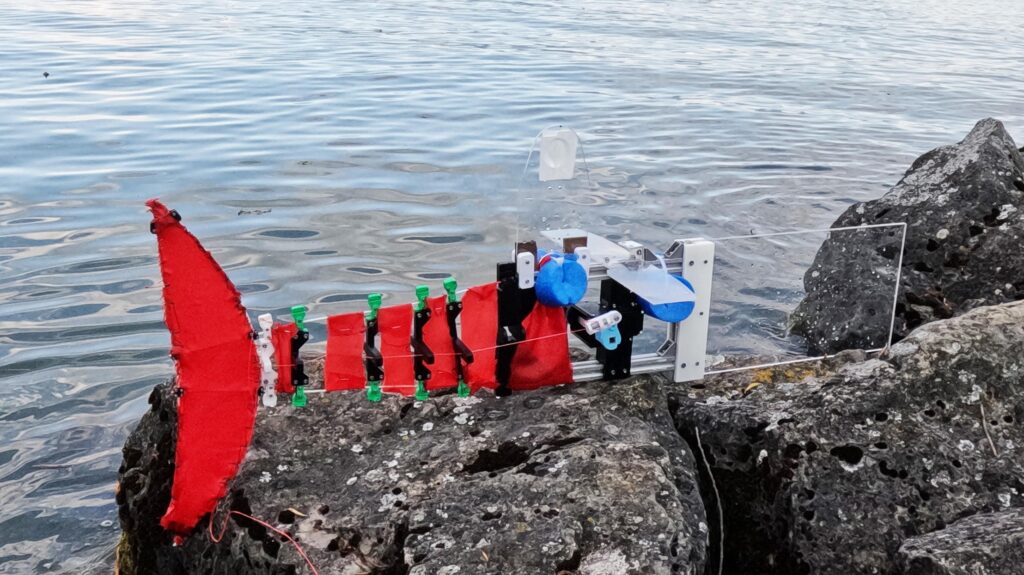
A joint team from EPFL (Switzerland), Duke University (USA), and the Instituto Superior Técnico (Portugal) took on this challenge by creating a realistic larval zebrafish simulation and a biomimetic robot, published in Science Robotics . The team found a way to replicate the body and known neural circuit architectures of live zebrafish, first as a physics-based simulation, then as a free-swimming robot that autonomously navigates upstream using vision and these bio-inspired neural circuits.
The results revealed the minimal set of neural components needed for the OMR and, more interestingly, showed that this balanced neural circuit allows autonomous upstream navigation even in poor visibility. It also highlighted that the fish’s body and eyes are part of the neural computation.
A blueprint from the living fish brain
The starting point was work in the Naumann Lab at Duke , where detailed behavioral studies and whole-brain calcium imaging of larval zebrafish exposed to visual stimuli that mimicked riverbed optic flow, paired with circuit modeling, yielded a best-fit wiring diagram of the brain-scale OMR pathways .
Drawing on other insights about neural processing in the vertebrate retina and spinal cord, Dr. Xiangxiao Liu and Luca Zunino from the EPFL team used this neural circuit model to develop a neuromechanical simulation, simZFish, that not only recreates the larval fish body, complete with eyes and fins, but also takes this experimentally derived brain blueprint to be the simulation’s brain, opening new paths for neuroscience and brain-inspired robotics.
simZFish: a brain you can take apart
Built in the physics-based Webots simulator, simZFish reproduces a six-day-old larva at 1:1 scale: a tiny 4 mm body, weighing only 0.3 mg with seven segments, driven by six simulated motors, a head with two sideways-facing cameras for eyes, and realistic water fluid dynamics. With just the right head-to-tail weight balance, the simulated simZFish moves just like real larval zebrafish. Its artificial brain replicates the entire neural circuit found in fish, from light-changing pixels to muscle activation.
The pretectum is a visual brain region that contains neurons that receive direct input from the retina, computing motion directions. The artificial retina detects motion and feeds four types of direction-selective ganglion cells, which drive pretectal neurons that integrate and process visual information from both eyes, and downstream hindbrain motor command neurons that set how often the fish swims and which way it turns. Finally, to emulate how the real fish swims in intermittent bouts, a “bout gate” releases a burst of tail beats, producing the characteristic burst-and-glide swimming of real larval zebrafish.
Because every part is simulated, researchers can change any aspect of simZFish’s body or neural connection weights, delete or add neurons, or change the eye’s lens and see the consequences immediately. In contrast, with animal experiments, one can only record correlations of neural activation if the fish happens to execute the behavior in question, but cannot exclude that some other processing was going on or easily change or interact with the internal structure. simZFish turns that black box into an open, well-lit one with identified components, allowing the team to pinpoint the “minimal essential elements” for OMR behavior.
Figure 1. The larval zebrafish-sized simZFish can swim around in simulated water in a virtual Petri dish and be presented with an unlimited number of visual environments. SimZFish has two laterally placed virtual cameras that can ‘see’ the virtual environment (top-left boxes), a sensorimotor controller, and six motors linked in series in the tail, enabling it to capture and respond to visual motion information.
The body is part of the computation
One specific insight from building this bio-inspired system concerned retinal-brain connectivity. With cameras on the sides of simZFish’s head, optic flow generated when fish are dragged in a river produces conflicting swirls across the visual fields, highlighting a version of the classic “aperture problem”. Therefore, feeding the motion information from the entire simulated retina into the circuit caused those signals to cancel out, breaking the OMR behavior. When the team restricted input to the lower posterior part of the visual field, the behavior snapped back into place.
Strikingly, that is exactly the region that most strongly drives the OMR in real zebrafish, and it matches the large, lower-posterior receptive fields neuroscientists have recorded in the real fish’s pretectum. The insight is not so much that the simulation “reveals” the circuit, but that embodiment, in this case the perspective distortion of the laterally placed eyes, explains why the circuit is wired the way it is: the layout of the body and eyes dictates a configuration that captures the most useful motion information with the fewest connections, an…
News is gathered automatically from public robotics & AI feeds on a schedule.
Related
Small, medium or large, a robotic fish maintains its swimming ability
The scalable robot ScaFi. 2026 CREATE Lab EPFL. CC BY SA-4.0. Propeller-powered underwater vehicles have long helped scientists explore and monitor aquatic environments. But they’re limited by their own mechanics: spinning blades can snag on vegetation, stir up sediment, and startle the wildli

Video Friday: Life’s Better With a Little Robot Goose
Video Friday is your weekly selection of awesome robotics videos, collected by your friends at IEEE Spectrum robotics. We also post a weekly calendar of upcoming robotics events for the next few months. Please send us your events for inclusion. IROS 2026 : 27 September–1 October 2026, PITTSBURGH CoR

Robot Talk Episode 163 – Robots helping people, with Aaron Edsinger
Claire chatted to Aaron Edsinger from Hello Robot about their Stretch robots that can help people with mobility issues live more independently. Aaron Edsinger is CEO and Co-Founder of Hello Robot, a robotics company dedicated to developing practical, safe, and accessible robots for people. With a pa
An open source approach to physical AI from Intrinsic
Deborah Lupton / Pop Chips / Licenced by CC-BY 4.0 Intrinsic (an AI robotics group at Google) announced that the company is making parts of its platform open source. Intrinsic Core™ is a set of ROS-compatible capabilities for building sophisticated robotic applications. The capabilities included in

Mexican EPICS in IEEE Team Builds Portable Educational Platform
In Guadalajara, Mexico, many high schools have motivated teachers and talented students with an interest in science, technology, engineering, and mathematics, but they lack access to advanced tools such as robotics laboratories. The resources shortfall limits the students’ opportunities for hands-on

What’s coming up at #IROS2026?
The 2026 IEEE/RSJ International Conference on Intelligent Robots and Systems (IROS 2026) will be held from 27 September – 1 October in Pittsburgh, USA. The programme includes plenary and keynote talks, workshops, tutorials, forums, competitions, and a debate. Keynote talks The keynote talks wi