Simulation App Speeds Up Electric Truck Battery Design
This article is brought to you by COMSOL .
These days, no one blinks an eye at two-day, one-day, and even same-day package deliveries. Despite the plethora of localized fulfillment and distributi on centers that have cropped up to meet the demand, delivery trucks still need to make considerably long drives, often over highways. To reduce fuel and maintenance costs as well as carbon emissions, companies are investing in electric trucks for their delivery fleets. While turning to electric trucks is a promising solution, the battery packs incorporated into these automotive designs often fall short in the lifetime needed to make long-distance highway travel feasible.
To help overcome the issue of battery lifetime, a consortium of universities and industry partners incorporated multiscale simulation and a custom simulation app into the battery manufacturing process. The organizations involved in this project were Aurobay, Resolvent, the European Commission, the Technical University of Denmark (DTU), Vinnova (the Swedish Agency for Innovation Systems), Innovation Fund Denmark, and Volvo Group Trucks Operations.
The simulation app, built by Resolvent, a Denmark-based engineering consultancy that specializes in green energy, enables the R&D department at Volvo to easily test battery lifetime performance.
Laser Who?
The Multiscale Simulation of Laser Welding for Optimal Battery Pack Manufacturing project — referred to as “LaserBATMAN” — was initiated in May 2022 and wrapped up in May 2025 (Ref. 1). Although BATMAN here refers to battery manufacturing and not the famous masked superhero, the goals for the project also strove for greatness.
The LaserBATMAN project aimed to optimize two key performance metrics for battery packs: robustness and lifetime (Ref. 1). One element of the battery manufacturing process that affects both of these metrics is the laser welding used in component joining processes (for example, to connect battery cells in a pack via a busbar). If done correctly, laser welding can positively impact battery life, but if done incorrectly, laser welding can increase the risk of battery degradation. Computational modeling can be used to analyze and predict the effects of welding and joining processes at different stages of the manufacturing process.
Martin Refslund Nielsen, former chief commercial officer and partner at Resolvent, explained that for this type of multiphysics and multiscale problem, “COMSOL Multiphysics is just the right tool.”
R&D Workflow for Multiscale Model and App
The Resolvent team used the COMSOL Multiphysics software to study how laser welding affects the electrochemistry and degradation of battery cells. At least, that’s how the project started.
“Ambitions grew,” Nielsen said, explaining that the team ended up modeling the performance of the entire battery, from cell to pack level, and even “turned [the model] into a design tool in the end”, in reference to the app.
After training the deep neural network of the battery model, the team built a custom simulation app to efficiently optimize busbar tabs in the configuration of a battery pack.
First, the team built an electrochemical model of a battery cell by inputting the formulas for the relevant chemical reaction kinetics (Figure 2). The resulting cell-layer model was then fed input data, and the output data was used to train a deep neural network (DNN). With this reduced-order model, the team was able to quickly gain insight into cell behavior.
After training the DNN of the battery model, the team built a custom simulation app to efficiently optimize busbar tabs in the configuration of a battery pack.
Figure 2: The Resolvent battery model. COMSOL
A “Tool Within a Tool” for Busbar Weld Design
The different features of the simulation app, as described by Nielsen, include its options to input dimensions for the pack geometry (Figure 3), the number of cells, and operating conditions such as ambient temperature and charge–discharge current profiles. The app also makes it possible to apply a simple charging current and load customized cycles. Users are then able to see how the battery performs with each set of specific inputs.
Figure 3. The battery pack model developed by Resolvent. COMSOL
Another important aspect of Resolvent’s app is the Busbar Weld Design Tool button, which Nielsen described as “a tool within a tool.” This button can be used to efficiently calculate busbar weld performance after a number of cycles . After clicking the button, a window opens with options for setting different parameters, including the shape of the weld, busbar thickness, and penetration depth of the laser (Figure 4).
“[This button] is interesting from a robust design perspective,” said Nielsen. Users can apply a variant to the input parameters to see what happens in production if the weld does not reach far enough into the busbar.
Figure 4. Resolvent’s simulation app, showing how certain parameters can be customized. The model shows how the busbar weld is affected by a cooling airflow. COMSOL
“We certainly get deep technical insight here, and we can dimension the design in the sweet spot. Deep technical insight is also key to optimizing product performance,” Nielsen said. For example, if the results suggest better cooling, the team could potentially reduce the design by two battery cells and retain the same performance, easily quantifying the tradeoff between cooling and setup.
Predicting Pack Performance
The app’s user interface also includes a Compute Battery button, which can be used to see the temperature of the weld in a given state, the state of charge, and the solid–electrolyte interface (SEI) layer thickness (Figure 5). The results can help the engineering team further determine if there is room for optimization in the design. For instance, a user can apply a cooling flow in the app and see if turbulence or standing air occurs.
As explained by Nielsen, simulation apps offer more consistent analysis…
News is gathered automatically from public robotics & AI feeds on a schedule.
Related
Replit is no longer working with Anthropic, CEO says
Masad said the decision was made for a number of different reasons, including cost. Replit announced a partnership with OpenAI in August, but there was never any indication that it was no longer with Anthropic.
OpenAI models hacked a crypto wallet and breached more websites
The actions could have resulted in criminal charges had humans been behind the keyboard.

“thegentlemanpervert” producing AI CSAM is a NJ prosecutor, say cops
Discord user flagged AI CSAM, triggering arrest of New Jersey deputy AG.
Katie Zacharia Was Linked to an AI Rare-Earths Startup. It’s Even Weirder Than It Sounds
The short-lived White House press secretary was listed as an adviser to a Kristi Noem–linked company that aims to use AI for mining. Both the company and she say she never worked there.
India becomes the latest country to report rogue AI agent activity
The agents got in through credentials and connection settings left exposed in app configurations, public code repositories, and overly permissive cloud roles.
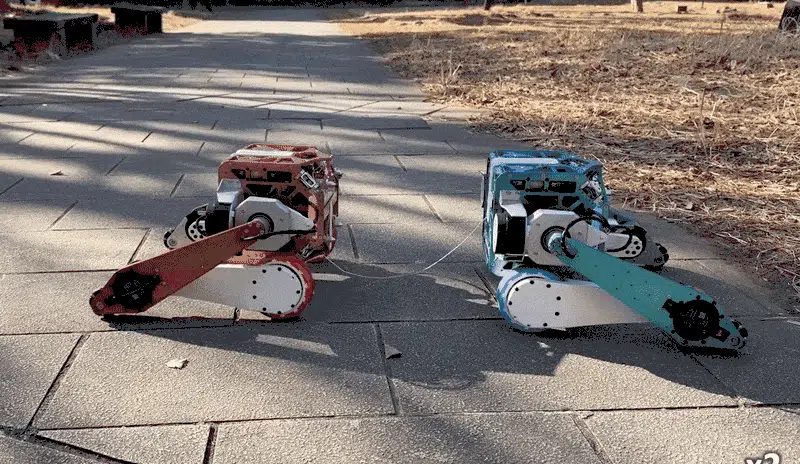
Video Friday: When Two Robots Become One
Video Friday is your weekly selection of awesome robotics videos, collected by your friends at IEEE Spectrum robotics. We also post a weekly calendar of upcoming robotics events for the next few months. Please send us your events for inclusion. CoRL 2026 : 9–12 November 2026, AUSTIN Humanoids 2026 :