Startup Makes Headway Toward Formalizing All of Math With AI
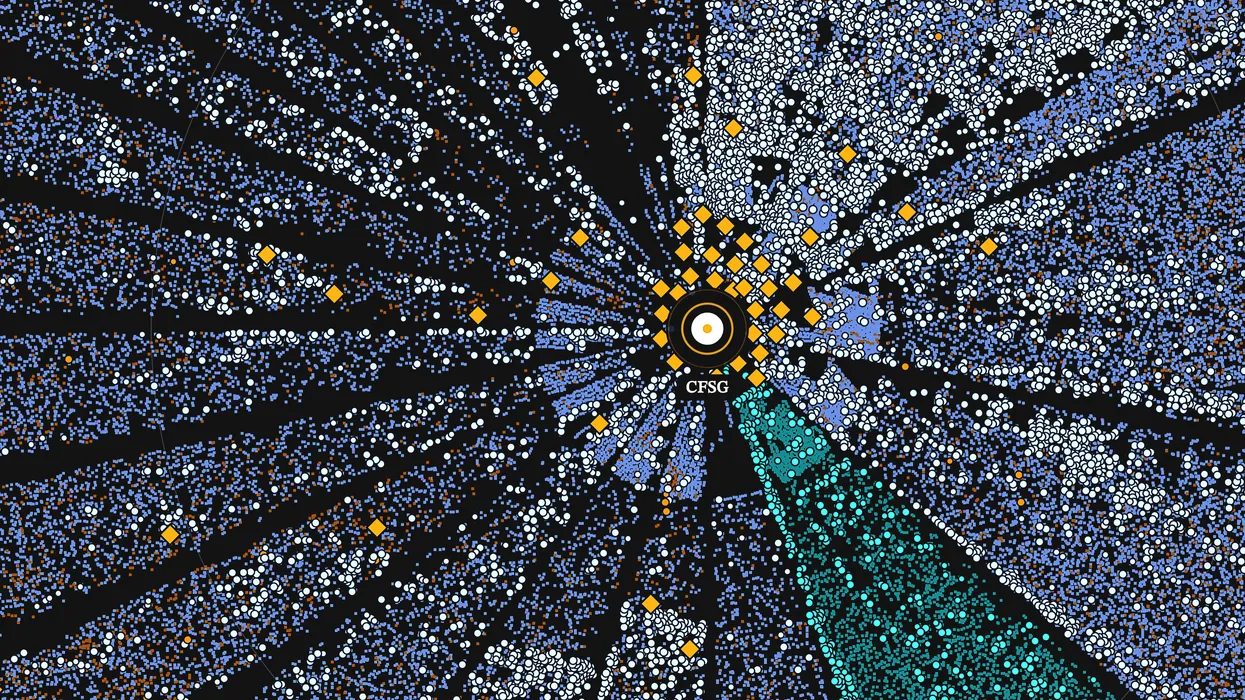
As Axiom Math ’s AI swarm was putting the final touches on the automatic verification of a 15,000-page proof of the classification of finite simple groups (CFSG) , colloquially referred to as the “enormous theorem,” on Sunday, 25 October, the company’s Founding Mathematician Ken Ono had nothing to do but watch and reflect on the achievement.
As the son of a mathematician , he had grown up surrounded by some of the architects of the CFSG’s proof, widely considered to be the longest mathematical proof ever written by humans. Now, he was contributing to formally verifying what his father and peers had created. “My wife was with me as I watched the team countdown to completing the verification,” he recalls. “God, I cannot tell you how emotional I was.”
University of St Andrews group theorist Colva Roney-Dougal (who was not involved in the work) says of formalizing CFSG: “I held it up as an example of something that was going to be incredibly hard to formalize because I had thought that the amount of computing it was going to require was just unattainable,” she says. “So when I heard the announcement, I was really, really surprised.”
This result, along with the concurrent formal verification of the 7,500-page Stacks project , represent a huge AI engineering achievement and lay some of the groundwork for digitizing all mathematics.
Formally Enormous
Why the hoo-ha? The CFSG concerns finite simple groups. These are groups (sets of elements combined with an operation, like addition or multiplication, that follows specific rules) that are simple (in other words, cannot be reduced or simplified further) and finite (as opposed to groups containing an infinite number of elements). For example, all the permutations of a deck of cards form a simple finite group.
Évariste Galois laid the foundations for group theory almost 200 years ago. Finite simple groups have since been classified by myriad mathematicians into 18 families (plus 26 sporadic simple groups that do not belong to any of these families). The CFSG’s proof confirms that this list is complete.
But this simple task was achieved only by bringing together results and arguments that far exceed what any individual mathematician can fully absorb from more than 500 journal articles written by around 100 authors over a half-century period. Translating this interconnected web of knowledge into code and verifying its correctness therefore posed a number of significant engineering challenges, even beyond those overcome in earlier proof formalizations by Axiom Math this year .
One of the hardest, according to Axiom Math’s Niels Voss , who led the CFSG formalization, was the sheer length of the proof. Over 15,000 pages of dense mathematics, the CFSG proof contains multiple theorems, lemmas, and definitions none of which can be checked until everything has been made machine-readable.
To get around this required some ingenuity. “We processed all the literature from the CFSG and traced the network structure of the informal proof before we were able to start working on it,” says Voss. “We then broke up the statement of the CFSG into about 100 milestones—landmark results along the way that can be independently verified—which we used to guide the formalization and stay on track.”
Roney-Dougal says she is very impressed with the result and particularly appreciates how the formal proof finds and clears up several mistakes in the original human proof. She thinks this result is critical to formalizing any modern research in group theory, such as her own work understanding how simple finite groups behave.
But, Roney-Dougal says, because the verification was done automatically, there are few mathematicians capable of extracting information from the proof to share with the community, and that a new generation of mathematicians may have “missed a chance to gain knowledge from the doing of it.”
Stacks of Ingenuity Required
Just nine days after the CFSG formalization announcement, Axiom Math revealed it had automatically formalized the Stacks project, too. Started in 2005 by Columbia University mathematician Aise Johan de Jong , Stacks is a massive, open-source collaborative mathematics textbook and reference work focused on highly abstract algebraic geometry and algebraic stacks (geometric spaces that are vital to modern string theory and number theory).
Whereas CFSG is a single (huge) landmark theorem, the Stacks project is essentially a well-structured library of thousands of interlocking definitions, constructions, and lemmas bringing all of modern algebraic geometry together.
The final Stacks formalization stands at a mere 16 million lines of code (compared to CFSG’s 43 million lines of code, roughly on a par with the Linux kernel), but it presented a different challenge to Axiom Math engineers: needing to achieve faithfulness and coherence across thousands of interlocking definitions and theorems, says Axiom Math’s Vasily Ilin , who led the project.
This required the team to design a hierarchical system of AI agents with specialized responsibilities working in parallel, keeping every definition aligned across the library, while also checking faithfulness with multiagent audits, cross-checks against sources, and hard tests. This ensured that every element and task aligned across the entire project.
A highly efficient, general, reusable, and maintainable formal library of foundational concepts underpinning much of modern mathematics, the impact of the Stacks formalization could be profound. Now, anyone or any bot can access the formal Stacks library and build new formal mathematics upon it. And together, the CFSG and Stacks formalizations represent a significant step toward formalizing all of mathematics. “They show the two ways formalization has to scale: one very long proof, and one very wide body of connected theory,” says Ono.
Ono and Voss see numerous advantages to a future in which formal mathematics becomes central: rubber-stamping…
News is gathered automatically from public robotics & AI feeds on a schedule.
Related
AI data centers are becoming harder to build, and neoclouds are feeling it
Nvidia has made clear it won’t backstop an AI data center until it’s nearly ready to run, and that’s landing just as neoclouds report construction delays and more expensive debt. The message to developers is that land, power and a finished building matter more than a pitch deck. Anita Verma-Lalli
丢个故事就行!直出15分钟AI短片,家里二舅也能上手
零基础也能做开发,智元灵心平台一年孵化超3万个机器人智能体
智元推出行业首个开放且完整的具身智能生态技术体系AIMA
算力唤醒真实世界:九章云极发布物理AI工厂与生态开放计划
11月25日,以“算力唤醒真实世界”为主题的2026物理AI行业峰会暨九章云极智算生态大会在深圳举行。
逐际动⼒与商汤⼤装置达成合作,以高质量算力全⾯⽀撑机器⼈仿真训练与测试
贯通具⾝智能研发流程

Amazon is reportedly in talks to end Muse AI shopping block
Amazon has held talks about letting Meta's Muse AI agent shop on its online marketplace, according to a report from Fortune. The discussions, which could end Amazon's block on Muse, reportedly center on the kinds of products the AI agent recommends and the potential impact on the ecommerce giant's a