Undergrads’ weed-killing robot wins top prize
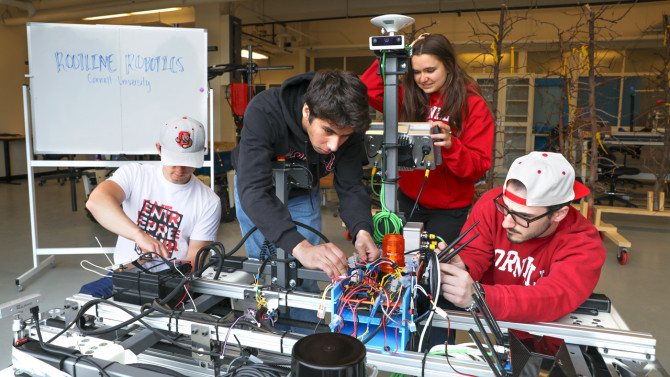
Andrew James (from left), Neil Morrison, Natalia Kurz and Michael Neiss work on a prototype of their weed-killing robot ahead of The Farm Robotics Challenge, which they won on May 21.
By Holly Hartigan
A team of Cornell undergraduates beat 95 other teams to take the grand prize at The Farm Robotics Challenge with their invention: an autonomous robot that kills weeds with electricity.
Their robot can travel through a vineyard or orchard without a human operator, zapping weeds with a small amount of electricity, saving labor and energy and preventing crop loss, without the use of herbicides.
Led by Andrew James, an agricultural sciences major in the College of Agriculture and Life Sciences (CALS), the team of agricultural specialists and engineers studied the existing electrical weeding technology, developed their own low-energy system and built a working prototype over the course of four intense months.
Natalia Kurz, a biological engineering major in CALS, said the project required a lot of late nights. “There were fears for us, like, was it just going to be for nothing?”
Now, James and his co-founders are using the $50,000 grand prize to form a company – Rootline Robotics – to continue working on the robot. Agricultural technology firm Reservoir sponsored the award and will host the startup at its incubator in Sonoma, California.
“I’ve always been interested in building a startup within the ag-robotics space,” James said. “So after winning this competition and seeing all the amazing support from so many different industry stakeholders in this really exciting collaboration, it makes a lot of sense to keep going.”
The problem of weeds
Weeds are a huge challenge in orchards and vineyards because they steal water and nutrients, especially in the spring, according to Steve Selin, owner of South Hill Cider in Ithaca.
“The weed pressure is very strong, and the grasses grow right up to the trees because we can’t afford to weed whack or mulch them as much as we would like to in order to control them,” he said. “If the trees get really stressed out, they’ll just drop the fruit.”
To control weeds, organic growers typically employ string trimming, mowing and mulching, which are all very labor intensive. Existing electric weeders require an operator, consume a lot of energy and cost $150,000, on average, which is out of reach for most growers, James said.
Selin provided feedback to the students as they developed their robot and said he is excited to try out Rootline’s new technology.
“In May and June, if you could do something to knock the weeds back enough that they’re not going to compete with the trees, then the rest of the year you wouldn’t have to worry about it,” he said. “You can let them come back and have positive impacts, like shading the soil, which would help the soil microbes to have a healthier ecosystem.”
The interdisciplinary nature of robots
“Robotics is many different systems in one,” Kurz said. “It is interdisciplinary by definition.”
Next, the Rootline team will work on improving its technology and validating it with growers before bringing it to market, all while Kurz and Neiss finish their degrees.
Neiss said the way the team came together felt a bit like destiny.
“If you have many different minds in one room that gives you the ability to reach solutions that are going to be the most feasible and effective,” he said.
News is gathered automatically from public robotics & AI feeds on a schedule.
Related
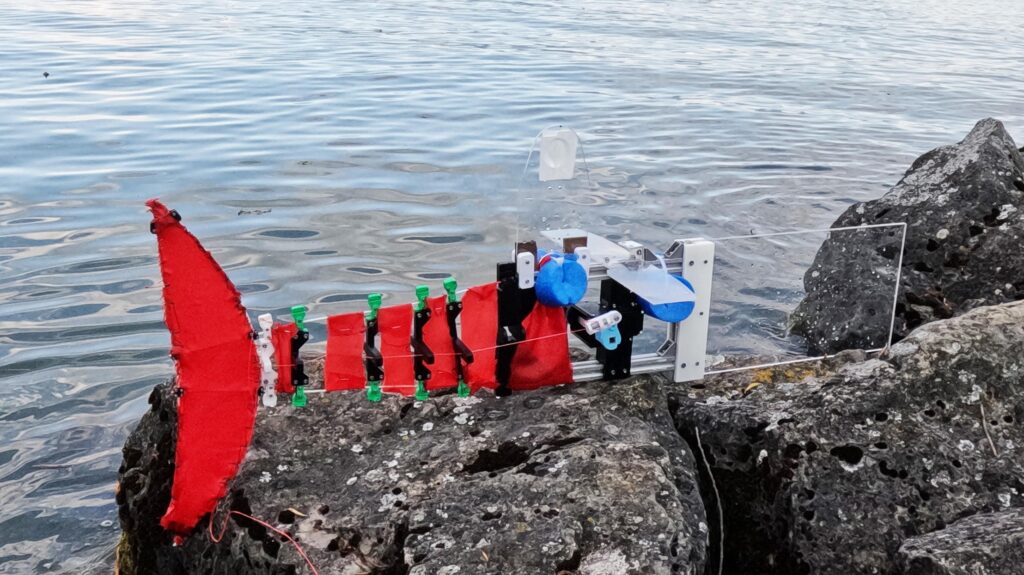
Small, medium or large, a robotic fish maintains its swimming ability
The scalable robot ScaFi. 2026 CREATE Lab EPFL. CC BY SA-4.0. Propeller-powered underwater vehicles have long helped scientists explore and monitor aquatic environments. But they’re limited by their own mechanics: spinning blades can snag on vegetation, stir up sediment, and startle the wildli

Video Friday: Life’s Better With a Little Robot Goose
Video Friday is your weekly selection of awesome robotics videos, collected by your friends at IEEE Spectrum robotics. We also post a weekly calendar of upcoming robotics events for the next few months. Please send us your events for inclusion. IROS 2026 : 27 September–1 October 2026, PITTSBURGH CoR

Robot Talk Episode 163 – Robots helping people, with Aaron Edsinger
Claire chatted to Aaron Edsinger from Hello Robot about their Stretch robots that can help people with mobility issues live more independently. Aaron Edsinger is CEO and Co-Founder of Hello Robot, a robotics company dedicated to developing practical, safe, and accessible robots for people. With a pa

An open source approach to physical AI from Intrinsic
Deborah Lupton / Pop Chips / Licenced by CC-BY 4.0 Intrinsic (an AI robotics group at Google) announced that the company is making parts of its platform open source. Intrinsic Core™ is a set of ROS-compatible capabilities for building sophisticated robotic applications. The capabilities included in

Mexican EPICS in IEEE Team Builds Portable Educational Platform
In Guadalajara, Mexico, many high schools have motivated teachers and talented students with an interest in science, technology, engineering, and mathematics, but they lack access to advanced tools such as robotics laboratories. The resources shortfall limits the students’ opportunities for hands-on

What’s coming up at #IROS2026?
The 2026 IEEE/RSJ International Conference on Intelligent Robots and Systems (IROS 2026) will be held from 27 September – 1 October in Pittsburgh, USA. The programme includes plenary and keynote talks, workshops, tutorials, forums, competitions, and a debate. Keynote talks The keynote talks wi