Two hundred applications, and nobody said a word
81% of job seekers in the UK and Ireland were rejected last year by a company where nobody ever spoke to them. 78% used AI to apply. 60% then rewrote their CV so it would not sound like AI.
On this page5
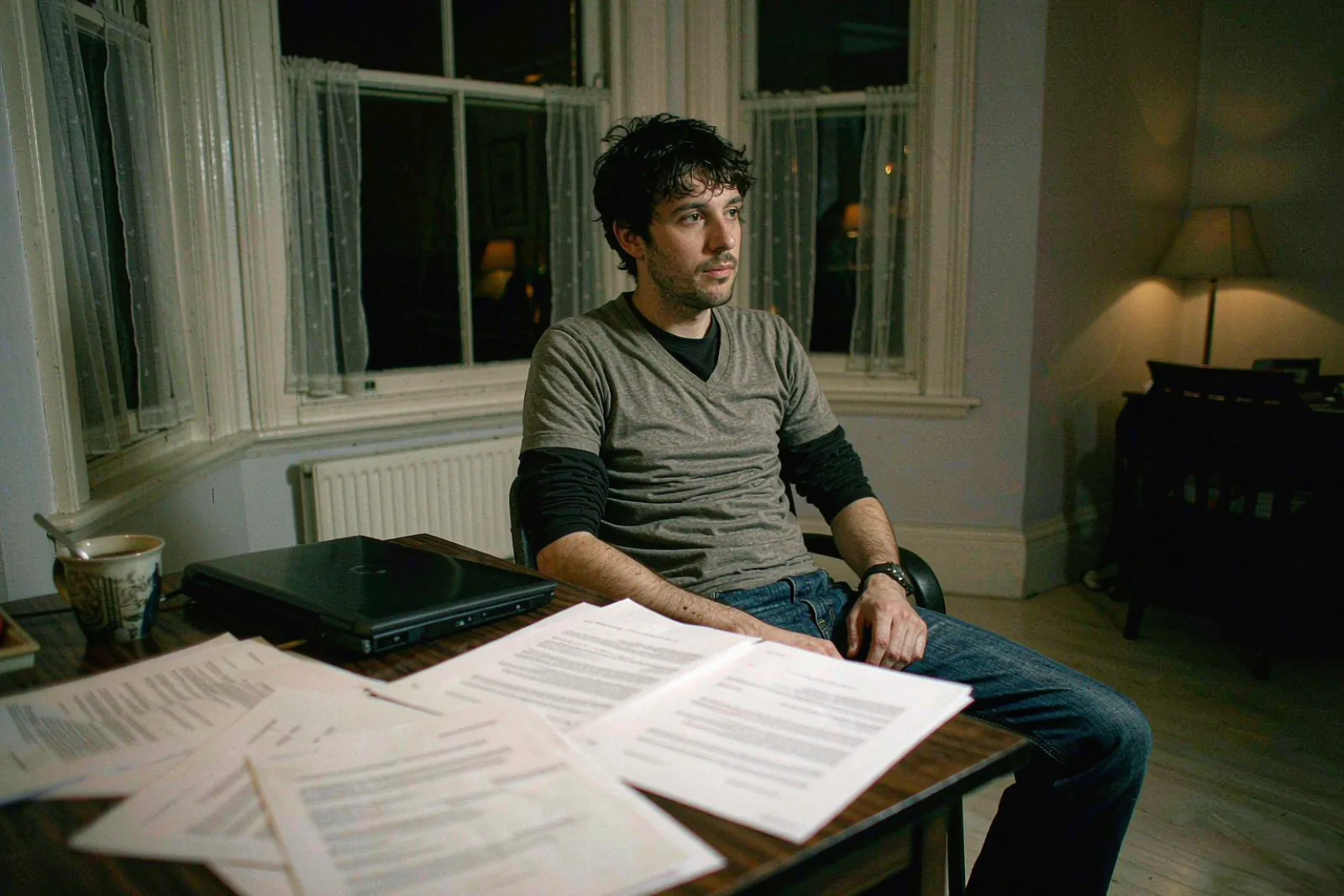
It is half past eleven and he is rewriting his CV again.
This is the fourteenth version. The first one he wrote carefully. By the second he was adding keywords. The fifth had a new layout. The ninth had no long sentences left in it. In this one, a single line has been rewritten three times, because it read too well.
He is not afraid of writing badly. He is afraid of writing so well it looks like a machine wrote it.
He is not the only one.
On 20 October, the hiring platform Greenhouse published its Future of Hiring: Candidate Report 2026. They asked 2,832 adults aged 18 to 64 who are currently looking for work, in the United States, the United Kingdom and Ireland, Germany and Australia.
The sharpest number in it has nothing to do with ability.
Four rejections in five arrive without a voice
81% of job seekers in the UK and Ireland said that in the past year, at least one job rejected them without anyone at the company ever speaking to them.
Not "they interviewed me and said no". No conversation at all. No recruiter, no hiring manager, not even an automated interview.
The United States came out at 81% as well. Australia 85%. Germany 86%.
31% said it happens often or almost every time. Among Gen Z, that figure is 38%.
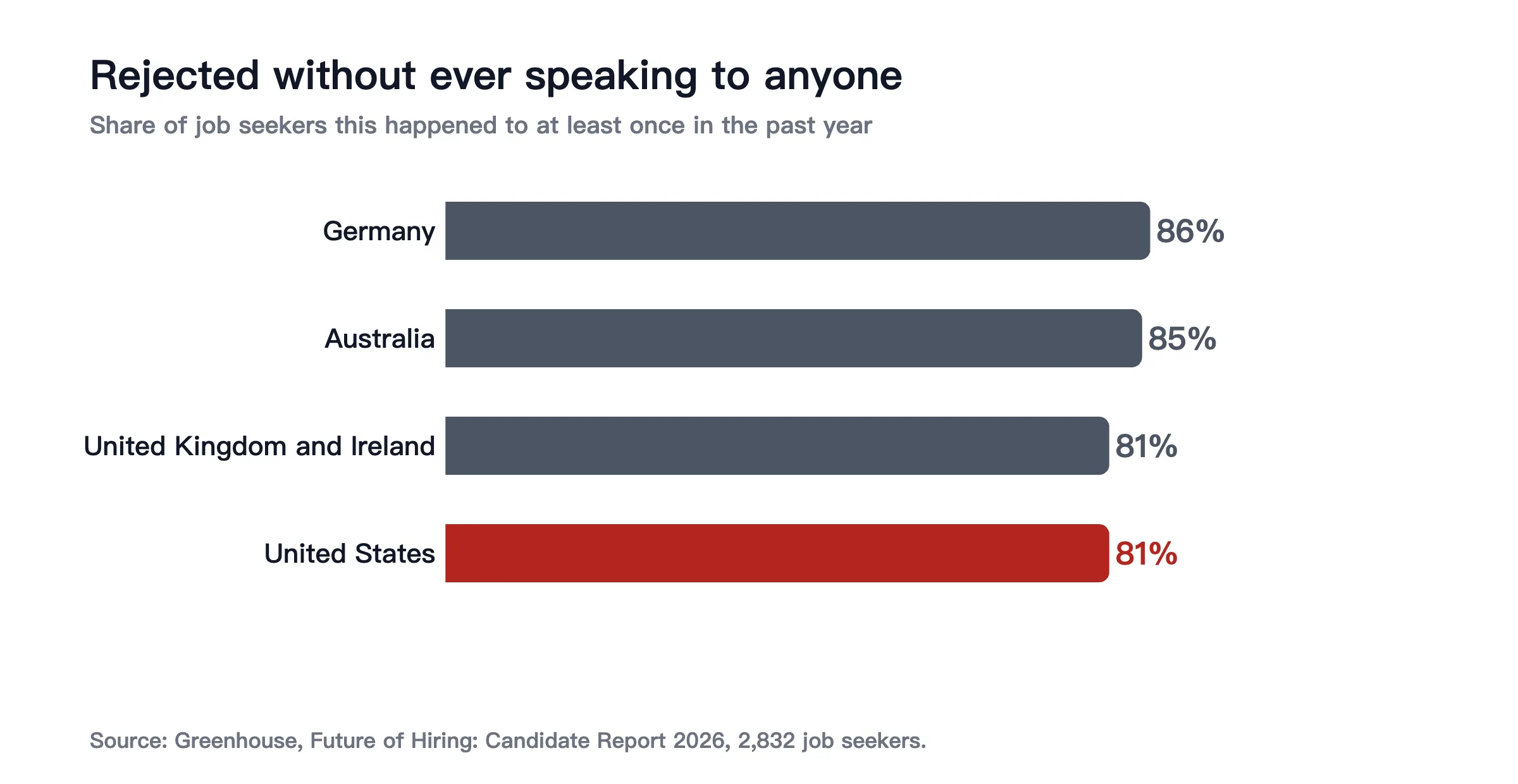 Share of job seekers rejected in the past year without ever speaking to anyone: Germany 86%, Australia 85%, UK and Ireland 81%, US 81%
Another set of numbers in the same report only makes sense next to that one.
78% of job seekers in the UK and Ireland used AI at some point in the last year of searching. The United States 77%. Australia 84%. Germany 87%.
The more they use it, the more they hide it. 60% have changed how they write, or thought about changing it, so they would not be read as AI. 39% actually did it. Another 21% are considering it. Among Gen Z it reaches 63%.
And 62% have tried to get around automated screening on purpose. 54% used AI to guess what the system wanted. 40% added skills or keywords they do not have. A third of those hid white text in the footer, written for the machine and invisible to anyone who opens the file.
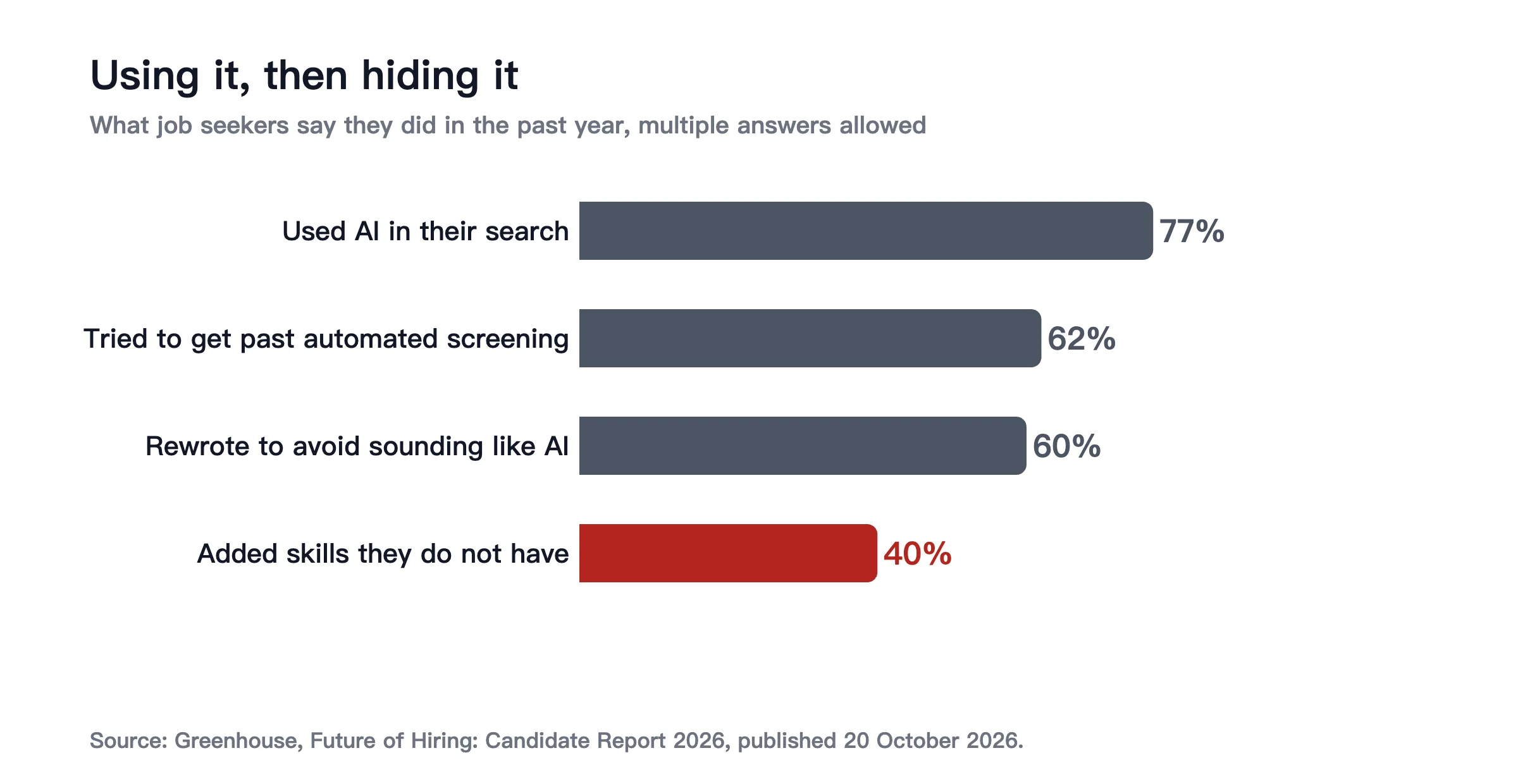 77% used AI in their search, 62% tried to get past automated screening, 60% rewrote to avoid sounding like AI, 40% added skills they do not have
They use a machine to send more, then spend longer proving they are not one.
The other side is using it too
Tom Hyde at Greenhouse tells a story about one client. They were hiring a marketing director. Twelve candidates made the first cut. Six of them sent a cover letter. The hiring manager opened all six and found at least one paragraph that was identical in every one.
That is a director-level role.
On the employer side, Recruitics published another report the same day. Among companies with more than 5,000 employees, 97% now use AI somewhere in hiring, most often to screen and rank CVs.
Both sides are using it. Both sides are more tired. In the Recruitics data, hiring teams spend an average of nine hours a week on applications that are unqualified, duplicated or dishonest. And the more stages use AI, the more time they lose: teams using it in four or more stages lose 10.4 hours a week, against 7 hours for those using it in three or fewer.
Automation did not buy the time back. It moved it. Candidates spend it rewriting. Employers spend it working out what is real.
How I read this
I do not think the problem is AI screening CVs. Screening has always existed. It used to be a recruiter spending seven seconds on a page.
What changed is the price of saying no.
It used to cost something to refuse someone. Someone had to type "we read it, it is not quite right", or make a call. That takes three minutes and a small amount of nerve, which is why refusing two hundred people used to be hard work. Now a model runs once and two hundred applications disappear together. Nobody has to own the word no.
Once the cost is zero, silence becomes the default. It is not aimed at anyone. It is simply the cheapest option.
And the cost moves. 81% of people get no explanation, so they guess. Too old. Wrong university. The gap in the middle. The photo. Guess long enough and people stop applying. That kind of quitting is quiet. It will not show up on anybody's dashboard.
"Not this time, and here is why" takes three minutes. Skip it and the other person pays for it with their own estimate of what they are worth.
Five specific things worth doing now
One: move the effort from polishing the CV to finding one actual person.
71% of people in the report did something extra to get noticed, and nearly half of that was looking for a referral. Referrals work because they skip the ranking step and turn an application back into one person looking at another. Find somebody who worked there. Ask three concrete questions. That beats version fourteen.
Two: put verifiable things in the CV, not adjectives.
When both sides are using AI, "strong communicator" is worth nothing. Project names, dates, the bit you owned, numbers you can explain. Those are hard for a machine to invent and awkward for a person to fake.
Three: do not hide white text. Do not claim skills you do not have.
40% do it because it works when nobody notices. When somebody does notice, you are out, and you will not get a reason. The trade is not worth it.
Four: if you are offered an AI interview, ask two questions first.
48% went through one in the past year. Of those, 70% felt it let them show what they can do. The same people stated their conditions: 49% want to know a human reviews the result, 40% want to know how they are being assessed. You are entitled to ask both. Ask before it starts, in reply to the confirmation email. How they answer is itself a filter.
Five: keep your own record.
Which company, which role, what date, any reply, how long it took. After three weeks you will notice something: some of these roles were never going to hire anybody. Once you can see that, the emotional cost drops sharply.
One last question
There is one more number in the Greenhouse report. Of people who did get an interview, 96% had at least one complaint, and the most common was not rejection. It was being ghosted, at 45%.
Rejection is not the worst part. The silence is.
So: when did you last receive a sentence that began "we read it, it is not right for us, because..."? If the answer is never, you already understand why so many people stop halfway through.
Sources:
- Greenhouse, Future of Hiring: Candidate Report 2026, published 20 October 2026, 2,832 job seekers in the US, UK and Ireland, Germany and Australia, https://greenhouse.io/newsroom/6-in-10-job-seekers-are-rethinking-how-they-write-to-avoid-sounding-like-ai-even-as-most-use-it-in-their-search
- HRD, interview with Greenhouse's Tom Hyde and country-level breakdown, https://www.hcamag.com/nz/news/general/ai-in-hiring-leaves-most-job-seekers-rejected-without-a-conversation/594138
- Recruitics, State of AI in Hiring 2027, published 20 October 2026, 159 hiring leaders at large employers, summarised by Best Practice Institute, https://bestpracticeinstitute.org/workplace-report/the-silent-rejection-ai-hiring
Related reading
AI Insights
Ofcom spent nine months on this. Here is what it can and cannot do.
Ofcom opened its case into X in January and narrowed it in October. It secured new restrictions for UK users of Grok. It still cannot order an individual image down, and an urgent court order was out of reach.
The Budget put a price on AI's electricity. Nobody put it on your bill.
The Budget launched a British Data Centre Covenant: five tests a data centre must meet to get priority grid connections. The first is that households should not pay for the energy costs it creates. The second is a Local Benefit Plan.
The photo you posted in 2016 is now in somebody else's training set
On 21 October the Council of the EU agreed that companies may rely on legitimate interest to process personal data when building AI. It is not law yet. What it moves is the default: from opt-in to opt-out.