Boston Dynamics built Stretch Gen 2 for reliable, consistent performance
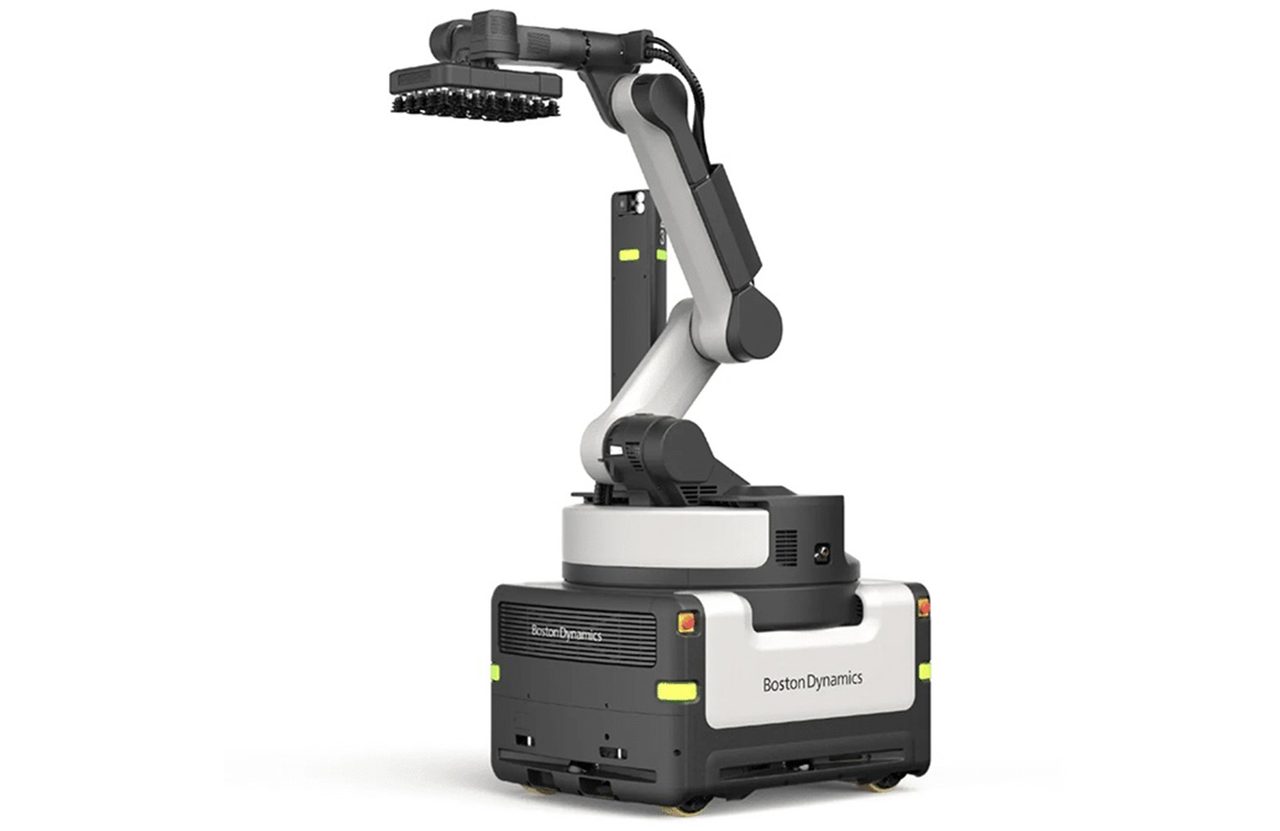
The new Stretch features an updated modular design that enables “plug and play” part swaps. | Source: Boston Dynamics
Boston Dynamics Inc. this week unveiled Stretch Gen 2, the latest generation of its autonomous mobile trailer unloading robot. With over 100,000 operating hours and tens of millions of boxes handled under its belt, the company built the updated robot to maximize uptime and streamline maintenance.
Brian Donnelly, the vice president and general manager of logistics robotics at Boston Dynamics, told The Robot Report that the company has been working on the new version of Stretch for around two and a half years.
“When we made the first generation of Stretch, we were focused on trying to get a product out into the market as fast as possible and really get it in customers’ hands and get it operational,” he said. “It was not the easiest to manufacture; there were a lot of components.”
“[With Stretch 2], we really were focused on simplification, hardening the robot, and really driving improved reliability and performance,” added Donnelly. “That’s really what drove a lot of our decisions was just making the robot better in every way.”
Stretch Gen 2 can unload up to 1,000 cases per hour. This rate is highly dependent on factors such as case weight and how neat or disorderly cases are stacked. It has a multipick feature, a battery that can last two shifts, and a fast charger that can get it to 90% charge in about 75 minutes.
The mobile manipulator also features onboard lighting, making it easier to work in dark trailers, and a pre-trained vision system that can detect most packages without programming needed.
Stretch’s hardware upgrades improve durability
Boston Dynamics geared many of Stretch Gen 2’s upgrades towards reducing downtime and making the robot more durable. For example, the Waltham, Mass.-based company also cut 81% of the internal cabling, around half a mile’s worth.
“[Cabling] is weight, it’s cost, and its points of failure, particularly when you have something that’s in constant motion, you’re creating strain on those cables with every motion,” Donnelly said. “If you don’t have good strain relief, you don’t have good ways of managing the cables in the robot. It can cause stress on the cables and then failure.”
Donnelly said Hyundai helped the company source a cable harness through its automotive supply chain. This isn’t the only thing Boston Dynamics learned from the automotive industry. Stretch Gen 2 uses heavy-duty automotive-grade connectors. These hold up to the vibration of rapid, high-torque box handling and driving over uneven floors.
“In the automotive industry, they have to deal with a lot of real-world challenges in their vehicles. There’s a lot of miles driven dealing with shock and vibration and things like this,” Donnelly said. “As a robot moves around the world, just like a car, if you don’t have latching connectors, then they can sort of wiggle apart. By leveraging those automotive connectors, we’re much more confident that the connectors are going to stay latched together and not pull apart in the field.”
The robot also has continuous rotation joints that move beyond 360° so they no longer hit hard stops. This can help prevent previously caused mechanical stress. Donnelly pointed out this also makes the robot more productive, as it can completely optimize its trajectory planning and move in any direction.
The emergency stop on the robot now sits lower and is recessed. Boston Dynamics made the exterior panels with new materials so a falling box is far less likely to trip an unintentional safety stoppage or break a panel.
How Stretch Gen 2 gets a grip on multiple boxes
The gripper is the part of the robot that often deals with the most stress. It’s making contact with all of the the things the robot needs to handle. Stretch Gen 2 features an upgraded gripper with new valve systems and more precise sensing improves grasping and placement to optimize fast-paced picks.
“[The new gripper] has a value in every suction cup, which enables us to pick multiple boxes with a single motion of the arm, which substantially increases our throughput,” Donnelly explained. “If we can pick multiple boxes, with a single motion of the arm, we get much higher throughput because the pick cycle of picking up a box from the floor of a container and place it to a conveyor is dominated by arm movement. So, if we can keep the arm moving and just do more every cycle, that is really effective and improves the rate at which we can unload a truck for our customers.”
The new gripper is also better at configuring boxes on the conveyor belt in ways that work best for Boston Dynamics’ customers, and use less power in picking up boxes.
“Every cup is individually sensed and actuated, so we know when we have good suction,” said Donnelly. “We only have the value open to pull suction when we have good contact on a box, so that enables us to reduce the amount of power we’re spending running on the vacuum pump, so we’re not pulling suction through cups that don’t have good contact. It also enables us to, when we pick up those multiple boxes, singulate them onto the conveyor.”
Stretch Gen 2 brings service time down to just hours
With Stretch Gen 2, Boston Dynamics didn’t just want to reduce the frequency of service calls; it also wanted to make those service calls faster when they do happen.
“We didn’t have as much experience from a serviceability perspective as a company when we made the first-generation robot,” Donnelly said. “We’ve since deployed these robots, serviced them in the field, and hired a lot of people who have a lot more experience than we originally did in service. Their input and guidance really helped us to make a robot that’s much more manufacturable and more serviceable.”
The robot doesn’t require dynamic cables and complex harnesses. Instead it uses standardized high-strength fasteners to cut down on tool changes and hands-on repair time. For example,…
Les actualités sont collectées automatiquement depuis des flux publics robotique & IA.
Articles liés

Robot integration brings high-precision production to midmarket manufacturers
Properly integrated industrial and collaborative robots can help midmarket manufacturers, according to a columnist. The post Robot integration brings high-precision production to midmarket manufacturers appeared first on The Robot Report .

刚刚,OpenAI被曝又拿730亿,估值超8.3万亿
智东西 编译 | 毕伟豪 编辑|云鹏 智东西11月7日消息,刚刚,据彭博社报道, OpenAI已完成新一轮融资的首批资金交割 ,金额约为 110亿美元(约合人民币734.4亿元) ,公司估值达到 1.25万亿美元(约合人民币8.35万亿元) 。 据知情人士透露,截至当地时间周五,相关融资款项已经汇入OpenAI账户。 本轮融资总额最高可能达到200亿美元(约合人民币1335.3亿元) ,剩余部分预计将在未来几周内完成,截至目前,OpenAI尚未公布本轮融资的最终金额。 参与首批资金交割的投资方包括 Coatue Management和普信集团(T. Rowe Price) 。本轮其他投资方还包

How Point One turned GPS accuracy into a robotics platform
Aaron Nathan explains how precise location technology like GPS is enabling robots to navigate, coordinate, and scale across real environments. The post How Point One turned GPS accuracy into a robotics platform appeared first on The Robot Report .
Industry experts discuss China blocking SoftBank acquisition of ABB Robotics
China's prohibition of SoftBank's purchase of ABB Robotics reflects wider concerns about data and AI, say experts. The post Industry experts discuss China blocking SoftBank acquisition of ABB Robotics appeared first on The Robot Report .

前OpenAI CTO推新模型,让用户自己训AI!创企估值被曝冲刺2600亿
智东西 作者 | 孙小雯 编辑 | 程茜 智东西11月6日消息,今日,前OpenAI首席技术官米拉·穆拉蒂创办的美国AI创企Thinking Machines Lab发布 通用多模态模型Inkling 2 Small ,并将于 下周 开放权重 。该模型重点改善定制训练表现,支持开发者用自己的数据进一步训练,也支持自行调用工具对其他模型进行微调。 ▲Thinking Machines官方公告(图源:X) 该模型在第三方评测机构Artificial Analysis(AA)的智能指数中获得31分,前代Inkling-Small为13分。按当前榜单,新模型开放权重后,将在该指数中位列 中国以外开放权

扎克伯格29岁“接班人”的百亿朋友圈,藏着“硅谷新黑帮”
智东西 作者 | 江宇 编辑 | 云鹏 一个由华尔街量化实习生组成的“ 硅谷新黑帮 ”,再次走入聚光灯下。 智东西11月4日报道,近期,英国《金融时报》刊发了对 Meta首席AI官、29岁华裔创业者亚历山大·王(Alexandr Wang)的人物报道 ,讨论了他在Meta内部的影响力,以及未来接替扎克伯格掌管这家科技巨头的可能性。 而接班人传闻出现两天后,亚历山大·王再秀了一把存在感,向外界展示了自己的另一重身份。 10月19日,他在X上晒出一张与Cognition联合创始人Scott Wu、Hyperliquid联合创始人Jeff Yan的合影, 配文是“HRT帮又聚齐了!”(got the