Atlas Robot’s New Hand May Outperform Humanlike Designs
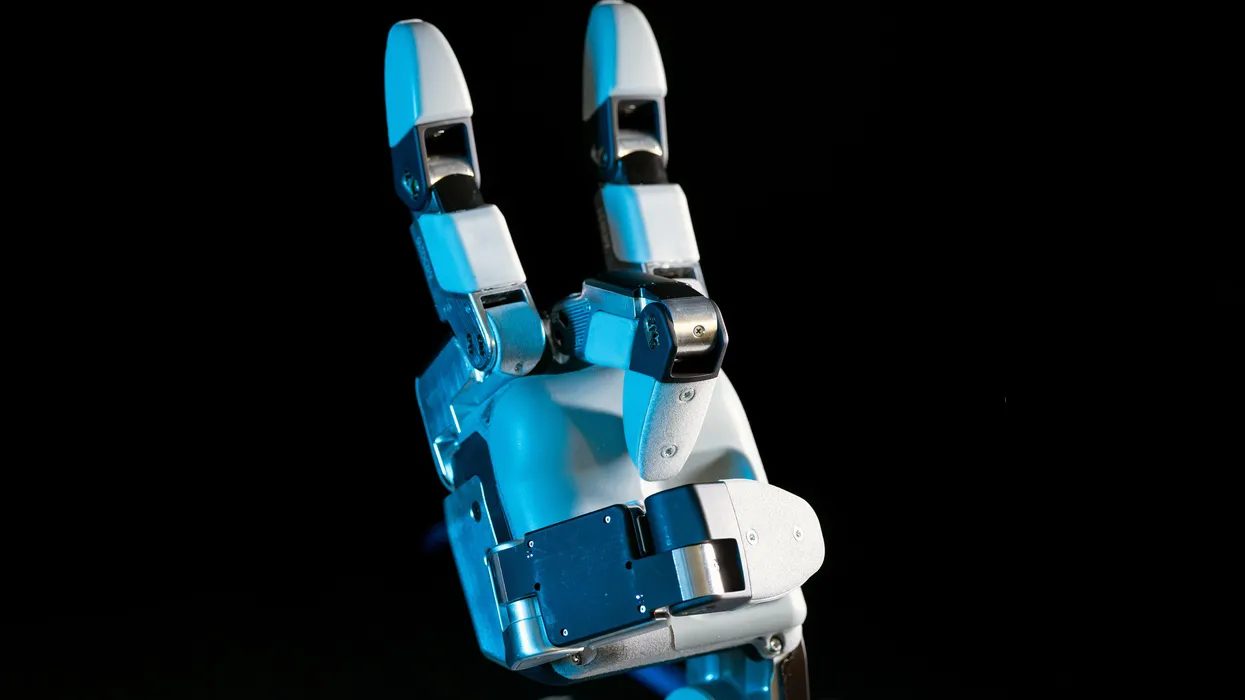
Today, Boston Dynamics is announcing a redesigned hand for its Atlas robot . The previous generation could do some crazy superhuman things with its three fingers, but it was never intended for mass production in the tens or hundreds of thousands. Switching from research hardware to a scalable product makes previously ignorable questions suddenly paramount: How can you make a hand that does everything you need it to do but is also rugged and reliable and cost-effective? It’s questions like these that drove the design of the new Atlas hand, and while it doesn’t look much like a human hand, it might be a hand that makes it out into the real world.
- YouTube www.youtube.com
Compared to the almost eerily humanlike hands designed by a litany of other humanoid robotics companies , Atlas’s new hand does look awfully clunky. We’ve certainly seen some of those robots with much more humanlike hands perform dexterous manipulation tasks that are, speaking as someone who has personally witnessed robots haplessly fumble their way through the world for nearly two decades now, nothing short of incredible. And it’s not just what these hands can do—it’s how they look while doing it, as slim, graceful mechanical copies of our own hands. They seem like science fiction, and to some extent, that’s exactly what they are.
“Hands are a ruthless design trade-off,” Alberto Rodriguez , director of robot behavior at Boston Dynamics, tells IEEE Spectrum . “There’s no way around it, you’re always giving up on something. And many of the current designs are giving up on things like reliability and manufacturability.” This is what invariably happens when you try and cram everything necessary to make a robotic hand function within the form factor of a human hand: It’s going to be either very fragile or very expensive, and likely both at the same time. The unfortunate reality is that for now, and likely for the immediate future, all that these sorts of hands are good for are research and demos.
With Atlas’s new hand, Boston Dynamics is making the design trade-offs necessary to achieve a hand that, according to the press release, is capable of a vast array of useful tasks, including using tools; is strong and rugged; can be cleanly simulated; can be mass-manufactured and repaired at reliably low cost; and is close enough in form factor to a human hand that human demonstrations can be used to train it.
You’ll notice that “looks cosmetically like a human hand” is nowhere on that list, and this new hand doesn’t. Rodriguez explains that getting rid of the pinky was a straightforward decision, agreed on after his team spent a day with their pinkies taped to their ring fingers. But why even add a fourth finger, when the previous generation of Atlas’ hand seemed to do well with only three? It’s not just the extra finger, but a complete redesign that almost doubled the degrees of freedom between the old hand and the new, going from 7 to 13.
Boston Dynamics
“We also added the ability for the fingers to splay open because we knew that it was important for one finger to be able to move against another, and we also knew that we needed to be able to hold the handle of a tool with a trigger,” Rodriguez says, which includes many common tools like drills or welding torches. “We’re convinced that from a product perspective, this hand should be able to do everything we need it to do for the foreseeable horizon.” And that ability to finger splay goes beyond what human hands are capable of. According to Rodriguez, “With reinforcement learning, we can discover uses for these superhuman extra motions and exploit them.”
Reliability, manufacturability, and cost are all closely related. By reducing the degrees of freedom relative to other more anthropomorphic hand designs down to just 13, Boston Dynamics can use fewer, larger, and more powerful actuators. The actuators are embedded directly into the joints themselves in a direct-drive configuration, with a transmission that allows the motors to be back-driven and react to force and contact. Each actuator pack is a single unit that can be easily replaced, and there are no delicate tendons or cables across joints to stretch and break. “What we’re working on right now is figuring out what needs to change in the fine details of our design if we want to make 100,000 of these hands a year,” Rodriguez says.
Not every humanoid company will make the trade-offs that Boston Dynamics has done here, and there’s still plenty of room for creativity when it comes to hand design. But if humanoids with hands are going to scale, some difficult decisions will have to be made, and it’ll take some compromise to deliver on the promises that the humanoid industry has committed to.
News is gathered automatically from public robotics & AI feeds on a schedule.
Related
The U.S. Nuclear Plant Fleet Is Leaning Into AI
If there is any place that would be off-limits to AI, the control room of a nuclear power plant certainly sounds like one. The nuclear industry is historically cautious and risk averse—understandable given the possible catastrophic consequences of an accident or a mistake. Even well-trained managers
This Disembodied Hand Is All the Robot You Need
A hand attached to the end of an arm is a given for most humans, but what if robots didn’t have to play by the same rules as we do? Researchers from ETH Zurich have turned an off-the-shelf robotic hand into a completely self-contained robot that walks on its fingertips while using those same fingers

HiPHI: A Large-Scale Benchmark for High-Precision Human Motion and Object Interaction
This White Paper gives robotics researchers and engineers an overview of a new large-scale motion capture dataset built to close the data gap limiting humanoid robot learning. It also shows how policies trained on the dataset transfer to a real humanoid robot. What you will learn about: Why humanoid
What three days building a robot taught me
Last month, I went to York to build a robot. I came back with a robot, a tiny trophy-shaped sense of achievement, and somehow a few new friends. From 25th-27th August, I joined the UK RAS STEPS MicroMaze Robot Hackathon at the Institute for Safe Autonomy, University of York. The brief sounded simple
6 Guidelines for Governing AI
For the first 10 years of my career, I worked in product management and data analytics by myself. I wrote database queries that pulled numbers out of corporate systems, built statistical models to predict what customers would buy, and shipped data pipelines that moved information between business sy

Attempts to Keep Humans in the AI Loop May Actually Push Them Out
A crucial safeguard against AI agents going rogue —keeping humans in the loop to review and approve their decisions—will fail unless designers and users change their current practices, a trio of leading AI ethics researchers argue. Though most autonomous agents have systems to keep users in the loop