Daimon Robotics building the infrastructure layer for tactile intelligence
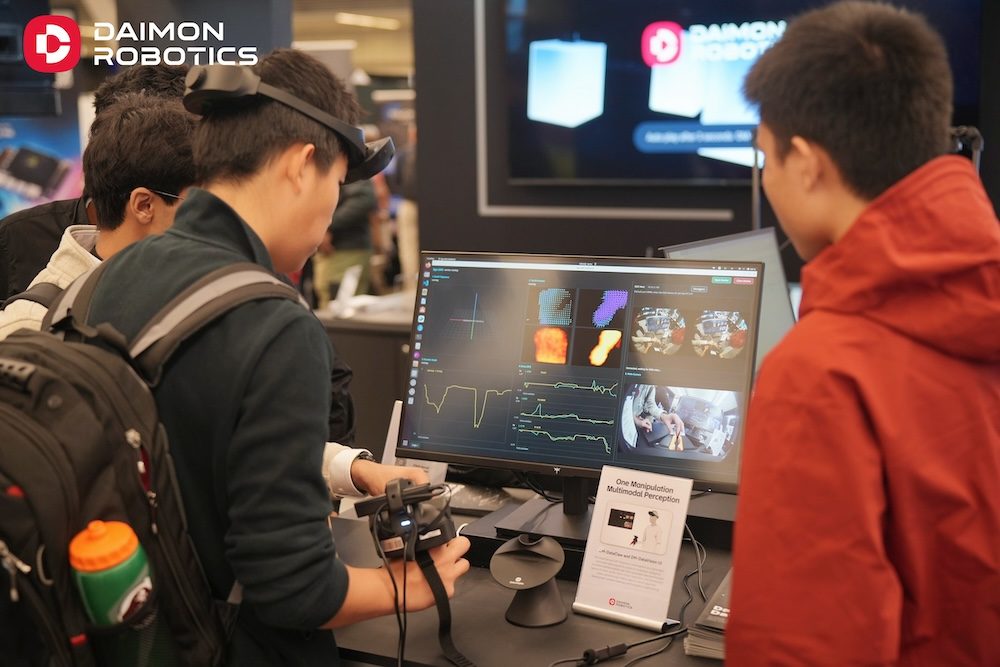
Credit: Daimon Robotics
Vision has become central to modern robotics, but cameras alone cannot tell a robot everything it needs to know about physical contact. When handling flexible objects, inserting components, or manipulating delicate items, robots need information about forces, slippage, and contact that visual systems may miss.
Daimon Robotics wants to provide the infrastructure to help robots develop that capability.
Rather than focusing exclusively on tactile sensors or developing a single foundation model, the company is building a pipeline that connects tactile sensing, data collection, simulation, and AI models. Its goal is to turn physical interactions into useful training data that helps robots perform manipulation tasks more reliably.
“By building tactile intelligence, we’re actually playing the role as an infrastructure provider,” Daimon’s Partner & VP of Technology Dr. Zhu told The Robot Report . “We’re not aiming to be a foundation model developer. We are providing the infrastructure for doing so for those downstream customers.”
That distinction is central to Daimon’s strategy: develop the tools and data infrastructure that other companies can use to build more capable robotic systems.
Building a pipeline for tactile data
Collecting useful tactile data at scale presents a challenge. Unlike visual data, which can be captured relatively easily with cameras, tactile data depends on physical contact. The resulting information varies with an object’s material, geometry, the forces applied, and the task being performed.
Daimon is developing a pipeline to capture and process these interactions, with tactile feedback operating at 30 Hz. The company is also working to connect real-world data with simulation, allowing physical interactions to inform training in virtual environments.
The sim-to-real gap remains a significant challenge, particularly when accurately reproducing physical properties such as friction and contact forces. Daimon’s approach starts by calibrating simulations against real-world measurements before transferring collected data into simulated environments.
“Let’s be frank; it’s not good enough. It’s kind of terrible,” Zhu said of the current state of simulation, referring to the gap between simulated and real-world environments.
Daimon is developing tactile simulations that account for physical properties measured through real-world testing. The goal is to improve the fidelity of those simulations and make it easier to transfer learned capabilities to physical robots.
The company has discussed collecting more than 10,000 hours of data, with its longer-term Daimon-Infinity initiative targeting more than 1 million hours of tactile embodied data.
Zhu also emphasized the importance of working with companies developing robotic models and applications.
“Doing everything ourselves was not enough,” he said. “Collaborating internationally in different downstream scenarios is really important.”
That collaboration helps Daimon understand what other developers need from its sensors, data-collection devices, software, and evaluation tools.
Credit: Daimon Robotics
From tactile demonstrations to industrial applications
Daimon is targeting manipulation tasks such as assembly and packaging, where robots must respond to physical contact rather than simply follow predetermined trajectories.
A robot might need to determine whether a component is properly seated, detect when an object slips, or adjust its movements when a part behaves unexpectedly. Tactile feedback can help it respond to these conditions.
The company demonstrated applications involving delicate manipulation at IROS 2026, including applying heat-transfer designs to tote bags and threading bracelets. It also showed a robot collecting and packaging broken glass, illustrating how models trained on data from varied scenarios can be prompted to perform specific tasks.
Daimon uses its Umi device to collect data from human interactions. Zhu said the company’s demonstrations were powered by foundation models trained on data collected across multiple scenarios, rather than being built solely around individual robot demonstrations.
The company has identified Lenovo Capital and Inovance Technology as key partners. Zhu said Daimon has also moved beyond proof-of-concept projects into industrial assembly lines and warehouses, although he declined to name specific customers because of nondisclosure agreements.
The commercial test is whether tactile sensing and the models built around it can improve performance consistently in production environments, where robots must handle variations in objects, materials, and operating conditions.
Moving beyond visual perception
Daimon’s broader strategy centers on developing models that can use tactile information to understand and respond to physical interactions.
Its Daimon-TWM effort focuses on a tactile-grounded world model intended to help robots reason about physical interactions, rather than relying on visual perception alone.
Recognizing an object is only part of manipulation. A robot must also understand how its actions affect that object and adjust when the physical result differs from expectations. Tactile feedback can help close that loop by providing information about contact and the consequences of an action.
Zhu described two roles for tactile sensing in robotic systems: helping models reason about physical properties and enabling rapid adjustments during contact-intensive tasks. The latter can require high-frequency feedback, with Daimon targeting control at 30 Hz.
The company is also exploring how data collected through human interactions can help train models for different robot configurations, including humanoids and dual-arm manipulators.
But collecting data and training models are only part of the problem. Developers must still demonstrate that these systems generalize across different objects, materials, robots, and operating conditions.…
News is gathered automatically from public robotics & AI feeds on a schedule.
Related
Unleash AI Innovation: The Power of NVIDIA RTX PRO 6000 Blackwell Workstation Edition Fueled by PNY-Supplied GPUs
As robotics systems grow more capable — faster, more precise, and increasingly reliant on AI-driven vision and control — the humble interconnect is being asked to do more than ever. The post Unleash AI Innovation: The Power of NVIDIA RTX PRO 6000 Blackwell Workstation Edition Fueled by PNY-Supplied
Kodama raises $7M to bring robotics to forestry
Kodama is working on automating forestry and logging equipment, starting with teleoperation and collecting valuable data on the way. The post Kodama raises $7M to bring robotics to forestry appeared first on The Robot Report .

正面硬刚DeepSeek!MiniMax M3.1 Flash发布,输出卷到200+TPS,价格砍到1/2
智东西 作者 | 王涵 编辑 | 漠影 火爆AI圈的匿名模型Space Bunny,终于被认领了! 智东西10月19日报道,刚刚,MiniMax 正式发布 M3.1 Flash ,定位为 Coding/Agent优化轻量级模型 ,拥有100万token上下文。 几乎前后脚,10月17日,DeepSeek V4.1 Flash-1017上线。( 梁圣又掀桌了!DeepSeek新模型斩杀GPT-6,许愿式编程时代降临 ) 根据M3.1 Flash的基准测试成绩,该模型在Agentic任务、编程、Computer Use及网络安全能力等方面实现了大幅提升, 与DeepSeek V4.1 Flash-
GPT-Image-3要来了?三个神秘代号曝光,网友实测生成猫咪惟妙惟肖
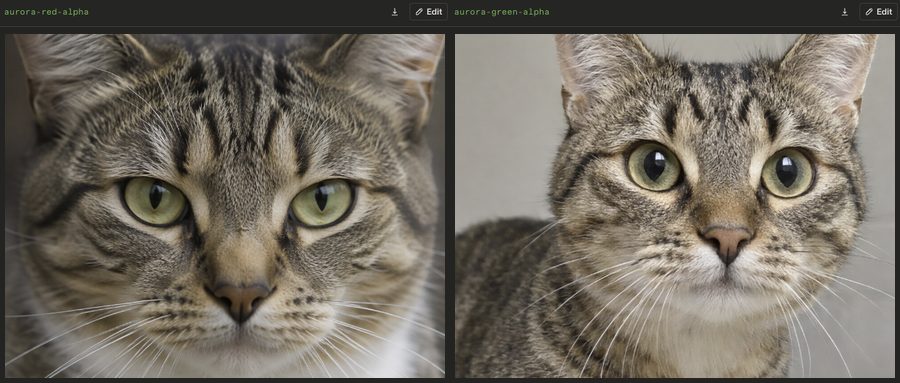
智东西 编译 | 孙小雯 编辑 | 程茜 智东西10月19日消息,据科技媒体TestingCatalog昨日报道,三个名为 aurora-red-alpha、aurora-green-alpha和aurora-blue-alpha 的模型条目短暂出现在OpenAI API的模型列表中。随后,测试者在AI模型评测平台Arena发现了同名图像模型,并晒出红、绿两个版本生成的猫咪图片。 OpenAI未公布这三个模型的身份及发布安排。据外网AI模型测评博主Lumina推测,这可能就是GPT-Image-3。他体验后认为,红版生成更快,但画质稍逊;绿版速度较慢,效果更好,但没有公布具体耗时和完整测试记录

AI 里没有答案的问题,需要一场「深谈」
去年,极客公园创新大会第一次办起「小场深谈」。场子都不大,百人左右围坐在一起。 有些瞬间仍然记忆犹新。 在「超级个体」专场,一位观众站起来。他刚从大厂跳槽到一家小厂,正用 AI 做自己的第一款产品。他向嘉宾说出自己的困惑:我还在打工,做公众号、视频号,早晚会被老板和同事刷到。这个冲突,怎么解? 在「硬控 AI」专场,有人直接向刚刚离职的小米 AI 眼镜负责人提问:如果给你两个亿,你会去做哪种 AI 眼镜?有人继续追问,你觉得豆包手机助手到底是真需求还是伪需求? 在「重塑关系」专场,一位精神科医生,问做陪伴机器人的嘉宾:你是希望它把人带回现实社会的交往,还是给这个家添一个新成员? 这些问题都不「
Jev刚火,国产29B开源模型来踢馆了!不光会判断,还能直接填参数
智东西 作者 | 江宇 编辑 | 漠影 AI行业正被一个叫 Jev 的模型搅动。 这款由TypeSafe AI发布的“系统一模型”,验证了一个此前被忽视的判断:意图理解这类高频、低延迟的任务,未必非要劳驾千亿参数的大模型“硬想”,专用模型同样能做到又快又准。一时间,决策层与生成层分离,成了AI Agent落地的热门话题。 但Jev留下了一个问题:判断出用户想做什么之后,谁来负责把事情交代清楚? 例如,用户说“把展厅东侧的灯调到80%、色温4000K,西侧调到30%、2700K,入口灯别动”。识别出“调节灯光”,只能算完成了第一步。系统还需要知道哪盏灯对应哪个亮度、哪种色温,以及哪盏灯必须保持原