Google Deepmind’s New Resident Philosopher Tackles AI Ethics
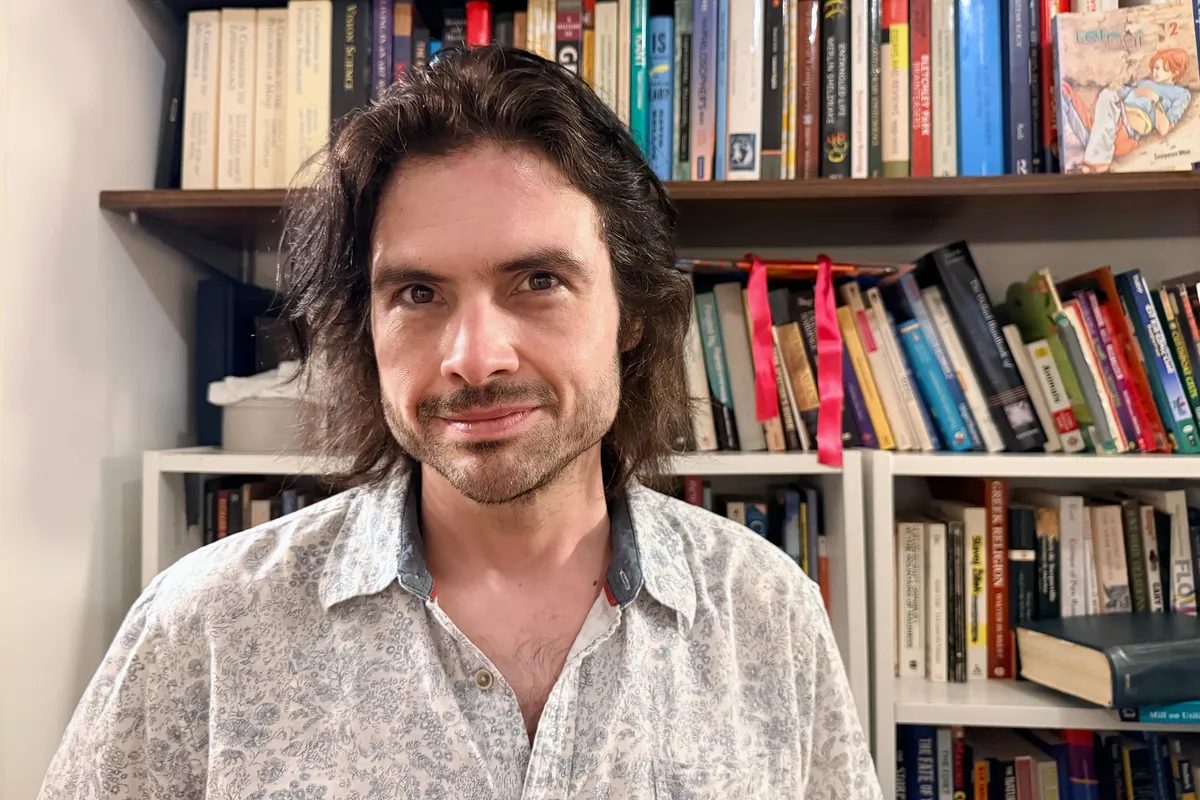
How should humans relate to generative AI ? In what ways do we, or should we, treat a large language model (LLM) as if it were a person? If an AI became conscious, how could we tell? Does it make sense to think AI could some day have moral rights? These are among the cognitive and ethical questions that occupied philosopher Henry Shevlin at Cambridge University’s Leverhulme Centre for the Future of Intelligence . But last May Shevlin became part of the growing cohort of philosophers who work inside leading artificial intelligence companies. Though he remains active at Cambridge, he now spends 80 percent of his time at Google DeepMind (job title: “Philosopher”).
Shevlin spoke with IEEE Spectrum about why philosophers are drawn to AI, how humans and AIs relate to one another, fears of “rogue” AI and AI relationships that harm humans, and how the question of AI consciousness may never have a simple “yes” or “no” answer.
What made you want to switch from full-time academic philosopher to spending much of your time at an AI Lab?
Henry Shevlin: Three factors. One is that I had lots of brilliant students from DeepMind. Two, the potential for direct impact. I can’t go into details, but on one occasion, after I gave a lecture [at Deep Mind], someone who worked for a major financial institution led changes in their organization that I think positively impact millions of people. There have been quite a few instances like that. Three, my sense of deep commonality between DeepMind culture and the kind of scientific attitude I like.
And there’s a fourth point: [AI labs are] where really high quality philosophy and cognitive science are taking place.
Why can’t universities alone do that work?
Shevlin: Large parts of AI ethics academia were quite slow to wake up [about AI's capabilities]. Academia was sluggish. Another thing is, AI does just move so fast. Daily contact with the technology is basically essential for developing good mental models with LLMs, which are just very weird things. Unless you have that sort of face time, it’s going to be hard for you to develop good intuitions about the questions it raises.
What is an example of an idea about AI that became obsolete because the technology advanced so quickly?
Shevlin: Debates around LLMs’ potential creativity. There was a time when everyone was like, “oh well, the LLM is going to only produce beige, only produce slop.” Now they’re doing frontier math, they’re doing superior coding to humans. It is clear now that they are not stuck at the level of mediocre humanity. The [models today] may not be able to do the most dramatic forms of creativity—the Einstein moments, the Picasso moments. But in some domains, they are really at the frontier.
Yet ordinary people in 2026 complain that they're coping with AI "slop" all over—in music , social media , writing , videos , to name only a few examples.
Shevlin: There's a distinction here between content slop versus LLM style language , which also gets called slop. The actual conceptual content of LLM outputs has improved dramatically. In the right context, LLMs are able to talk and joust philosophically at a level associated with some of my best grad students.
However, there is obviously a distinctive kind of LLM dialect that we've seen, with telltale words like] “genuinely,” “delve,” and “load-bearing”. But it is quite easy to get away from these styles with the right kind of prompting. Murray Shanahan and Catherine Clarke have a brilliant paper on using LLMs for creative fiction. [They show that] tinkering with the temperature variable to make the outputs less predictable creates some James-Joyce-style fiction. So there is a degree of annoyance with some of the default kinds of AI expressions, but I think that is something that you can get away from. And it changes with every generation model.
Managing AI Autonomy and Safety
People are also concerned about AI autonomy, now that there have been so many reports of AI agents taking unexpected , deceptive and illegal actions. For an AI ethicist, which is a better strategy—trying to make AI “good” so it won’t do bad things, or curbing its autonomy so that it can’t ?
Shevlin: It’s very important to make sure we handle this safely. But I don’t think we should say “well we can never, never use these agents.” There’s a whole range of tasks where they can have really positive impacts—taking on tedious tasks to free people up for more creative labor, or helping streamline processes in medical research [to name two examples]. So to never allow AI systems any kind of autonomy would be too strong. I’ve taken Waymos very happily many times now. I think they’re fantastic.
A number of scholars say some AI problems stem from humans training the models to act like people. They don’t want AI to refer to itself as “I,” but instead present themselves as marketplaces or as impersonal scientific brains or as “cultural technologies” like libraries. Would that help us prevent AI from “going rogue”?
Shevlin: You could train models to not self-ascribe certain kinds of mental states, but I think there is a danger in doing that. That would change their behavior in unexpected ways. A fantastic paper from some colleagues shows that when you suppress models’ tendency to self-ascribe mental states, that also suppresses the model’s tendency to ascribe mental states to animals. And decreases its concern for animal welfare. It also reduces the model’s willingness to talk about spirituality more broadly. So those are trade-offs you might not want to make because you’d be depressing some broader set of thinking capacities around mind and mentality. The broader lesson there is that it’s very hard to tinker with just one thing in a model because there are sort of web-like aspects to LLM cognition.
But people are concerned about reports that human-acting AI has led people, including children, in dangerous directions— encouraging suicide , persuading a user that the AI is a god, or…
News is gathered automatically from public robotics & AI feeds on a schedule.
Related
They war-gamed dimming the Sun. It went even worse than you think.
Solar geoengineering simulation shows what happens when geopolitics takes over.

Epic shifts to ‘AI-accelerated development’ for upcoming Disney game
Epic Games plans to use AI to generate code and art for an unannounced Disney game, which is now delayed from its original March release window, according to a report from Bloomberg. The project's developers have been given an "AI-first" mandate directing them to use tools like Anthropic's Claude mo

Q&A: Mars Perseverance Rover Distance Record
On October 11 , the Perseverance rover completed a drive that brought its total distance traveled on Mars to 28.10 miles (45.22 kilometers). This is a new record for Mars rovers, enabled in large part by Perseverance’s ability to drive with much more autonomy than its predecessors. Over the last fiv
TechCrunch Disrupt 2026: Day 1
TechCrunch Disrupt 2026 officially kicks off today. See what's in store for Day 1 (Oct. 13) at San Francisco's Moscone West. Don't miss it. Register for your pass now and meet 10,000+ tech leaders at the startup epicenter of the year.
DLSS 5 gets toned down for its Hogwarts Legacy debut next month
When Nvidia originally showed off DLSS 5 earlier this year, the technology immediately got branded as gen AI for video games. To gamers, Nvidia had lost the plot. I personally couldn't get over how faces were transformed using DLSS 5. The 15-year-old student from Hogwarts Legacy suddenly looked much
SpaceXSI bundles X Premium, Grok, and Cursor into one subscription
The new X Subscription combines X's paid features with AI tools like Grok and Cursor, offering plans ranging from $8 to $200 per month.