Q&A: Mars Perseverance Rover Distance Record
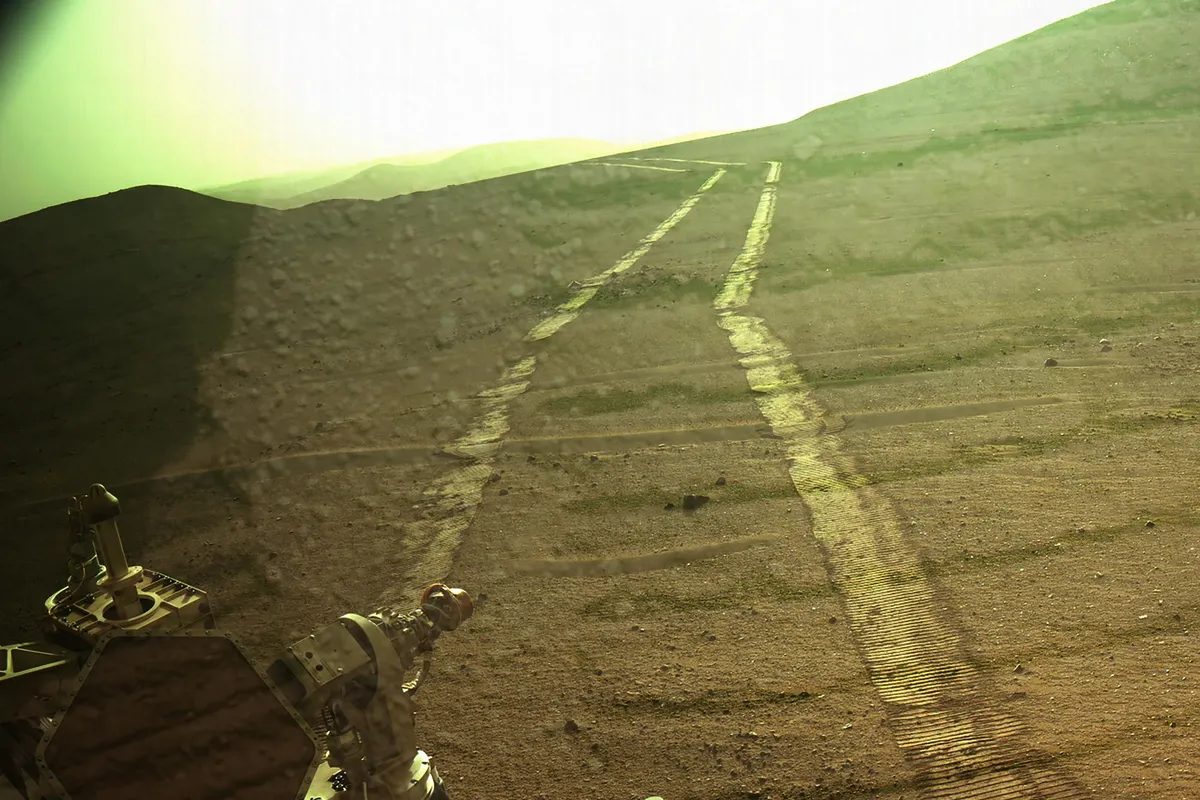
On October 11 , the Perseverance rover completed a drive that brought its total distance traveled on Mars to 28.10 miles (45.22 kilometers). This is a new record for Mars rovers, enabled in large part by Perseverance’s ability to drive with much more autonomy than its predecessors. Over the last five years, Perseverance’s autonomy software has been steadily upgraded, and to learn more about how the record was broken and what the future holds for the rover, we spoke with Mark Maimone , the Perseverance Robotic Operations Deputy Team Chief at NASA’s Jet Propulsion Laboratory, who designed and developed the self-driving software for Mars rovers Spirit, Opportunity, Curiosity, and Perseverance.
Before we talk about Perseverance, let’s pour one out for the previous record holder Opportunity , which landed on Mars in January of 2004 for a 3-month mission and ended its epic journey 15 years later in February of 2019. This NASA video compresses Opportunity’s entire mission into four minutes, and gives a poignant sense of the incredible distance that this little rover traveled over its 15 year life on Mars, doing science as it went:
Opportunity drove 45.16 kilometers until a planetary-scale dust storm stopped it in its tracks, appropriately enough, in Perseverance Valley.
JPL/YouTube
On Feb. 18, 2021, Perseverance joined NASA’s Curiosity rover on the red planet, carrying the Ingenuity helicopter tucked under its belly. Curiosity and Perseverance both ditched Opportunity’s solar panels for a radioisotope thermoelectric generator . Curiosity has been active on Mars since 2012 .
Despite Curiosity’s nearly 10 year head start, Perseverance is the rover to first break Opportunity’s record. There are several reasons for Perseverance overtaking Opportunity— ruggedized wheels for one —but the biggest contributor is that Perseverance was built for autonomy .
To understand how JPL taught a Mars rover to drive itself from 225 million kilometers away without crashing, IEEE Spectrum spoke with Mark Maimone , the Perseverance Robotic Operations Deputy Team Chief at NASA’s Jet Propulsion Laboratory.
This animation shows Perseverance’s point of view during a drive of 807 feet (246 meters) along the rim of Jezero Crater on Dec. 10, 2025, the 1,709th Martian day, or sol, of the mission. Captured over two hours and 35 minutes, 53 Navigation Camera (Navcam) image pairs were combined with rover data on orientation, wheel speed, and steering angle, as well as data from Perseverance’s Inertial Measurement Unit, and placed into a 3D virtual environment. The result is this reconstruction with virtual frames inserted about every 4 inches (0.1 meters) of drive progress. JPL-Caltech/NASA
Let’s talk about rover autonomy on Mars. Even before Perseverance, rovers were driving themselves, right?
Mark Maimone: Yes! Sojourner [in 1997] had an early kind of autonomous behavior—for sensing, it used four laser stripes projected onto the surface, which it used to measure the height of 20 points in the terrain in front of it. It could steer around big obstacles, or even thread the needle between two things. It was a real autonomy system, which is very impressive considering its CPU was less than one megahertz.
With Spirit and Opportunity, I developed the autonomy for those rovers. Every time they drove, they would use 256 x 256 pixel stereo pairs to map the geometry of the terrain and find a safe route forward. Spirit actually ended up driving itself 23% of the time, which I was frankly shocked by, since it drove much more slowly in that mode. But using autonomy helped Spirit travel 50% faster than it otherwise could have . Opportunity and Curiosity both only used autonomous driving about 5% of the time. Perseverance is the first Mars rover that drives itself 90% of the time, with its enhanced autonomy system that includes a second processor with an FPGA to do speed up extra image processing operations.
What was it like to let Perseverance drive itself for the first time?
Maimone: Perseverance is the culmination of decades of work on Mars rover autonomy, so seeing Perseverance use its AutoNav system to drive itself basically at full speed, up to 120 meters an hour, was incredible.
These two images taken by Perseverance’s hazard avoidance and navigation cameras show (on left) the very first AutoNav drive on Mars where the rover autonomously stopped before running into a rock pile, and (on right) the second AutoNav drive where the rover successfully steered around a rock. JPL-Caltech/NASA
Where are the humans in this process?
Maimone: The plan of where to go is specified by the science team, and then on the engineering side, the strategic route planning team develops a path to get us to that goal by guessing, based on lower-resolution maps from orbit, what the terrain is going to look like for the rover. Each day a tactical operations team combines the strategic overall route with that day’s science goals to pick the actual route the rover will follow.
We want humans to keep doing long-range planning because that avoids wasting time. For example, we’ve learned that if we see sandy areas with intersecting waves or crests—not just ripples blown in one direction, but cross-ripples going in multiple directions—the rover tends to sink into terrain like that, so we tell the rover to keep out of those areas. The onboard autonomy only measures terrain shape, not terrain type, so it benefits from those location-based annotations.
We now have years of experience correlating images taken from orbit with images taken by the rover, and understanding how different kinds of terrain affect the drive. With the current orbiters at Mars, we sometimes get 25 cm resolution on orbital images. That’s still not quite enough to see all obstacles; there could be a big rock that doesn’t really show up on a scale of more than one or two pixels, making it very hard to notice. That is why you want to have autonomy on the rover, but the greater help…
News is gathered automatically from public robotics & AI feeds on a schedule.
Related

Google Deepmind’s New Resident Philosopher Tackles AI Ethics
How should humans relate to generative AI ? In what ways do we, or should we, treat a large language model (LLM) as if it were a person? If an AI became conscious, how could we tell? Does it make sense to think AI could some day have moral rights? These are among the cognitive and ethical questions

Meet the Anthropic Engineer Keeping Its AI Agent Trustworthy
If you’ve ever wondered how Claude and similar AI agents can answer complex questions in seconds and where they get the information, you’re not alone. Gurmeet Saran works to find that answer every day as an engineer at Anthropic in San Francisco, the AI research company behind Claude. The IEEE senio

Learning to Play Like a Pro: Adaptive Motion Planning and Tracking for Humanoid Robots
This White Paper provides roboticists and control engineers with a comprehensive overview of how motion planning and motion tracking can be decoupled to preserve professional athletic style in humanoid robots, and why adaptive, speed-aware control is essential for closing the gap between simulation

Humanoid robots can sprint and box – but the real test is doing the laundry
By Wai-keung Fung, Cardiff Metropolitan University At the recent World Humanoid Robot Games 2026 in Beijing, robots sprinted, boxed, played football and tackled tasks inspired by factories, restaurants and emergency situations. The robot Tiangong Ultra even completed the 100 metres in 8.64 seconds,
Master AI Chip Principles With New IEEE Design Program
Today’s engineers face an unprecedented acceleration in AI hardware complexity, as explained in the recent research article “ Revisiting Edge AI: Opportunities and Challenges .” The article examines the rapid growth of edge AI and the challenges it creates, including resource constraints, model arch

Video Friday: Robot Decommissioning Takes a Fun Turn
Video Friday is your weekly selection of awesome robotics videos, collected by your friends at IEEE Spectrum robotics. We also post a weekly calendar of upcoming robotics events for the next few months. Please send us your events for inclusion. CoRL 2026 : 9–12 November 2026, AUSTIN Humanoids 2026 :