Humanoid robots can sprint and box – but the real test is doing the laundry

By Wai-keung Fung , Cardiff Metropolitan University
At the recent World Humanoid Robot Games 2026 in Beijing, robots sprinted, boxed, played football and tackled tasks inspired by factories, restaurants and emergency situations. The robot Tiangong Ultra even completed the 100 metres in 8.64 seconds, quicker than Usain Bolt’s 9.58-second world record.
But if we really want to know whether humanoid robots are ready for everyday life, a far less glamorous challenge may tell us more: doing the laundry. Can a robot take a crumpled T-shirt from a laundry basket, work out which way round it is, fold it neatly and recover when the sleeve slips from its hand?
No robot system can yet reliably handle the whole laundry process, from carrying a basket to the washing machine and sorting clothes for different programmes to taking them out, hanging them to dry, folding and ironing them. Even folding remains a challenge: robots need to cope with clothes of different shapes, sizes, materials and levels of creasing.
Running fast is difficult, of course. A humanoid has to coordinate many joints, keep its balance and generate powerful movements without falling over. The task itself, however, is fairly clear. The robot knows where to go, the track is predictable and the finish line does not suddenly change shape.
Laundry is a very different problem. A shirt may be inside out. One sleeve may be hidden underneath another garment. A pair of trousers may be twisted around a towel. Fabric is also soft and constantly changing shape. Pick up one corner of a T-shirt and the rest of it moves.
Humans deal with this without giving it much thought. We shake a shirt out, notice where the sleeves are, feel when the fabric slips and adjust our grip almost automatically. For a robot, every one of those little actions is a problem to solve. This is why an everyday chore can reveal more about robot intelligence than a spectacular athletic feat.
A useful household robot cannot simply replay the same movement again and again. It has to notice when reality is different from what it expected and adapt. That’s important to consider because humanoid robots are increasingly discussed as future helpers in homes and care settings, as well as factories and warehouses.
A factory production line can often be arranged so that parts arrive in predictable positions. A family home is not like that: clothes, toys and furniture move around constantly, while people, children and pets make the environment even less predictable.
Why one robot cannot simply copy another
There is another difficulty. Once one robot learns how to fold a shirt, it might seem obvious that we should simply transfer that skill to every other robot. Unfortunately, physical skills do not work like an app that can be installed on any machine.
Imagine a specialist laundry robot with rigid arms, overhead cameras and grippers designed specifically for fabric. A humanoid may have cameras in its head, five-fingered hands and different joints and balance constraints. The same movement could therefore produce a very different result.
A fixed robot arm can reach forward without worrying about falling over. A humanoid may have to move its hips, legs and feet just to keep itself stable while reaching across a table.
Sensors are important too. One robot may have sensitive touch sensors in its fingers. Another may rely mainly on cameras.
Some knowledge can still transfer. One robot can teach another something about what a shirt looks like, where its shoulders are likely to be, what a good fold looks like or how to recognise when a sleeve is trapped underneath. The receiving robot still has to work out how to carry out those ideas with its own hands, joints, cameras and body.
Research projects such as Open X-Embodiment are exploring exactly this problem by pooling experience from many different robots. The project has brought together more than one million real robot trajectories from 22 different robot types. The hope is that robots can learn useful patterns from one another rather than starting from zero every time.
What should count as progress?
The Humanoid Robot Games are valuable because they make robotics visible and show how quickly the technology is moving.
We should simply be careful about what those demonstrations prove. For robots intended to live and work alongside us, better questions might be: can the robot deal with an unfamiliar object? Can it notice that it has made a mistake and recover without human intervention? How long can it keep working before someone has to step in?
These measures are unlikely to produce viral videos. They are, however, much closer to the abilities that will determine whether humanoid robots become genuinely useful.
A robot that can run 100 metres faster than the human world record time is impressive. A robot that can take a messy basket of laundry, sort it, fold it and recognise when things have gone wrong may tell us far more about whether general purpose robot intelligence has really arrived.
The most important race for humanoid robots may not be against the clock. It may be against the laundry pile.
Wai-keung Fung , Senior Lecturer in Electronics Robotics & Control Engineering, Cardiff Metropolitan University
This article is republished from The Conversation under a Creative Commons license. Read the original article .
News is gathered automatically from public robotics & AI feeds on a schedule.
Related

Video Friday: Robot Decommissioning Takes a Fun Turn
Video Friday is your weekly selection of awesome robotics videos, collected by your friends at IEEE Spectrum robotics. We also post a weekly calendar of upcoming robotics events for the next few months. Please send us your events for inclusion. CoRL 2026 : 9–12 November 2026, AUSTIN Humanoids 2026 :
Robot Talk Episode 165 – Robots behind the research, with Kushant Patel
Claire chatted to Kushant Patel from Brookhaven National Laboratory about robots that work in scientific facilities, such as particle accelerators. Kushant Patel builds software that helps robots and instruments perceive, map, and move through the physical world. After completing a Master’s in Mecha
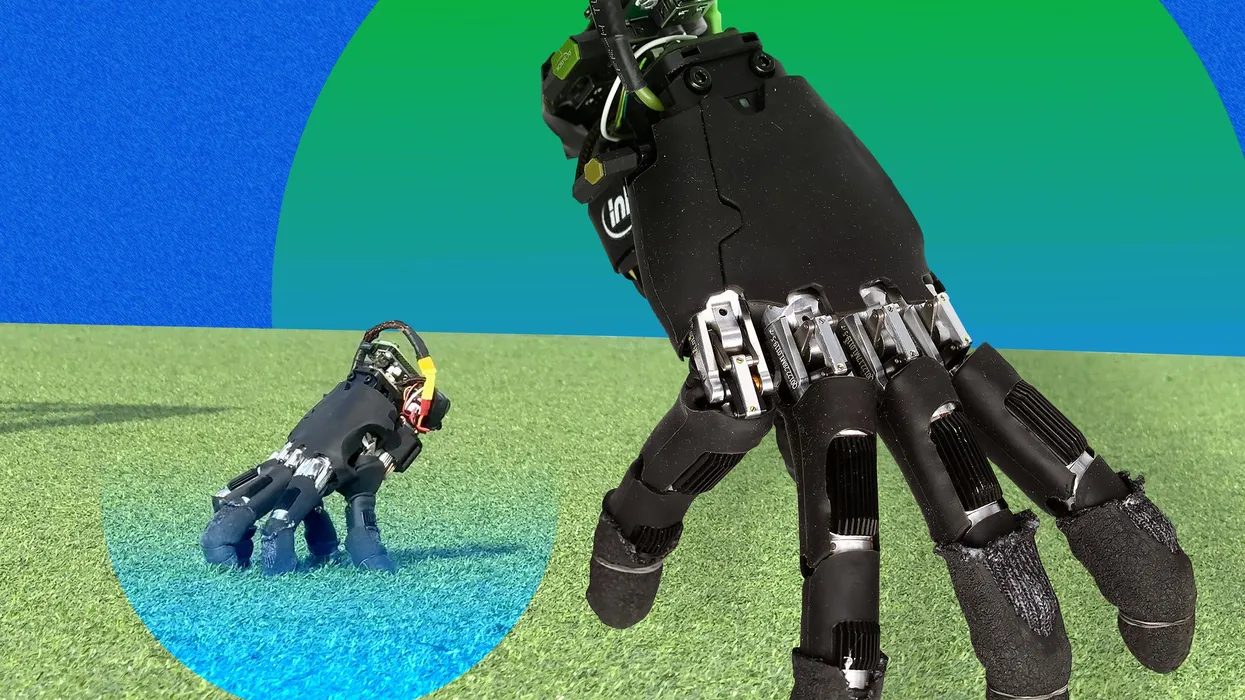
This Disembodied Hand Is All the Robot You Need
A hand attached to the end of an arm is a given for most humans, but what if robots didn’t have to play by the same rules as we do? Researchers from ETH Zurich have turned an off-the-shelf robotic hand into a completely self-contained robot that walks on its fingertips while using those same fingers

What three days building a robot taught me
Last month, I went to York to build a robot. I came back with a robot, a tiny trophy-shaped sense of achievement, and somehow a few new friends. From 25th-27th August, I joined the UK RAS STEPS MicroMaze Robot Hackathon at the Institute for Safe Autonomy, University of York. The brief sounded simple
Research could guide the future design of social robots
By the University of Glasgow Giving robot companions animal-like or anime-style faces and voices could maximise their emotional appeal to users, according to new research which could help guide the growing field of social robotics. Social robots can provide companionship and comfort to their owners

Video Friday: Albatross Falls, Spins, Self-Rights, and Sails Away
Video Friday is your weekly selection of awesome robotics videos, collected by your friends at IEEE Spectrum robotics. We also post a weekly calendar of upcoming robotics events for the next few months. Please send us your events for inclusion. CoRL 2026 : 9–12 November 2026, AUSTIN Humanoids 2026 :