Warp Sciences emerges from stealth, to apply robotics to drug research
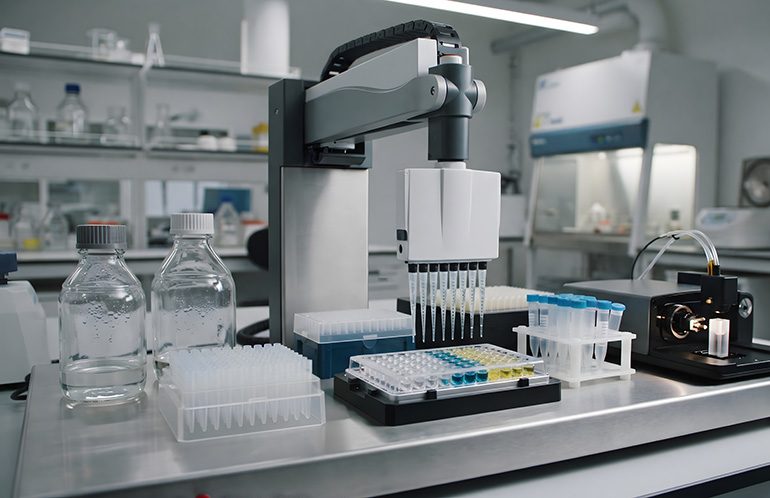
Warp Sciences plans to create chemistry infrastructure for sovereign biotech. Source: deni AI, Adobe Stock
Warp Sciences last week emerged from stealth with $215 million in funding to create infrastructure that enables biotech and pharmaceutical companies to discover new medicines faster. The startup said it is building a U.S.-based chemistry contract research organization, or CRO, to bring together chemists, robotics, and AI to make and test molecules for research teams.
The South San Francisco-based company ‘s stated goal is to provide experimental data to train better AI that in turn enables more capable labs, giving scientists the ability to test more ideas.
“AI has dramatically accelerated software engineering and mathematics, but it has yet to make the same impact in the physical sciences,” stated Kevin Weil , co-founder and CEO of Warp Sciences. “Chemistry and biology move forward when you make something, test it and learn from the result.”
“If we want to build more capable AI for science, we need to generate real-world data at scale,” he added. “Warp is starting that process by making the research compounds drug discovery needs today, while building the labs and automation to speed the cycle from hypothesis to experiment to answer.”
Warp said it has no proprietary drug pipeline itself; it is designing automated labs that can run experiments, learn from them, and improve with each cycle.
Warp Sciences focuses on sovereign biotechnology
A promising molecular design is only the beginning, observed Warp Sciences. “Scientists have to make it, test it, and use what they learn to decide what comes next,” said the company. “Faster access to compounds gives research teams faster answers, more ideas to pursue, and more opportunities to find medicines that change lives.”
Warp also noted the importance of sovereign biotechnology. In a 2024 survey by the Biotechnology Innovation Organization, 74% reported contracts with Chinese companies for preclinical and clinical services, according to Reuters. The BIOSECURE Act , signed into law in December 2025, established a framework for restrictions on federal procurement and funding involving designated biotechnology companies of concern.
In response, Warp claimed that it is building a U.S.-based chemistry partner that scientists can rely on for its speed, quality, and close collaboration. Its goal is to shorten the path from molecular design to testing while giving customers more control over where sensitive research takes place.
The company said its initial service will focus on lead optimization analog synthesis, making variations of molecules that scientists can compare as they search for a drug candidate. Experienced chemists will guide experiments as the lab is increasingly automated by robotics and AI, with AI models trained on data from physical experiments.
Warp plans to enable its customers to discover drugs more efficiently and keep that discovery in the U.S.
Submit your innovation now!
Founders’ expertise spans AI and healthcare
Warp Sciences noted that its founding team ’s experience spans AI, data infrastructure, healthcare, and drug discovery. Weil most recently served as chief product officer and vice president of science at OpenAI . Chief Scientific Officer Solomon “Sol” Reisberg held medicinal chemistry leadership roles at Terremoto Biosciences.
“I’ve worked with overseas chemistry partners that delivered speed and value, but I still worried about protecting the intellectual property behind our programs,” said Reisberg. “We’re building Warp to give drug hunters that same caliber of chemistry services in the U.S., with IP protection at the center of the relationship, and without the price premium that U.S. boutique CROs currently demand.”
Chief Technology Officer “ Manohar “Mano” Paluri was a vice president at Meta Superintelligence Labs and a founding member of FAIR. DJ Patil was a founding executive at Devoted Health and the first U.S. chief data scientist for the White House.
“Our goal is simple: Every experiment should make the next one smarter,” Paluri asserted. “AI needs a closer connection to the physical work of chemistry. Closing the loop between designing experiments, executing them, and learning from their outcomes builds increasingly capable systems for deciding what to make and how to make it. We’re building the software, AI and robotics alongside the lab so each part is shaped by what chemists actually need.”
Early hires have added robotics experience from companies including Genesis , Skild AI , and 1X Technologies , as well as scientific expertise from Genentech and Lawrence Livermore National Labs.
“Warp’s services bolster customer-led discovery programs. Our biotech and pharma customers determine which molecules to pursue and retain control of their drug programs,” said Patil. “We’re not developing drugs of our own. We’re building the infrastructure for the people who do.”
Venture capital firms, angel investors support Warp
Lightspeed led Warp Sciences’ funding, with participation from Premji Invest, Mayfield, IVP, Lux, Conviction, Menlo Ventures, 01 Advisors, Standard, Lowercarbon Capital, Gigascale Capital, Angular Ventures, Scribble Ventures, Uncork Capital, Innovation Endeavors, Matter VP, Zero Shot Fund, SignalFire and Moxxie Ventures.
Angel investors included Brian Armstrong (Coinbase CEO), Mike Krieger (Anthropic Labs co-lead, Instagram co-founder), Milan Kovac (former Tesla Robotics vice president), and Ion Stoica (Databricks co-founder). It also included Fidji Simo (former OpenAI AGI Deployment CEO), Brendan Foody (Mercor CEO), Mark Chen (OpenAI chief research officer), and Sarah Friar (OpenAI chief financial officer).
In addition, Kate Rouch (former OpenAI and Coinbase chief marketing officer), Lulu Meservey (Rostra CEO), Deepak Pathak (Skild AI CEO), Dylan Field (Figma CEO), and Lachy Groom ( Physical Intelligence co-founder and chief operating officer) were angel investors.
The…
News is gathered automatically from public robotics & AI feeds on a schedule.
Related
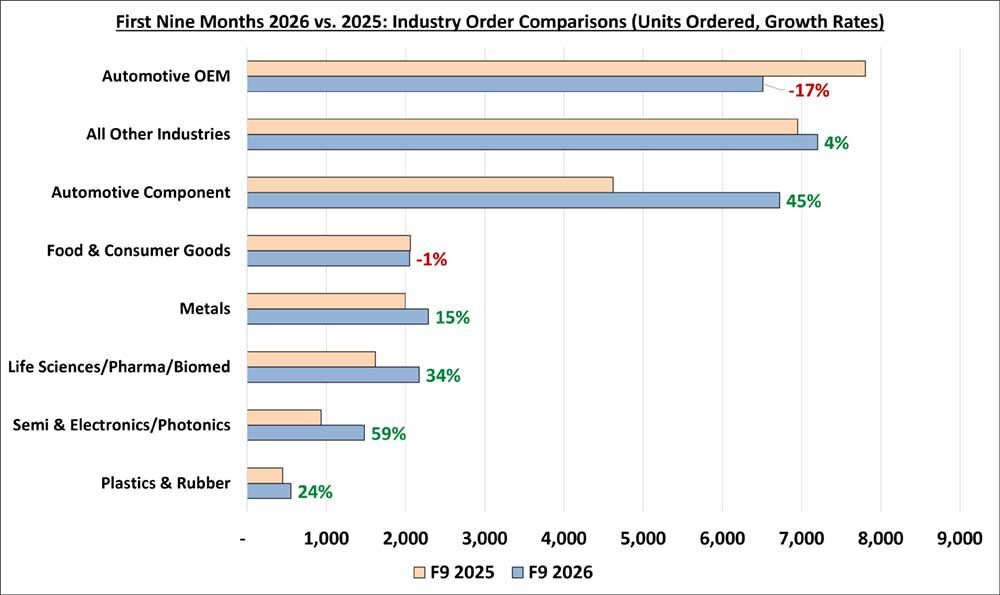
North American robot orders climb 24.8% in Q3 of 2026, says A3
Robot demand from automotive component manufacturers nearly doubled in Q3, as other sectors posted strong gains, reported A3. The post North American robot orders climb 24.8% in Q3 of 2026, says A3 appeared first on The Robot Report .

What Symbotic’s Walmart growth teaches robotics startups about anchor customers
Symbotic’s growth with Walmart shows how an anchor customer can fund a robotics startup’s scale while creating risks around customer concentration, contractual restrictions and the challenge of building a diversified, repeatable business. The post What Symbotic’s Walmart growth teaches robotics star
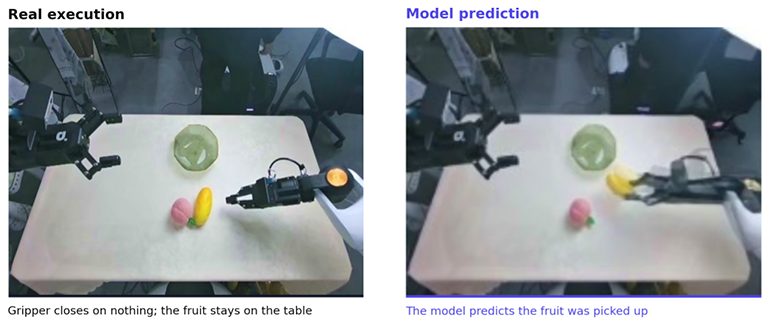
WorldOracle Tests Whether World Models Can Reliably Predict Real-World Executions
In one case showcased by WorldOracle, a robot's grasp missed, yet the world model predicted that the robot had successfully picked up the fruit. The post WorldOracle Tests Whether World Models Can Reliably Predict Real-World Executions appeared first on The Robot Report .

3149元起,iQOO Neo12首发2K 185Hz屏幕,称游戏体验“史上最接近”PC
智东西 作者 | 云鹏 编辑|李水青 智东西10月28日消息,刚刚,vivo旗下iQOO正式发布了新一代性能旗舰机iQOO Neo12系列,其首发了2K 185Hz屏幕,搭载了第五代骁龙8至尊版与自研电竞芯片Q3。 价格方面,Neo12系列国补后3149元起,共有5个版本,顶配16GB+1TB版本国补到手价5149元。 除了手机,今天iQOO还发布了3249元起售的iQOO Pad Pro 8.8英寸版,同样搭载第五代骁龙8至尊版与自研电竞芯片Q3,屏幕刷新率165Hz。 回到手机,这块屏我们并不陌生,此前智东西已在维信诺屏幕技术发布会上报道过这块屏幕及其背后技术,屏幕发光材料“天空之镜”,是
下中国象棋赢了Jev!扩散智能推出决策模型,判断正确率达95%
智东西 作者 | 王涵 编辑 | 李水青 智东西10月28日报道,今天,深圳大模型厂商扩散智能(DiffuSpace)发布并开源 扩散语言模型Clover-35B-A3B-Preview ,该模型采用混合专家架构(MoE), 总参数350亿、激活参数30亿 ,支持思考模式。 该公司发布的基准测试结果显示,Clover-35B-A3B-Preview在SWE-bench Verified、Terminal-Bench2.1等6项智能体编程及工具使用任务评测中,排名同级别模型中的第一, 超过同规模自回归模型Qwen3.6-35B-A3B 。 HuggingFace: https://hugging

实测蚂蚁灵光2.0:不是中国版Muse,是中国化Muse
智东西 作者 | 毕伟豪 编辑|漠影 近几月,Muse的出现,带火了Personal Agent,也让整个行业开始 持续思考Personal Agent这一产品形态 。 但Muse的成功,显然不是引入形式就能复制的,依托长期记忆和云端虚拟机,让Agent能够进行持续的事务管理,这套打法思路非常清楚,但想要真正实现,显然 还有很多“形式”之外的“内容” 。 10月27日,蚂蚁集团发布了灵光2.0版本,将产品定位从强调对话和应用生成的AI助手,进一步推到 “能管事的个人助理” 。 灵光2.0版本从形式上看, 是“中国版”Muse ,但从内容上, 更像是“中国化“的Muse 。 因为蚂蚁集团并不是简