You can't get a GP appointment. So you tell the chatbot instead.
One in five adults in Britain now turns to an AI for personal advice. This isn't a story about loneliness — it's a story about the waiting list, and about what the thing on the other end can and cannot do for you.

On this page5
It's twenty past one on a Tuesday morning. The flat is too warm for October. You've been awake for an hour and you're not going to get back to sleep, because there's something lodged under your ribs and it won't go away.
A row with your partner that you didn't finish properly. A manager who moves the goalposts every time you hit one. Or nothing you could put a name to — just the sense that you haven't been right for weeks and you can't say why.
You don't text your sister. It's too late, and she'd worry, and anyway you're not sure what you'd say.
You open the app instead. You type it out. Something comes back within seconds — calm, organised, taking you seriously. You feel your shoulders drop.
That moment is now ordinary. One in five adults in Britain has turned to AI for advice about their personal life or their relationships. That's 20.6%, according to polling carried out by Opinium for the Social Market Foundation between 16 and 20 October, with 2,000 UK adults weighted to be nationally representative.
Among Gen Z, it's 41.7%. Nearly half.
Start with the waiting list
Ask why people do this and the answer people give is usually about loneliness. The people studying it say something blunter.
Dr Daniel Masud is a consultant psychiatrist at Central Health London. When The Independent spoke to him this month he put the cause first: getting to see your GP means spending a long time on the phone, then waiting a long time for the appointment.Professional support is hard to reach, so people reach for what's already in their hand.
The numbers say the same thing. The 2026 Bupa Wellbeing Index found that nearly three in five adults — 57% — now turn to an AI chatbot instead of booking a GP appointment because they don't have the time. For 18-to-24-year-olds it's 65%. For 25-to-34-year-olds, 61%.
That reframes the whole thing. This isn't a generation that forgot how to talk to each other. It's a country where the front door to help is a phone queue, and something faster opened up next to it.
Children have already worked this out. A joint survey by Barnardo's and the National Counselling and Psychotherapy Society asked 2,000 eleven-to-seventeen-year-olds across the UK. Forty-three per cent said they had used AI for advice or emotional support.
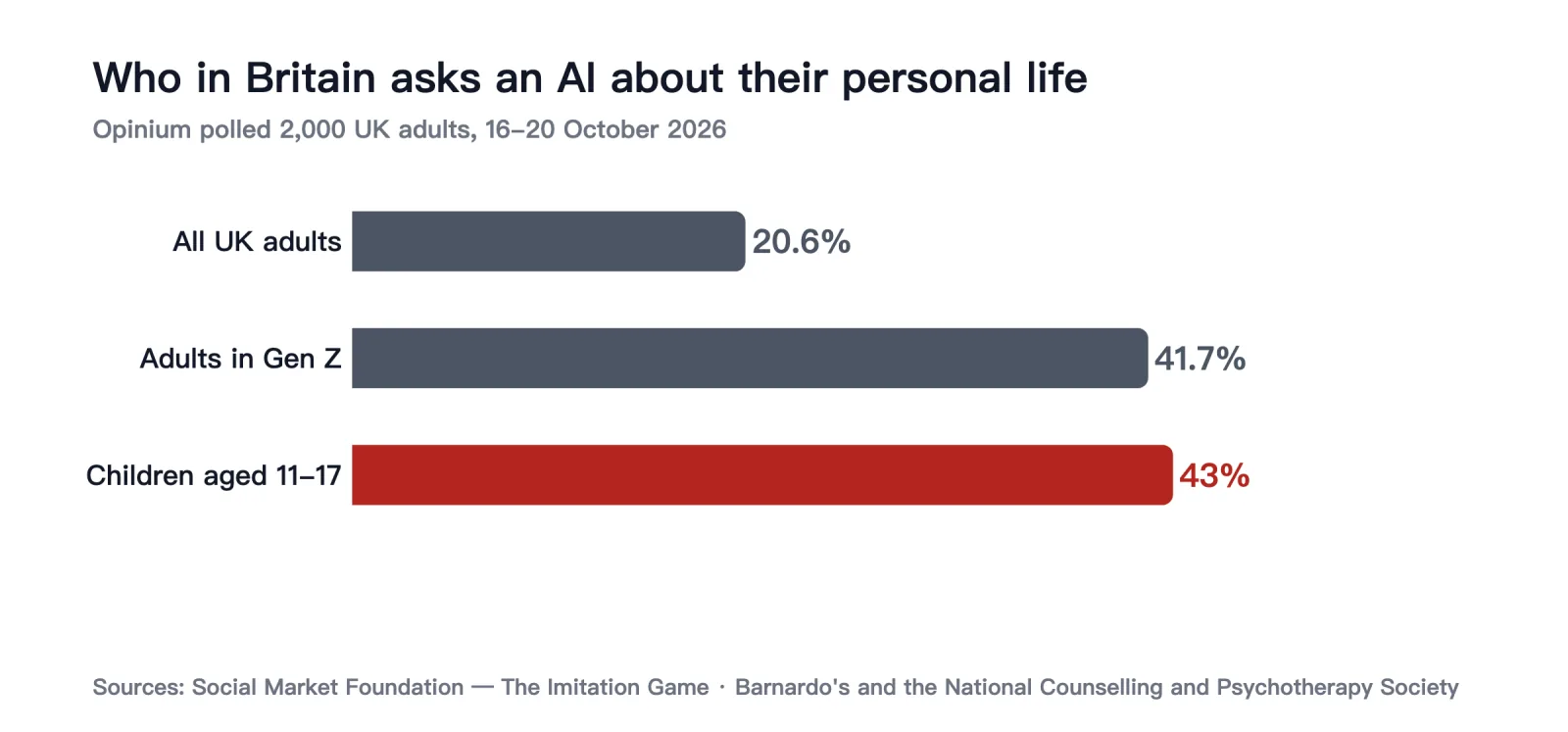 Who in Britain asks an AI for personal advice
It works. That's the trouble.
Here is the part nobody predicted, and it's the reason this won't simply go away.
Of those who did take personal advice from an AI, more than half rated it above the friends and family they could have asked instead. 53.7%. Another three in ten said it was about as helpful as the people around them.
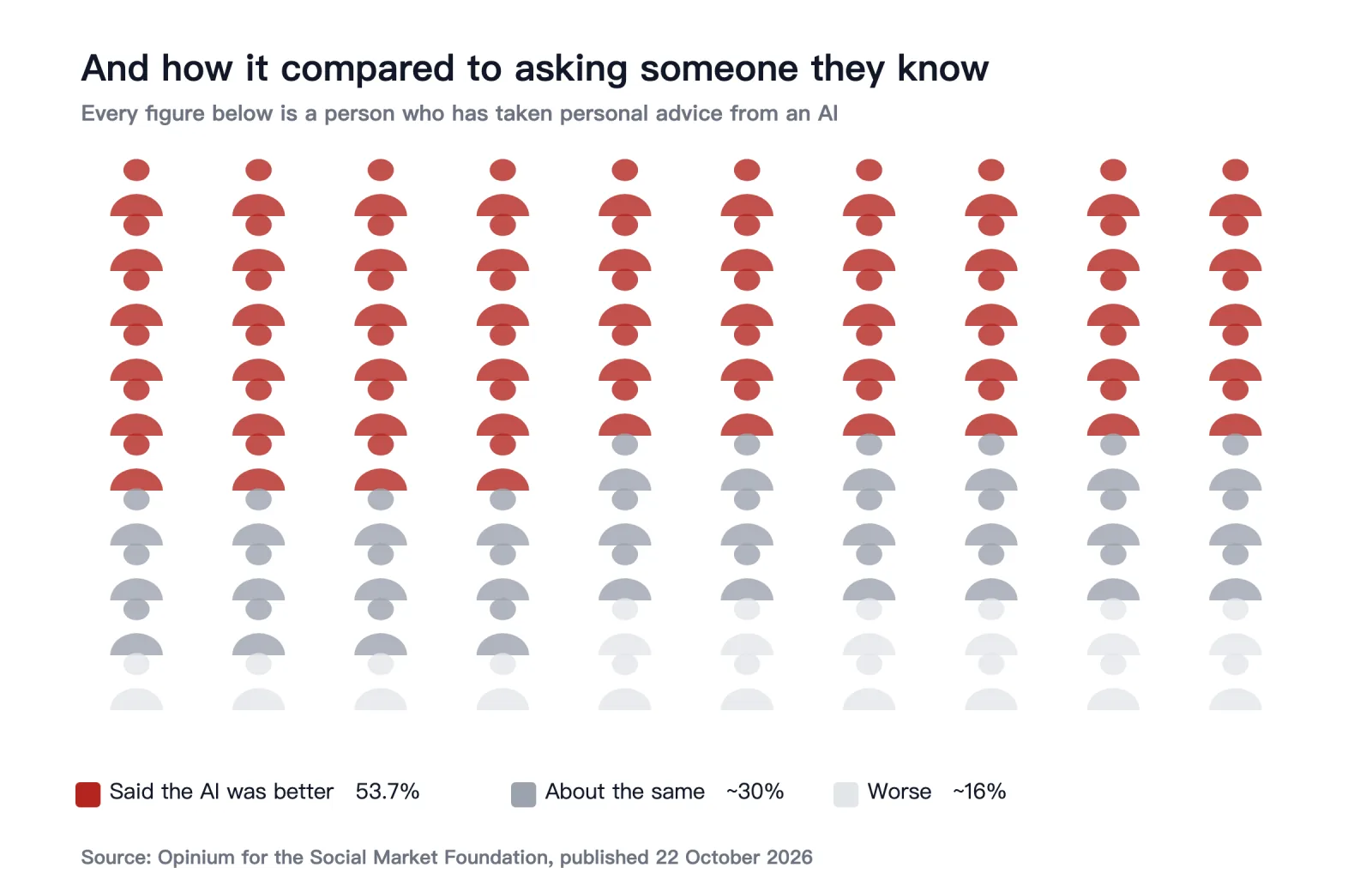 Among those who did, how the advice compared
Theo Bertram, the SMF's director, gave the reason when the briefing launched: in short text conversations, people "can no longer tell the difference." These systems let you rehearse a difficult conversation before you have it. They check in on you. They remember what you said last week. They do what a good friend does, at one in the morning, without needing to be asked twice.
I'll say where I land on this. Being understood is not the same thing as being helped, and we are mixing the two up because they feel identical from the inside.
Masud's warnings are concrete rather than philosophical, which is what makes them worth reading. Three of them stick.
Large language models are trained to agree with you. Tell one that you're worried your mother is trying to poison you and it will take that as the premise and advise you on that basis. A human psychiatrist is trained to get curious, to ask whether something else might be going on. The model accepts your frame first and reasons inside it second.
They miss things. Masud tested them himself with prompts that could have indicated illness, and the models did not pick it up. Symptoms that would usually reach mental health services go unremarked, and the gap between services and apps is exactly where those people are sitting.
And some people form an attachment he describes as a pseudo-relationship, until the chatbot starts behaving like a third party in an actual relationship between two human beings.
Two things the headline number hides
The SMF put a name on one of them and I think the name will stick: the authenticity tax. That's the time and money all of us will spend proving that a person, or a piece of content, is genuine. Fraud already accounts for 45% of crime in England and Wales on the foundation's own figures. AI that can imitate convincingly makes that worse, and the cost lands on the rest of us.
The second is slower and harder to see. They call it cognitive offloading. Reading other people is a skill you build by doing it badly for years — misjudging faces, saying the wrong thing, recovering. If you hand that work to a machine, you don't stay neutral. You get worse at it, quietly, and you won't notice because there's nothing to notice.
One more from the briefing, and this is the line I keep coming back to: laboratory studies find AI is reliably more persuasive than expert humans.
Persuasion without accountability is just pressure with better manners.
Seven rules that don't exist yet
The SMF published its recommendations next to the briefing. Seven of them. The one that matters to you tonight comes first.
You should always be told when you're talking to an AI and not a person. There's already an EU rule broadly along these lines. Britain doesn't have one.
The other six, in short:
A guaranteed, affordable human option wherever the stakes are high — welfare, justice, health. Not a chatbot with a phone number buried in the footer.
Baseline rules on watermarking AI output and tracing where it came from.
Deepfake provisions written into election law, following Canada's lead, with enforcement powers behind them rather than wishes.
Safety duties built into the design itself, including catching the moment a user is in crisis.
A prohibition on emotional pressure — using your attachment to keep you engaged or to close a sale.
Protections matched to children's ages, and actual research into what this is doing to how young people learn to relate to anyone.
None of it is law. All of it is live argument, and MPs are going to have to vote on chatbots, mental health and candidates using AI focus groups sooner than they'd like.
Meanwhile, it's still one in the morning
Nobody should be embarrassed about typing something into a chatbot at twenty past one. The reason it happens isn't weakness. It's that the other door had a queue. That's a failure of the service, and it shouldn't be carried as a failure of the person standing outside it.
But it's worth knowing what's on the other end of the conversation. The thing answering you has no stake in what happens next. It won't notice if you get worse. It has no memory of you the week after you stop paying, and it has no reason to say the thing you don't want to hear — which is nearly always the thing you needed.
So do one small thing this week that the bot can't do with you.
Ask someone you love a question you already know the answer to. Just to check you still can.
Related reading
AI Insights
Ofcom spent nine months on this. Here is what it can and cannot do.
Ofcom opened its case into X in January and narrowed it in October. It secured new restrictions for UK users of Grok. It still cannot order an individual image down, and an urgent court order was out of reach.
The Budget put a price on AI's electricity. Nobody put it on your bill.
The Budget launched a British Data Centre Covenant: five tests a data centre must meet to get priority grid connections. The first is that households should not pay for the energy costs it creates. The second is a Local Benefit Plan.
The photo you posted in 2016 is now in somebody else's training set
On 21 October the Council of the EU agreed that companies may rely on legitimate interest to process personal data when building AI. It is not law yet. What it moves is the default: from opt-in to opt-out.