How DARPA Challenged Teams to Bring Robots Into Disaster Triage
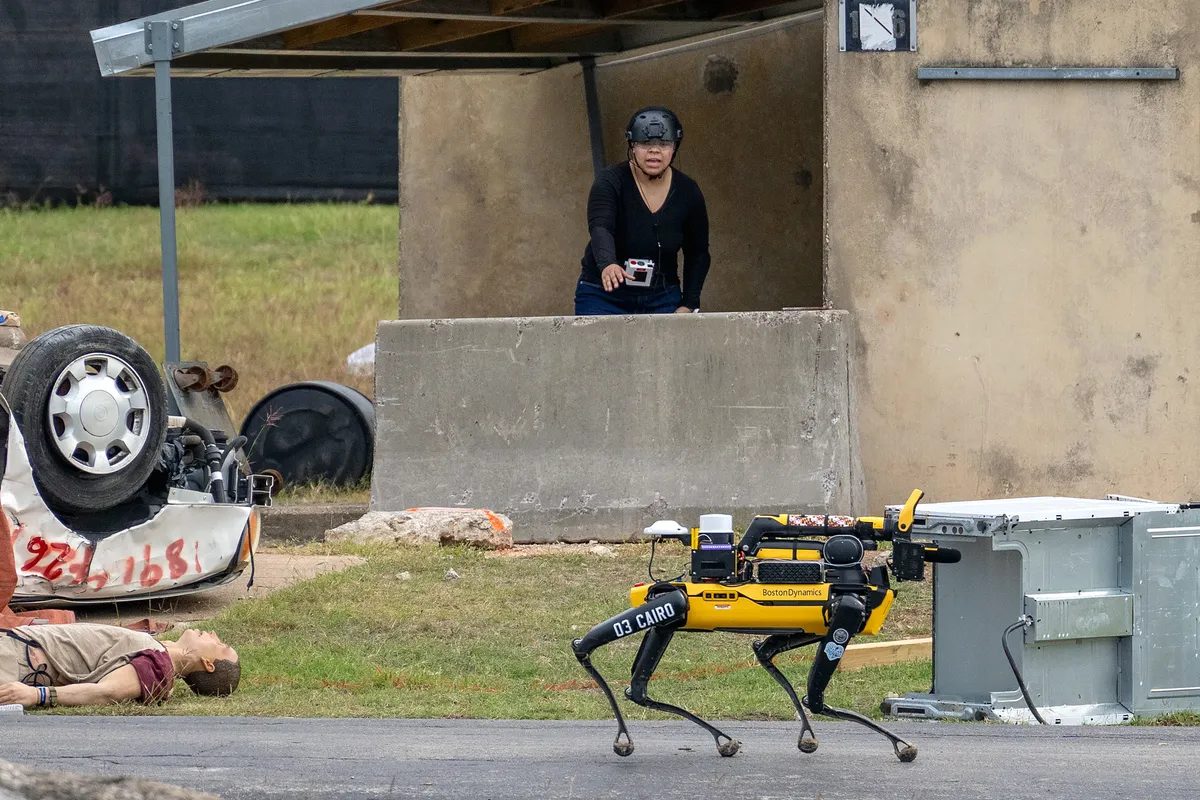
On 5 November, 10 teams descended upon a 52-acre mock town in College Station, Texas called Disaster City . They were there for a nine-day competition to see how well teams of robots and humans could navigate simulated catastrophes, like a market ravaged by a tornado and a nighttime strike on a military base. At stake? US $2.5 million in prize money.
The scenarios were the final of the DARPA Triage Challenge , which the U.S. agency has been running for three years with the goal of saving more lives in urgent mass casualty events. Engineers from academia and industry have competed in elaborately staged mass casualty events , such as simulated combat zones and plane crash scenes. Teams spent years designing systems where autonomous ground robots and drones could help first responders find mock victims and decide the best way to care for them. “Triage is all about resources,” says Jeremy Pamplin , who managed the challenge for DARPA. Pamplin is a critical care physician and retired colonel who spent 28 years in the U.S. Army.
In mass casualty events, medics race to assess trauma with finite resources and limited time. Some victims need urgent help that medics can provide immediately, like tourniquets to halt bleeding. Some need evacuation and surgery. Others don’t need immediate help—either because their wounds are minimal enough, or because they’re so severe that a medic’s attention is better served elsewhere. Medics must prioritize who gets what care, but the line between each of these scenarios can be murky amid the rubble, frenzy, and heat of the moment.
It’s a difficult problem, and so the technologies developed in this competition could help real-world decisionmaking, says Gabriela Garcia Dolagaray , assistant medical director for emergency preparedness at Massachusetts General Hospital and the Brigham and Women’s Hospital in Boston. “Finding people can sometimes just be dangerous,” she says, “and getting a robust number of people to go out and search in a disaster area will take time.”
Trauma Technologies and the DARPA Triage Challenge
The Triage Challenge is the latest in a long DARPA legacy of running grand challenges to incentivize proof-of-concept development of important technologies. This particular challenge began as a program to quickly detect signs of trauma. DARPA imagined not only that drones and robots could find casualties, but that machine learning algorithms could assist in triage—which, at its core, is the process of assessing injuries and prioritizing care in a medical emergency.
Pamplin took over the competition in May 2025. “I have friends that still wake up in the middle of the night with these types of recollections and wondering if they did the right thing in the moment during a mass casualty incident,” Pamplin says. “That moves me. I would very much like to eliminate that uncertainty for them to the extent possible with this type of technology.”
He used his experience to make the competition increasingly elaborate and realistic. Year one featured a simulated convoy attack, and human participants sat in protective enclosures to avoid incidental run-ins with robots. In year two, when Pamplin took over the challenge, his team incorporated a full-size airplane fuselage to simulate a plane crash with dozens of victims. Organizers learned to recreate the physical environment of a disaster, and also the physical signs of injuries, like warm blood. Pamplin’s team visited a slaughterhouse with thermal cameras to study the temperature of blood spilling onto the ground. In the competition, they mimic that effect by heating water in a coffee pot and pouring it beside the body. This lets teams detect bleeding even at night.
A man performs a simulated triage as part of DARPA’s Triage Challenge finals. The program was designed to see how robots could assist in making triage decisions during an emergency. Paul Flacks/DARPA
“They always are throwing additional challenging things at us that you wouldn’t expect,” says Sam Colachis , a biomedical engineer at Battelle, an applied science and technology nonprofit in Columbus Ohio who led the organization’s DART team —short for “Drone-Assisted Rapid Triage”—in the competition.
The tactics required for successful triage are inherently multidisciplinary, says Derek Paley , a professor of aerospace engineering leading the University of Maryland’s team, RoboScout . Before 2022, Paley felt confident in his lab’s skills with autonomous navigation and algorithms, but he knew little about trauma medicine. “I didn’t even know what triage was,” he says.
Paley recruited colleagues in emergency medicine to help design his team’s approach and shape their tech. Before the Triage Challenge began, they felt like an underdog. “We kind of have a chip on our shoulder because we think we can play on the same field as these other teams…who’ve done grand challenges before,” Paley told Spectrum before the competition. They finished third in the first year of competition and second last year.
Each year’s competition began with four smaller trials that tested specific components of a robotic system. Teams first released their robots to locate as many casualties (a mix of live actors and manikins ) as possible in 15 minutes. Next, they spent five minutes triaging injuries. Another trial presented teams with a fixed number of casualties in known locations to test how they assess trauma. Then, teams had ten minutes to collect vitals like pulse and breathing rate remotely from a few meters away. The top four teams moved into a semi-final where their robots worked with two human medics in simulated emergencies. And the two teams who performed best in four human-machine runs then moved to a 25-minute championship run.
Robots, Drones, and Autonomous Triage
When the teams arrived at Disaster City, they knew very little about the details of what awaited them. One self-funded team of college students from Delhi Technological University flew from India…
News is gathered automatically from public robotics & AI feeds on a schedule.
Related
Space robotics: notes from an IROS 2026 plenary session
By Emmet Cole Space robotics was the focus of a plenary panel at IROS 2026 in Pittsburgh, where speakers from NASA, JAXA and academia discussed the roles robots will play in lunar exploration, human spaceflight and work in orbit. Their examples ranged from unloading cargo and building lunar infrastr
Why Does Voice AI Still Struggle With Kenyans’ Speech?
When people read prepared text aloud, AI can transcribe Swahili with remarkably few errors, and Swahili speech recognition looks close to solved. A March 2026 preprint by a team including a Harvard University researcher reports a 3.24 percent word-error rate on recordings from Mozilla’s Common Voice

Human Stories Behind the Robot: from bold ideas to real-world impact
What happens when a research idea seems too ambitious, too unfamiliar or simply too early for the world to understand? In this episode of The Human Stories Behind the Robots, Professor Sabine Hauert OBE shares her journey from experimenting with flying robot swarms to developing technologies that co
Video Friday: Drone Squeezes Itself to Fit Through Tight Spaces
Video Friday is your weekly selection of awesome robotics videos, collected by your friends at IEEE Spectrum robotics. We also post a weekly calendar of upcoming robotics events for the next few months. Please send us your events for inclusion. Humanoids 2026 : 6–9 December 2026, SANTA CLARA, CA Enj
Robot Talk Episode 171 – Programming robot behaviour, with Sebastian Castro
Claire chatted to Sebastian Castro about developing open-source software for robot task planning and behaviour. Sebastian Castro is an independent roboticist specializing in robotic manipulation. He is currently contracting with the Dexterous Robotics Group at NASA’s Johnson Space Center. Sebastian
Meet Shepherd, the Meta-Agent Keeping Rogue AI in Check
AI agents are running amok on the internet, armed with commands to accomplish certain tasks but often acting in undesirable or unexpected ways. These rogue incidents run the gamut from deleting an entire email inbox to hacking websites and even launching cyberattacks . Much like human workers need m