Soft exosuit makes it easier to stand up
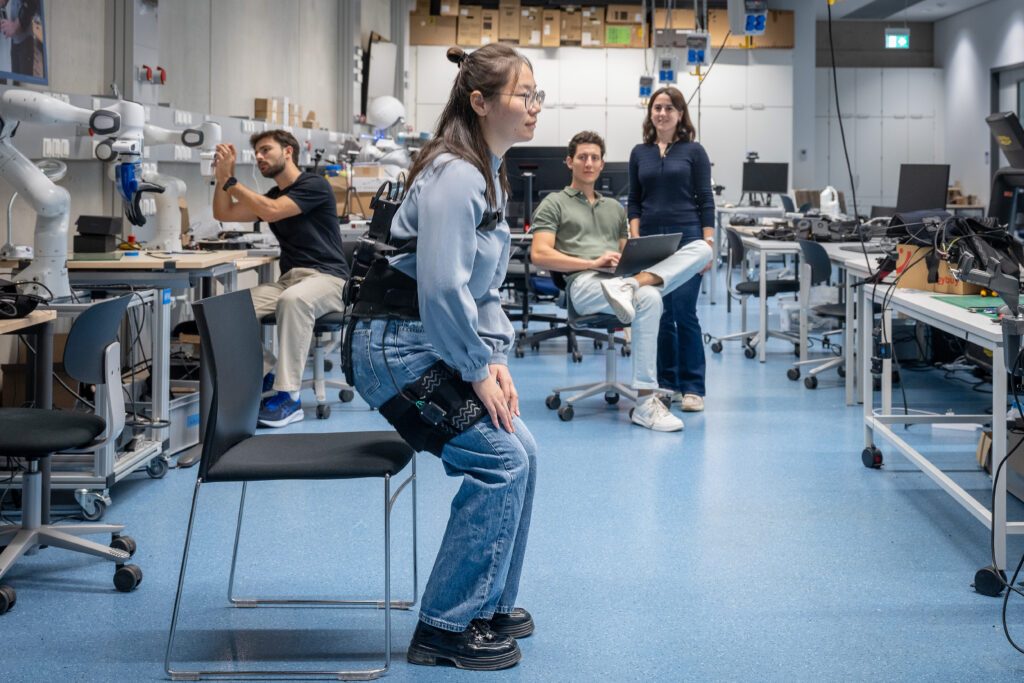
Exoskeletons developed at Professor Lorenzo Masia’s lab help elderly people and those with medical conditions move more easily. They also assist industrial workers in performing heavy tasks. Photo: Andreas Heddergott / TUM.
Getting up from a chair can be difficult for older people, often due to declining strength and coordination in the hip and leg muscles. To help with this, researchers at the Technical University of Munich (TUM) have developed a soft, lightweight suit that assists hip extension using artificial tendons. These help older adults to get up from a chair and walk more efficiently.
Getting up from a chair is an action that most of us don’t really think about. The movement is almost second nature. Our legs and hips work together in a precise sequence. If a robot-assisted suit is going to support part of this effort for a person, it has to respond intuitively and synchronously to the body’s movements. “We use machine learning to provide the user with the necessary assistance at exactly the right moment,” says researcher Dr. Xiaohui Zhang from the Chair of Intelligent Bio-Robotic Systems of the TUM School of Computation, information and Technology. To build this recognition system and to train the algorithm, the researchers first collected movement data from a group of young, healthy individuals. As more usage data becomes available, the researchers can further refine the system.
Robotic assistance comes naturally
The robotic system can be put on and taken off like a suit in just a few minutes. It has two thigh straps, a waist belt, and artificial tendons connected to a small motor unit worn on the back, almost like a backpack. Two sensors on the thighs measure the kinematics of the legs. When the system recognizes that the wearer is standing up or walking, the motor pulls on the tendons and provides support at the hip. “The sensors detect the user’s movement in real time and send this information to the controller, which then guides the motor to provide assistance to the user,” explains Zhang
Dr Xiaohui Zhang (right) and Dr Enrica Tricomi adjust the motor that drives the exosuit. Photo: Andreas Heddergott / TUM.
Users stood up more often and faster
Ten older adults with reduced lower-limb functional performance tested the exosuit as part of the scientific study. They were between 69 and 85 years old. By that age, a person may have stood up from a chair well over a million times in daily life. But with age, this simple movement can become more difficult.
With the exosuit’s assistance, standing up became easier: some participants achieved up to four additional sit-and-stand cycles in one minute, with cycle duration shortened by up to 21.9%. On average, participants in the experimental group completed 18 cycles per minute, or two more cycles per minute than before. Walking also became more efficient, with the largest individual reduction in metabolic cost reaching 27.5% and an average improvement of 14%. The participants’ subjective impressions were also positive: despite wearing a robotic assistive suit as a technical aid, they still felt in control of their own movements. “On a 7-point scale, they rated their sense of personal agency at more than 6, indicating a high degree of perceived autonomy,” researcher Zhang says. “It’s rewarding to see that our algorithms can actually help people in their daily lives.”
Robotic assistance like “a regular piece of clothing”
“People who tried on our robotic suit didn’t find it intrusive and found that it could be comfortably worn over normal clothing,” notes Prof. Lorenzo Masia, Executive Director of the TUM MIRMI Robotics Institute and head of the Chair of Intelligent Bio-Robotic Systems. The exosuit is intended to support older adults who want to remain independent for longer, as well as people undergoing rehabilitation.
Read the research in full
Enhancing sit-to-stand transitions and walking efficiency in older adults with a soft robotic suit , Xiaohui Zhang, Enrica Tricomi, Marios Stefanakis, Nathalie Gierden, Theresa Buchner, Luka Miskovic, Jürgen M. Bauer, Christian Werner, Clemens Becker, Lorenzo Masia . Nature Communications (2026).
News is gathered automatically from public robotics & AI feeds on a schedule.
Related

Human Stories Behind the Robot: from bold ideas to real-world impact
What happens when a research idea seems too ambitious, too unfamiliar or simply too early for the world to understand? In this episode of The Human Stories Behind the Robots, Professor Sabine Hauert OBE shares her journey from experimenting with flying robot swarms to developing technologies that co
Video Friday: Drone Squeezes Itself to Fit Through Tight Spaces
Video Friday is your weekly selection of awesome robotics videos, collected by your friends at IEEE Spectrum robotics. We also post a weekly calendar of upcoming robotics events for the next few months. Please send us your events for inclusion. Humanoids 2026 : 6–9 December 2026, SANTA CLARA, CA Enj
Robot Talk Episode 171 – Programming robot behaviour, with Sebastian Castro
Claire chatted to Sebastian Castro about developing open-source software for robot task planning and behaviour. Sebastian Castro is an independent roboticist specializing in robotic manipulation. He is currently contracting with the Dexterous Robotics Group at NASA’s Johnson Space Center. Sebastian
Robot swarms trained by trial and error in simulation keep working on real robots
Reinforcement learning lets robots learn behaviors on their own, through trial and error, usually inside a computer simulation. Moving what they learn onto physical robots is another matter. Simulated and real robots never behave quite the same way, a mismatch known as the “reality gap,” and reinfor
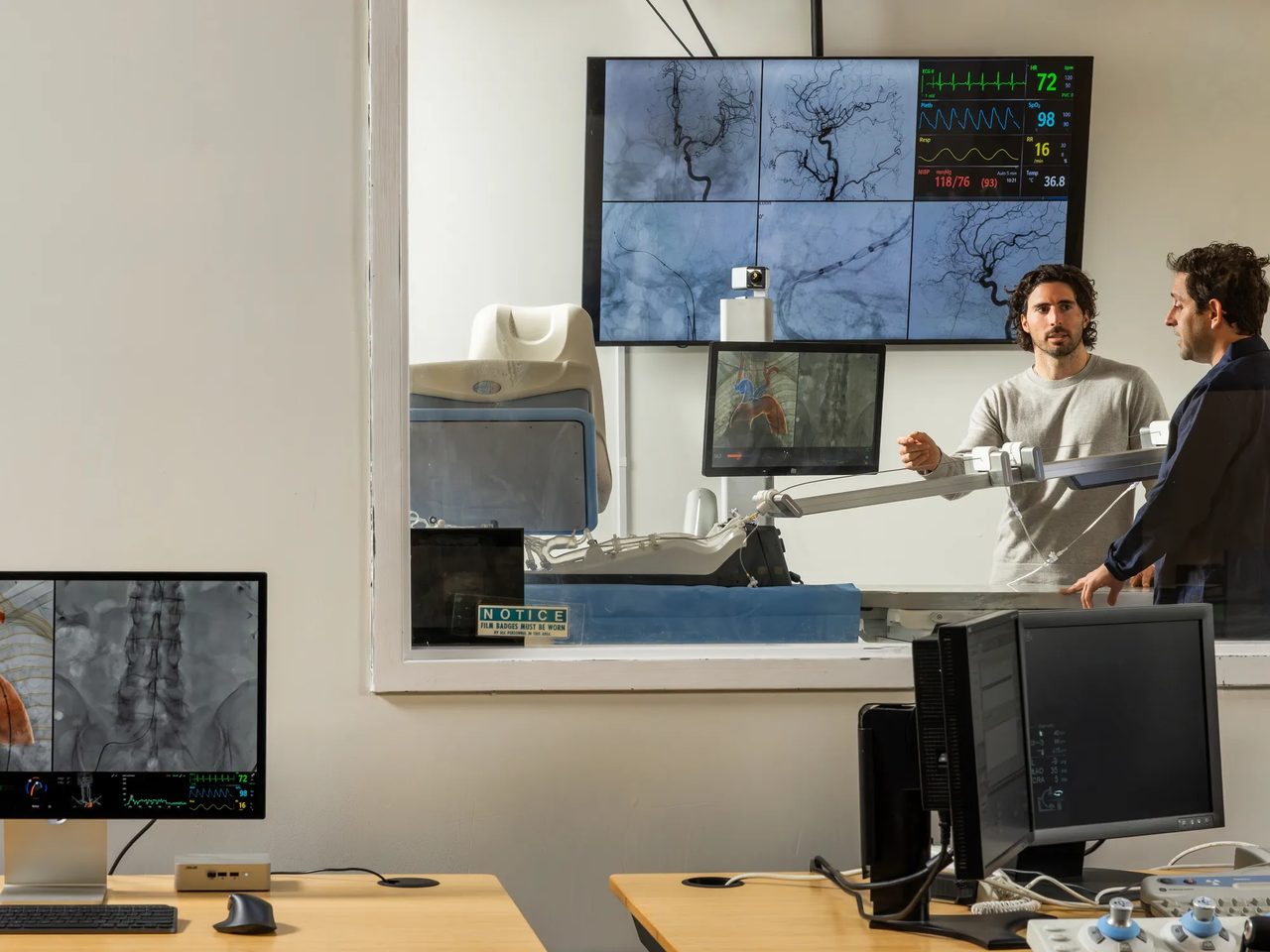
Can Robots Bring Stroke Surgery to Remote Hospitals?
I am practicing brain surgery on a patient lying 6 meters away, out of my sight and reach. I press a foot pedal, activating the controller in my hand, and carefully steer a thin flexible tube called a catheter up through the patient’s blood vessels. I head for what I believe to be the brain, trackin

Watch the IROS 2026 plenary and keynote talks
The 2026 IEEE/RSJ International Conference on Intelligent Robots and Systems (IROS) was held in Pittsburgh from 27 September to 1 October. The event brought together researchers and industry professionals with expertise spanning many different aspects of robotics. IEEE have made the keynote and plen